
General
– a Good Way to Learn Fundamentals of 4-Part Writing is to Study Vocal Writing as Vocal Music is Much Simpler than Instrumental Music Due to the Limitations of the Human Voice
– and the Natural Division of High and Low Human Voices into 4 Types Lends Itself Perfectly to 4-Part Writing
– Each of the 4 Voices has a Different Function or Role that they Play in Contributing to the Overall Sound and Texture of a Piece in 4-Part Harmony
– Easily Singable and have Its Own Identity
Vocal Range
– Human Voice can be Categorised into 4 Basic Types of Voices (SATB):
Soprano = High Women´s (or Children´s) Voices (C4 to G5)
Alto = Low Women´s (or Children´s) Voices (G3 to D5)
Tenor = High Men´s Voices (C3 to G4)
Bass = Low Men´s Voices (E2 to C4)
– the Range a Voice can Re-Produce is of Course Limited and in General as Below
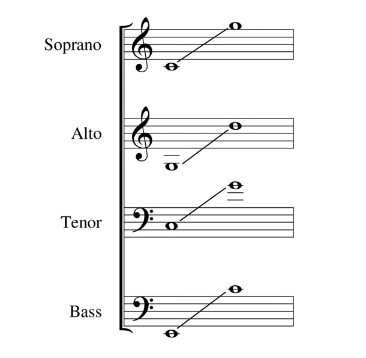
Open and Short Scores
Open Score
– Music for Voices is Typically Written on a Staff, with Each Voice on a Separate Staff which is Called an “Open Score”
– Soprano, Alto and Tenor in Treble Clef
– Tenor has a Small “8” Below the Clef to Indicate that is it Performed an Octave Lower than Written
– Bass is Written in Bass Clef
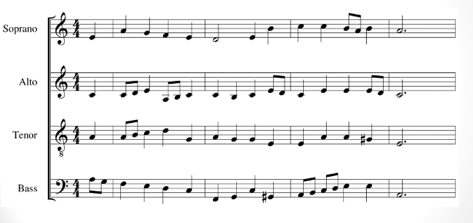
Short Score
– Sometimes it is Written on 2 Staff, Soprano + Alto Together (Treble Clef) and Tenor+ Bass Together (Bass Clef)
– to Save Space and Easier Reading as a Pianist
– the Soprano Stems then Point Up and the Alto Down
– the Tenor Stems then Point Up and the Bass Down
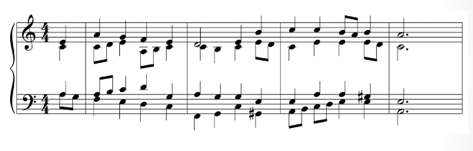
– Notice that the Soprano and the Bass are Called the “Outer Voices”, where as the Alto and the Tenor are Called the “Inner Voices”
– Memorise in Outer Voices, Stems “Point Out” (Away from the Center) and in “Inner Voices Stems “Point In” (Towards the Center)
Spacing and Position of Voices
Spacing Between Voices
– Distance between 2 Neighboring Voices is Very Important to the Overall Texture and Blending of the Voices in Context
– Too Much Distance will Make the Texture Sound Thin and Weak
– Never More than an Octave between Soprano and Alto
– e.g. in Below Example the Distance between Soprano and Alto is Greater than an Octave (G3 to B4)
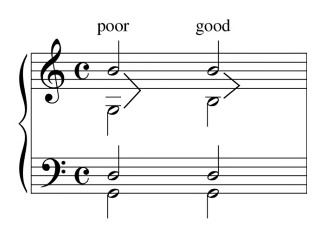
– Never More than an Octave between Alto and Tenor
– e.g. in Below Example the Distance between Alto and Tenor is Greater than an Octave (G3 to C5)
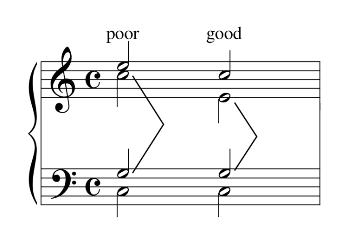
– Distance between Tenor and Bass is the Only that can be Greater than an Octave and Not Sound Thin or Weak
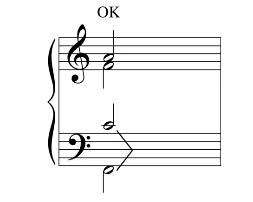
– but also for Tenor and Bass, Typically you Should Not be More than a 12th Apart which is Maximal a 5th 2 Octaves Higher (e.g. Below Picture Shows F2 to C4 which is the 12th from C)
Close Position and Open Position
– Both Positions can be Mixed within the Same Phrase of Music
– it is Often Very Pleasant to Switch Back and Forth between Close and Open Position for Variety in the Texture
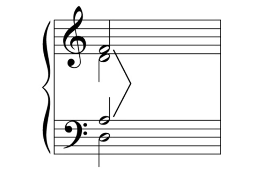
Close Position = Top 3 Voices (S-A-T) are so Close Together that No Other Chord can be Placed in between them
– e.g. S-A-T Form a Dm Chord A3 on Tenor – D4 on Alto – F4 on Soprano, thus No Other Dm Chord Tone can be Placed in between any of these 3 Notes
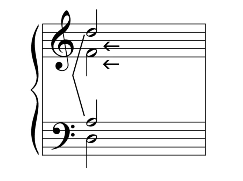
Open Position = Top 3 Voices (S-A-T) are Spread Further Apart so Possible Chord Tones are Skipped
– Fuller Sound than Closed Position
– e.g. S-A-T Form a Dm Chord but this Time A3 on Tenor – F4 on Alto – D5 on Soprano, thus the 2 Chord Tones D4 and A5 are Skipped (Marked with the Arrows)
Simultaneous Motion
Voice Movement
– How 1 Voice Moves in Relation to Another Voice, i.e. Interacts with Another Voice
– e.g. How Soprano Voice Moves in Relation to the Alto Voice
– there are 4 Types of Movement
– All are “Simultaneous Motion” Because the Relative Voice Movement Happens at the Same Time
Contrary Motion = Voices Moving in Opposite Directions (Most Attractive for the Listener Because when Voices Move in Contrary to One Another they have the Greatest Contrast and Independence)
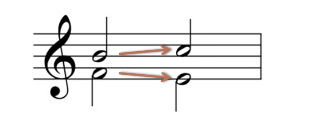
Oblique Motion = 1 or More Voices Moving while 1 or More Voices Remain on the Same Pitch
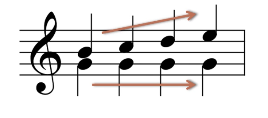
Similar Motion = Voices Moving in the Same Direction
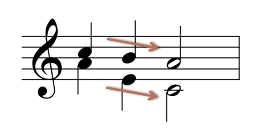
Parallel Motion = Voices Moving in the Same Direction and Remaining the Same Distance Apart from One Another
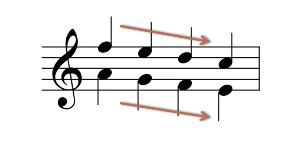
– Use Combinations of All 4 Types of Movement when Writing for 4-Part (or More) to Provide More Variety and Interest
– e.g. you can Not Write 4 Parts Moving in Contrary Motion at the Same Time, Since there are Only 2 Directions “Ascending and Descending”
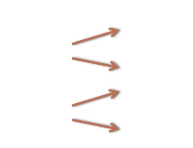
– thus Only 2 Parts at the Time can be Moving in Contrary Motion and the Other 2 Parts Must Use Some Other Motion
Things to Avoid
– Parallels in Different Variations
– when Checking the Writing for Parallels you Must Check All Possible Parings of Voices, Not Just the Voices that are Next to One Another
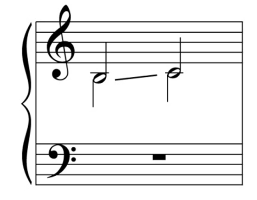
Parallels Unisons
– e.g. Below we See that the S and A Parts Singing the Same Pitches in the Same Register and Moving in Parallel Motion which Lacks of Individuality (Sounds as 1 Part)
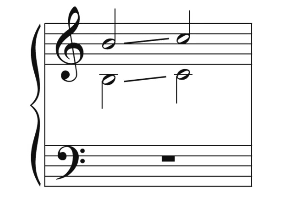
Parallels Octaves
– e.g. Below we See that the S and A Parts Singing the Same Pitches but in a Different Register while Moving in Parallel Motion
– this is a Slight Improvement as the Different Registers Give Some Contrast, but Due to the Parallel Octave the Parts Still have Not Enough Individuality for Part Writing
Parallels 5ths
– e.g. Below we See that the S and A Parts Singing in Parallel 5ths
– this is a Slight Improvement to Parallels Unisons or Parallels Octaves, but it Should Still be Avoided
– Because the 5th is the Only Interval that Outlines a Chord in Its Root Position
– i.e. when we Hear Parallel 5ths, Our Ears Tend to Focus on the Chord Outlined and Not the Individual Parts
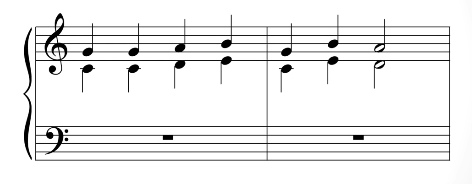
– Compare the Same Example with Parallel 6ths which has Much More Emotion
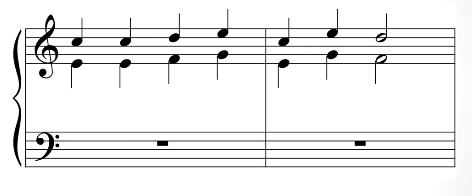
Parallels in Compound Intervals
– Same Rules Apply to Compound Intervals Moving in Parallel Motion
– Compound Intervals are Intervals Greater than an Octave are Treated as their Shorter Equivalents
– e.g. 15th is a Compound of an Octave Plus an Octave, means Scale Steps Added to the 8, i.e. C/8-> D/9-> E/10-> F/11->G/12 ->A/13-> B/14-> C/15->
– so 9th is 2nd, 10th is 3rd, 11th is 4th, 12th is 5th, 13th is 6th, 14th is 7th, 15th is Octave
– i.e. Parallel 12th is Still Considered as a Parallel 5th
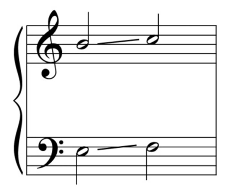
– Below Soprano and Bass Part are Moving in Parallel 5ths (Even Though they are a 12th Apart)
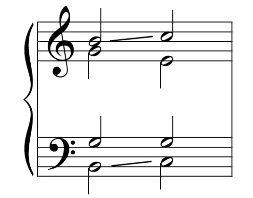
– or here the Soprano and Bass Part are Moving in Parallel 15th which is Considered as a Parallel Octave (15th is a Compound of an Octave Plus an Octave)
Voice Leading Guideline
– Voice Leading Allows Our Ears to Perceive Each Vocal Line as a Separate and Individual Vocal Line
– e.g. so the Soprano Part is Heard as Its Own Distinct Melody Line and the Alto Part as Its Own Distinct Melody Line
– Voice Leading Affects the Horizontal Aspect of the Music
– Achieved Through the Manner in which Pitches Move Melodically within a Single Vocal Line (Melodic Motion) and also How Vocal Lines Interact with One Another (Simultaneous Motion)
– in Good Voice Leading, One Vocal Should Never Interact with Another Vocal Line so that it Obscures the Other Vocal Line
Common Tone
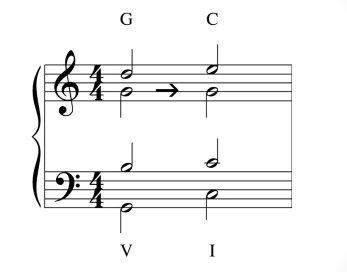
– when 2 Consecutive Chords have a Tone in Common, you Should Try to Keep the Common Tone in the Same Voice
– this Helps to Create Smooth Voice Leading Between Chords
– e.g. Below we See the G Chord Followed by a C Chord and the Alto Preserves the Common Tone G of Shared by Both Chords while the Other Voices are Moving
Overlapping
– Overlapping = when an Upper Voice Moves to a Pitch that is Lower than the Previous Pitch Sung by a Lower Voice (or Viceversa)
– Should be Avoided Because it Does Obscure the Individual Vocal Lines of 2 Parts
– e.g. Below you See the Tenor is Moving from B to F# and the F# is Lower than the Basses Previous G, this means the Melodic May be Perceived as Going from G to F# (and Not as Intended B to F#)
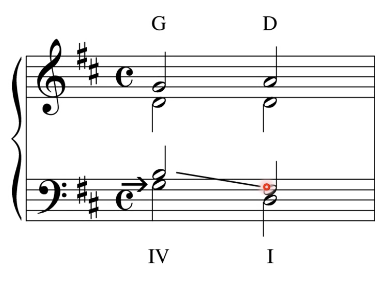
– to Avoid this you Would have to Raise the Tenor F# to A to Be at Least Above the Previous Bass G
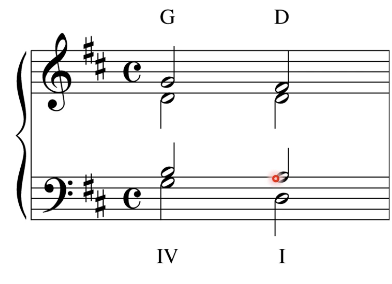
Crossing
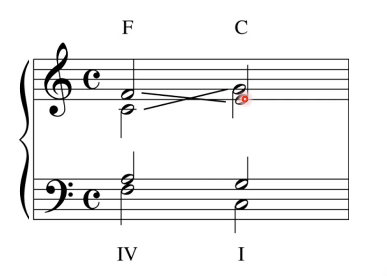
– Crossing = when 1 Voice Trades Places with Another Voice by Moving Higher or Lower than the Other Voice (Voice Crossing)
– Should also be Avoided Because it Does Obscure the Individual Vocal Lines of 2 Parts, Especially on Soprano Line or on Bass Line
– e.g. here the Soprano is Moving from F to E
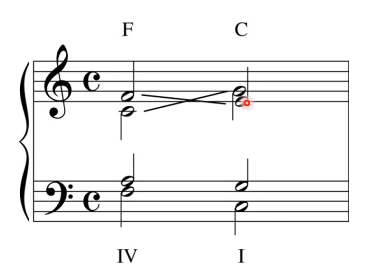
– but the Melodic Line May be Perceived as Going from F to G
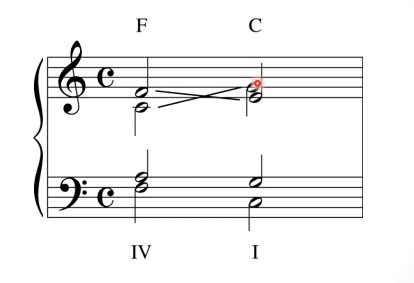
– while the Alto is Moving from C to G
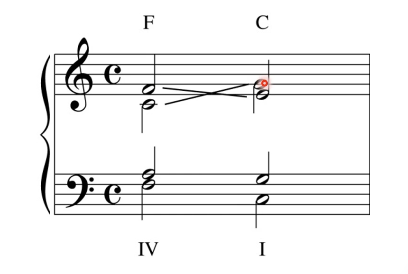
– but the Melodic Line May be Perceived as Going from C to E
Doubling
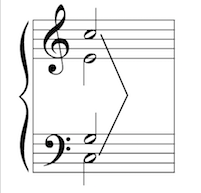
– Since there are Only 3 Pitches in a Triad, 1 of the Pitches Must be Used Twice when Writing Four Parts (which is Called “Doubling”)
– e.g. here Pitch C is Doubled in the Soprano and Bass Voices
– there are Some Guidelines to How to Choose which Note to Double (Although for Best Voice Leading Rules can be Broken)
Doubling Guideline:
1) Primary Chords (I, IV and V) = Double the Root or 5th of the Chord
– Although the Root or 5th may be Doubled, the Root is the First Choice for Doubling since this Reinforces the Tonic, Subdominant, and Dominant Functions of the Chords
– The Root of the First and Last “I” Chord of a Piece Should Always be Doubled since this Reinforces the Key of the Piece
2) Secondary Chords (ii, iii and vi) = Double the Root or the 3rd of the Chord
– Either of these will Reinforce the Chord functions
3) Root Position and First Inversion Chords = Same as for Primary and Secondary Chords
4) Second Inversion Chords = Double Only the 5th of the Chord
5) Leading Tone = Never Double the Leading Tone (the 7th of a Scale)
– Leading Tones Resolve to the Tonic (First Note of the Scale)
– If we had 2 Leading Tones they would both Resolve to Tonic tonic and this would create Parallel Octaves
6) Diminished Chords = Double the 3rd of the Chord
– Doubling the Root or 5th Only Reinforces the Dissonance of the Tritone formed by those 2 Pitches
– Also, in a Major Key the Root of the Diminished Chord (vii) is the Leading Tone which is Never Doubled (see guideline #5)
7) Augmented Chords = Double any Pitch that Makes for a Better Voice Leading
– Acoustically Speaking there is No Root of an Augmented Chord
– If you Want one of the Pitches to be Perceived as a Root, Double that Pitch
– Another way to choose is to Double any Pitch that is a Primary Tone (Tonic, Subdominant or Dominant)
8) Seventh Chords = Because 7th Chords have four Distinct Pitches, it is Not Necessary to Double a Pitch
– e.g. a G7 Chord Contains the Pitches G, B, D, and F
– When one of the Pitches is Omitted, Double the Root and Omit the 5th
– It is Less Common to Double the Root and Omit the 3rd
– Never Double the 7th
Omit
– Although a Much Fuller Sound is Achieved when All the Pitches of a Chord are Heard, Sometimes 1 Pitch is Omitted in Order to Create a Better Voice Leading between the Parts
Omit Guideline Triads:
1) Never Omit the Root of a Triad
– the Root is the Fundamental and Helps to Determine the Chord´s Function
2) Never Omit the 3rd of a Triad (Unless you are Trying to Create a Special Effect)
– the 3rd is What Determines the Tonality of a Chord (Major or Minor) and is therefore Usually Always Included
3) 5th May be Omitted
– Does Not Make the Tonality of the Chord Unclear
– Because of the Strength of the Second Overtone, the Ear will Automatically (Naturally) Supply the Missing 5th
4) 1st and 2nd Inversion Do Not Typically have Pitches Omitted
Omit Guideline Seventh Chords:
1) 5th May be Omitted
– this is Because the Other Pitches are More Important to Identify the Tonality of the Chord
– e.g. Root is Fundamental and the 3rd Determines the Tonality
2) Never Omit the 7th of a Seventh Chord
– Should be Obvious Since the 7th is What Makes it a 7th Chord (Rather than a Triad)
3) 7th Chord Inversions Do Not Typically have Pitches Omitted
Melodic Motion
– Motion within a Single Voice
– Not to Confuse with Simultaneous Motion that Interacts between Multiple Voices
– a Good Vocal Line will have a Combination of Conjunct Motion, Disjunct Motion and Repeated Tones
– Notice that Certain Vocal Parts May Tend More Towards a Particular Type of Motion Because of their Role in Music
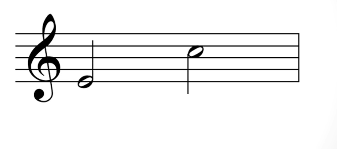
Conjunct Motion
– Movement by Steps, Either Whole or Half or a Combination of Both
Disjunct Motion
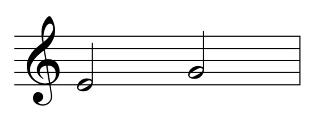
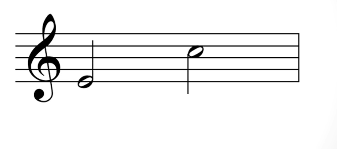
– Movement by Skips or Leaps, Either Whole or Half or a Combination of Both
Skip
Leap
Disjunct Motion Roles
– Disjunct Motion is the Movement by Skips or Leaps, Either Whole or Half or a Combination of Both
– Avoid Consecutive Leaps (4ths or More) in the Same Direction, this Will Break up the Melodic Nature of a Line, e.g. Such as Consecutive Leaps in 4ths
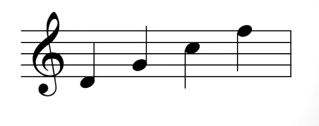
– Consecutive Skips (3rds) in the Same Direction are Acceptable, Since this Outlines a Chord
– Consecutive Skips and Leaps in the Same Direction are also Acceptable, but Only if the Pitches Outline a Chord, e.g. Below we See that the Em Chord is Outlined in the Melodic Line (G – B – E)
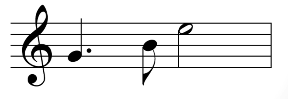
– when Leaping by a 6th or 8th, the Subsequent Pitch Should Move in the Opposite Direction of the Leap by Either a Step or a Skip
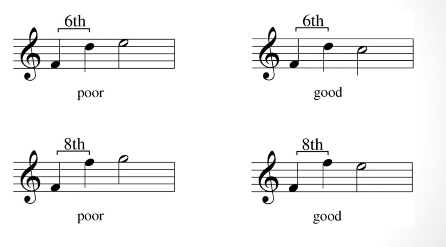
– thus there is More Flexibility when Leaping by a 4th or 5th as the Subsequent Pitch can Move in the Same or in the Opposite Direction of the Leap by Either a Step or a Skip
– whereas Leaping by 7ths is Generally Avoided Because the Dissonance of this Interval Makes it Hard to Sing
– Never Leap More than an Octave (Does Not Sound Good and Makes it Hard for the Singers)
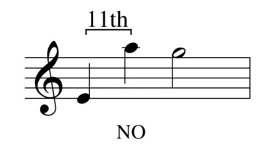
– Use Leaps Occasionally, which Helps to Keep Variety in a Vocal Line
– the Majority of the Melodic Movement Should Use Steps and Skips
– Remember that Certain Vocal Parts May Tend More Towards a Particular Type of Motion Because of their Role in Music
Repeated Tones
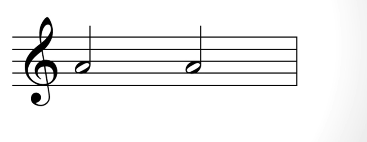
– Motion by Repeated Tones
– Staying on the Same Pitch (therefore Not a Truly Motion)
How Parts Function
Soprano
– Because Melody is Prominent Over Harmony, the Melody is Typically Sung by the Soprano Part
– the Highest Most Prominent Voice
– Since the Soprano is Melodic by Nature it Consists Mostly of Steps and Skips
– with Occasional Leaps for Variety
– Avoid Leaps Larger than a 6th
– if Larger than a 6th, Use 8th
– but Avoid 7th and Absolutely Anything Over than an 8th
– Typically a Soprano Line will Not Contain Repeated Tones (Same Pitches Repeated in Melody Sounds Static)
– if All Other Parts are Moving a Repeated Tone is Acceptable
– Example of a Typical Soprano Line

Bass
– Foundation for All the Other Voices
– Main Role is to Find Harmony by Regulating the Progression of Chords (Regulating Harmonic Progression)
– Bass Line Gives Harmonic Meaning to the Melody and the Soprano
– Should be Closely Linked to the Soprano Line
– Bass Lines Often Contain Disjunct Motion, i.e. Leaps of 4ths or 5ths or 8ths are Very Common
– Example of a Typical Bass Line

Inner Voices
– Main Role is to Fill-In or Complete the Chords that the Soprano and Bass have Outlined or Suggested
– Depending on Where the Outer Voices are Situated, the Alto and Tenor Parts are Not Able to Move Around Too Much and May therefore Contain Many Repeated Tones
– this is Perfectly Normal for Inner Voices
– if you have Followed the Guidelines for Good Voice Leading, Repeated Notes will Occur when Pitches Common to 2 Chords are Sung by the Same Voice
– it is Typical for the Alto and Tenor to Sing these Common Pitches
– Anytime that the Alto and Tenor Parts Do Take On a More Melodic Nature (e.g. when Soprano is Not Moving Much), the Motion Should be in Steps or Skips and Avoid Leaps Larger than a 4th
– Example of a Typical Inner Voice Line

Leave a Reply