
General
– it is Important to always Understand what the Smallest Division is when you are Playing, i.e. to Count the Smallest Division even on Long Held Notes (to Make better Use of Divisions)
– to Change Constant Material it is always about putting Accents in-between, regardless of the Meter
– try to Count each Pattern Upside Down, means Focus on a 1st Pattern vs the 2nd & then Focus the 2nd and count vs the 1st
– remember to keep it simple, you can play many different Signatures but leave the Meter in 4/4 & accent each Polyrhythm over Time you will get a different Flavor
– from each Beat a new Tone in every Direction can be made
– Extend a Polyrhythm to 4 up to 16 Bars, Change Patterns Start Point etc. but you need Know where the Groove is in order to make it Perfect (the underlaying Structure & Combination of all Patterns as Original Anchor)
– Break down Complex Patterns into 2 smaller more comfortable Sections, means a 7/4 can be 3 then 4 or 4 then 3, a 3/3 can be theoretically be a 2 then 1 etc.
– a 6/16th is the same as 3/8th, make sure you use a appropriate respective useful Grid Division
– Displace Patterns is the Key to make it Groove Best, search for the Sweet Spot and make sure the Starting Point of all Patterns from one to another are Embedded well
– Sing any Melody and Fit it into any Meter by “Brainstorming” then Record
Rhythmic Foundation
Whole Note
– a Whole Note means we are Holding a Sound for 4 Beats
– a Whole Note in Rhythm is Very Important, as it is Simple but Very Defined & Steady Chordal Movement
– a Good Rhythmic Interval for Huge Sounds
Half Note
– a Half Note means we are Holding a Sound for 2 Beats
– a little Bit more Movement, for Instance Playing 2 Chords per Measure
– in Music you Hear Very Often Only 2 Chords per Measure as a Chordal Movement, but there is some Motion Involved
Quarter Note
– Quarter Notes means we are Holding a Sound for 1 Beat
– pretty Fast Chordal Movement, when Playing a Chord 4 every of the 4 Beats
Adding Motion
– Introduce Motion to the Chordal Movement by Adding Harmonic Rhythm
– i.e. Adding In-between Beats that Follow the Rhythmic Foundation
Basic Harmonic Rhythm
– simply Mix and Match the Rhythmic Foundation by Playing either Whole, Half or Quarter Notes
Advanced Harmonic Rhythm
– also Mix and Match Whole, Half or Quarter Notes but with the Addition of Single Beats in-between
– kind of Guitar Strumming and Throw in Single Notes across Rhythmic Foundation
– kind of a Magnet towards Next Beat in a “Leading” Note Fashion
Rhythmic Anticipation
– As Humans we Feel very Comfortable with Patterns and Repetition, but we also Need Contrast
– Anticipation is about Changing the Accent to Right before the Beat (instead on Beat)
– this Changes the Perceived Feeling of a Chordal Movement
Melodic Anticipation
– Anticipation is also in the Melodic Figure
– i.e. Keep the Chordal Movement Steady but Change the RhythmicAccents in the Melodic Figure
– this will add “Syncopation” and Bring more Life into the Phrase
– to Enhance Syncopation, you simply use Anticipation in the Chordal Part as well as in the Melodic Part
Group of Two
– it is always Good to Simplify Things, Break it Down and don´t Think in Big Numbers
– no Matter how Complex a Rhythm might be (4/4, 5/8, 7/16), you can usually Break it Down to 2s or 3s
– the Trick is to Clap and Verbalise Beat against Beat
Ex. 4/4 into 2/2 in a Division of 8th Notes
– for Instance to Divide Up 4/4 into 2/2 by Clap Quarter and Verbalise Eight

Group of Three
– about Filling the Space of 4/4 with 3s
– Examples are in the Division of 8th Notes
1 Ex. 4/4 into 3s
– Fill the 4/4 Space with 3 + 3+ 2 = 8
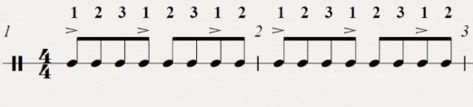
2 Ex. 4/4 into 3s
– or Fill the 4/4 Space with 3 + 2 + 3 = 8
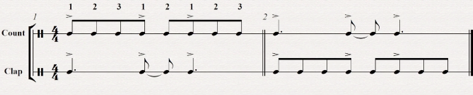
– or Take the very same “3+2+3 ” Example as above, but Put the Accent in those Divisions 3, 2 and 3
Three Plus Two Combinations
– think about simple Grouping of 3 and 2
– Example are in a Division of 8th Notes
– so if you have 3 Eight Notes and 2 Eight Notes you can Think of that as 5/8 Time
Ex. 4/4 into Groups of 3s and 2s
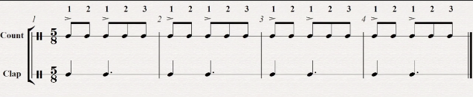
1 Ex. 4/4 into Groups of 2s and 3s

Making 3 Plus 2 into 5
– if we Take the Pattern of just going 3 – 2 and Repeating it Twice it Turns into 5/4 Time
– if you Count 5/4 the Accent comes around the Quarter Notes which is Musically vey Interesting
Ex. 4/4 into 5/4 by Count 3s and 2s
Ex. 4/4 into 5/4 by Count 5/4

Combining 3 and 2 into 7
– in this Example we are Creating either 7/8 or 7/4 by putting Groups of 3 + 4 together
Ex. 7/8 with 2+2+3

Ex. 7/4 by Counting Quarter Notes to it

7-8 Exercise
– we Keep the Concept of 3s and 2s and we are gonna keep Displacing the 3
Ex. 7/8 with 3 + 2 + 2
– you Clap the 1 Beat and Keep the 8th Notes really Even

Ex. 7/8 with 2 + 3 + 2
– Sums also in 7 but Changes the Accent

Ex. 7/8 with 2 + 2 + 3
– Finally we put the 3 to the End

Throwing Off Expectations
– we Take the 2 + 2 + 3 Pattern but Add an Extra 1 – 2 – 3 after the Repeat
– this Idea is to Build up something Repetitive so the Brain thinks this is a Pattern, then Break it

– in a Musical Way this could Sound like this
– we can Take this Concept even further
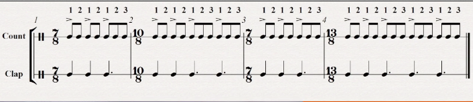
– another Trick is to Count and Improvise at the same Time in these Groups of 2s and 3s which gives literally Thousands of Possibilities
Wrapping Up Odd Meters
– a Common Way to Break up “Even” Material is to Take the Repetitive/Steady Material and Put in something “Uneven”
– for Example 1,2,3,4 – 1,2 and Instead 3,4 you Insert some 16th Notes
– this is really Good to Connect Phrases with Motion and Interesting Rhythm

– it is Important to always Understand what the Smallest Division is when you are Playing, i.e. to Count the Smallest Division also on Long Held Notes (to Make better Use of Divisions)
– e.g. to Feel the 7/16 at the End

Displacement
– one of the Interesting Things when Applying any kind of Pitch Pattern to Rhythm is, that our Brains tries to Automatically Count a Pattern
– so for Example a Pattern with 5 Ascending Notes could be Heard as 5/4 (most People)

– but we know it could also be 1-2-1-2-1-2-3
– but what if we Displace the Rhythm and Think of the Group of 5 Notes in 4
– so every Accented Pitch will Shift over Time, e.g. Imagine a Oboe, Bass or Guitar etc. always Accented on a different Beat over Time
– you can Take this even further and put Like a Chord to each Division of 4

– of course such Constant Ascending Notes can be Broken with any Meter (e.g. 5 Ascending Notes vs 7/8, vs 6/8, vs 5/8, vs 4/8, 2/8 which is also a Good Exercise)
Polyrhythms
– the Way of putting each Kind of Rhythms against each other, for Instance 2 against 3, 3 against 2, 4 against 3 or 5 against 2
– again, getting used to the Divisions and Divide up Grid into a Beat of 2, 3, or 4 etc.
– the Most easy Figure is 3 against 2 and against each other the can Sound like this (Glass P.)

– another Common Figure is 4 against 3
– Notice that the only Time the 2 Rhythm meet each other is on the 1 Beat

Brain Twister
– a Good Practice is to Play a Click at Medium Tempo and then Add one more Division each Time there is a Quarter Note (either Clap, Count or Play)

– for a Real Brain Twister, Mix and Mash Rhythms to Division

Leave a Reply