
General
– At the Heart of Rhythm is the Pulse / Beat (interchangeable), as the Individual Strokes of Measured Time
– Sort of Walking Styles by People when walking Shuffle, March, Bouncy, Dragging, Rushing
– Pulse is implied by the Notes that are played, as well as the Spaces or Silences (Rests) between the Notes
– In Order for a Series of Pulses to Feel like a Rhythm, it needs to have a certain Regularity to it
– Stressed or Accented Beats are Played Louder than others (Form and Shape a Rhythm)
Measure
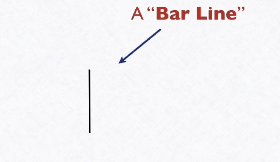
- Measure is a Section on the Staff that comes between Two Bar Lines
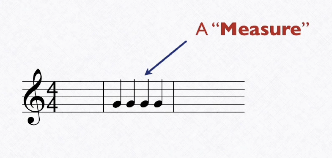
– The Picture shows 4 Pulses and we call then Quarter Notes
– “Subdivision” will allow you to subdivide any Pulses by any Number, means a Quarter Note : 2 = Eight Note where as a Quarter Note : 3 = Triplets (so you can play 2 Notes respective 3 in Triplets instead of One in the same Time)
– of course Quarter Notes are Subdivisions too, means 2 Quarter Notes = a Half Note and so is 2 Half Notes a Whole Note
Counting the Rhythm
1, 2, 3, 4 = Quarter Notes
1 and 2 and 3 and 4 and = Eight Notes
1 eeh and ah, 2 eeh and ah, 3 eeh and ah, 4 eeh and ah = Sixteenth Notes (eeh = 2nd 16th Note and ah = 4th 16th Note in the Beat)
1 trip let, 2 trip let, 3 trip let, 4 trip let
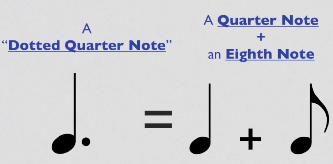
Example of a Dotted Quarter Note which is Halved a Eight Note +
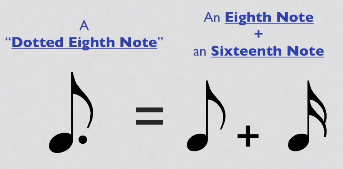
Example of a Dotted Eight Note which is Halved a Sixteenth Note +
Time Signatures
– In Notation you see usually see a Fraction which is Placed after both, The Clef and the Key Signature
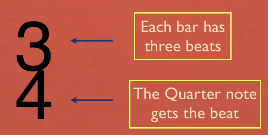
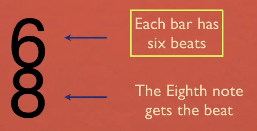
– Top Number = How many Beats are in a Measure , Bottom Number = The Note Value that is considered to be a Beat
– We use a Time Signature for easier Notation and make the Music more readable (so a 3/4 would indicate to Play in Triplet Mode)
– 6/8, 9/8, and 12/8 are known as “Compound Time” (Based on Multiples of 2 and 3)
– 5/4, 7/4, 13/8 or 11/4 for Example are “Odd Time Signatures” and Not Based on Multiples of 2 and 3 (use them when they are an Integral Part of what Makes the Music work)
– For Odd Time Signatures, Practice the more common ones as 7/8 or 5/8 to get comfortable
– Mix Time Signatures is Called “Change Of Meter”
Here we have a Measure of 3 Beats per Bar and each of these Beats gets a Quarter Note (1 Bar holds 3 x 1/4 Notes)
Here we have a Measure of 6 Beats and each of these Beats gets a Eight Note (1 Bar holds 6 x 1/8 Notes)
– Cut Time (also “Double Time”) tells the Musician to play everything Twice as Fast, means the Half Note gets the Beat (2/2 or Playing in 2)
– Half Time = One Measure is Expanded over the Course of 2 (Opposite of Cut Time)
Rests
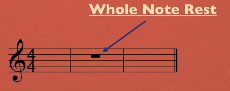
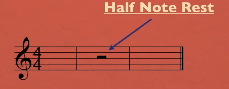
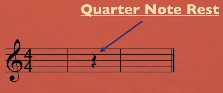
– Indicate a Measured Amount of Time in which nothing is Played
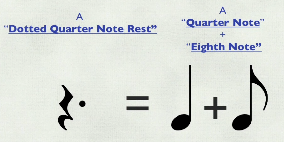
– Dot after a Rest adds Half of the Rest Value to itself (works the same as with “Normal” Notes)
Whole Note Rest
Half Note Rest
Whole Note Rest
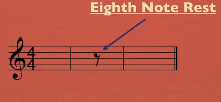
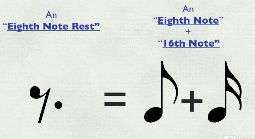
Eight Note Rest
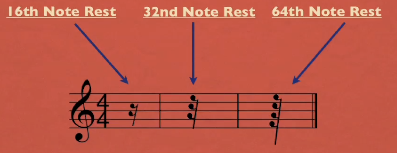
16th, 32nd, 64th are Variations of previous with additional Lines for each One
Examples with Dotted Rests
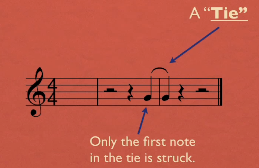
If we want not complete Silence, but Playing the First Note Sustained over a “Group of Rests”, we the “Tie” Symbol
Syncopation
– A Shifting or Displacement of the Beat
– For Example Force a Chord to be Played on the Upbeat (3rd Quarter Note), means on a usually unaccented Beat or a Beat that does Not occur on the Stronger Quarter Beats but in between the Quarter Notes
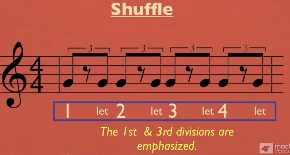
Shuffle
– Triplet Beat = The First is exactly Twice the Duration of the 2nd Note
– Very Constant Beat
Swing
– The Difference between the Long and Short Notes can vary
– the 2nd Note is often Referred to as the “Swung Notes”
Polyrhythm
– The Simultaneous Use of Contrasting Rhythmic Patterns
– Require at least 2 Rhythms to be Sounding simultaneously, “Superimpose” one another for a New Composite Rhythm
3:2 “Hemiola” in a 6/8 Signature
1) The Right Hand plays 2 Beats
2) in Order to Divide the Measure of 6/8 into 2 Beats, each of these Beats must have the Value of a Dotted 1/4 Note or 3 x 1/8 Notes
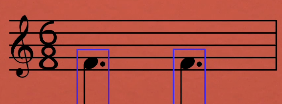
3) Now we need a Left Hand Pattern that divides the 6/8 Pattern evenly into 3 Beats
4) So we need 3 Quarter Notes, which is equivalent to 6 x 1/8 Notes
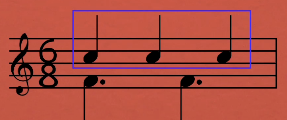
5) Note that the 3 Beat Pattern must move Faster than the 2 Beat Pattern in Order of them both to occupy the Length of a Measure
6) If well Done, You can Change your Focus from the 2 Beat Pattern to the 3 Beat Pattern and Back etc.
7) Listen to Right Hand on Right Speaker & Left Hand on Left Speaker
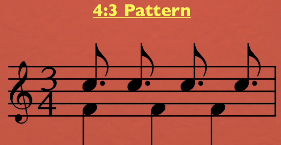
Example of a 4:3 Pattern in a 3/4 Signature (African Hemiola Quality)
1) Here the Primary Beat Pattern Needs 3 Beats
2) So the Right Hand Needs 3 x 1/4 Note to Fill the Measure of 3
3) For Secondary Pattern (Left Hand) to Occur along with it, we Need 4 Dotted Eight Notes (because 1/8 + 1/16 they Add up to 3 Beats)
4) Obviously the Dotted 1/8 Notes, here need to Move at a Faster Beat than the 3 1/4 Notes, in Order of them Both to occupy the Length of a Measure
Example of a 13:8 Time Signature
– How to Keep Track of 13 Beats?
– Break them Down into Smaller Divisions
– For Example to Look at it as 13/8 = 3+3+3 followed by a Unit of 4 (3+3+3+4 = 13 Beats)
Example of a 7:4 Time Signature
– How to Keep Track of 7 Beats?
– Break them Down into Smaller Divisions
– We can look at it as a Group of 4, followed by a Group of 3 (3+4 = 7 Beats or 3+4 or 2+2+3)
– Each Grouping will have its own Unique Set of Accents, since the Accents fall on Different Places of the Measure
Notation Extras
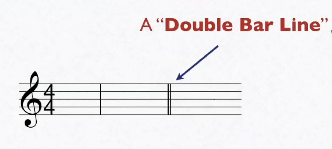
– A Double Bar Line separates Two Sections of a Piece (Verse || Chorus)
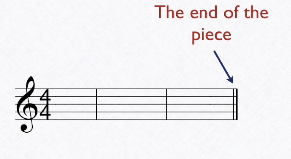
– Thicker Bar Line after a Thin Bar Line indicates End of the Piece
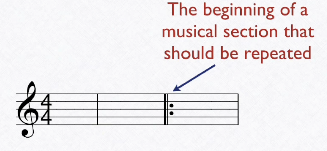
– Thick / Thin / and 2 Dots indicate the Beginning of a Section that should be repeated
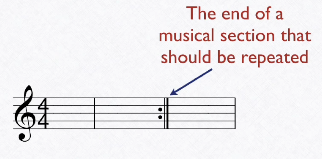
- 2 Dots /Thin / and Thick indicate the End of a Musical Section that should be repeated
Leave a Reply