
FET
- Field Effect Transistor
– Feedback Type of Compression
- Signal Goes Through the Whole Gain Reduction Chain and then the Needed Amount of Gain Reduction is Calculated and Sent Back to the Gain Reduction Circuit
- i.e Takes Signal that is Already Compressed and Feeds that Back into the Detector Circuit
- so the Part of a Compressor that is Telling a Compressor How Much to Compress is Being Fed by an Already Compressed Signal
– More Smoother / Transparent Compression as it Does Not Overreact
- Rely on Transistors for GR
– Quasi the Opposite of Opto Compressors
- Can Not Handle Great Amounts of Incoming Level, i.e. Starts to Distort Soon
- Incredibly Fast, i.e. Attack / Release can be Set to Just About Instantaneous
– Attack / Release Measured in Microseconds (Instead Milliseconds)
- Feedback Compressor Type (Negative GR in the Feedback Loop 1:-n)
- can Bring Punchy and Character and Ideal for Adding Energy
- Great on Drum and Bass, Room Mics, Adds Warmth, Electric Guitars for Body, Vocals
- Imparts Harmonic Color, Fast Attack, can Control Sharp Transients Well
- Adds Noticeable Color to Transients, Overly Aggressive, can Distort if Pushed Too Hard
– Good for Rock / Hip Hop or Genres that Need Punch and Attitude
– at Its Slowest Settings Still Faster than Opto or Tube
– FET at Their Fastest Settings are Quasi Limiters
- Pump and Breathe
– Not Really for Modern Sounds e.g. Make Snare Pop Out as the Attack Goes Only Up to 800ms (Since it is a Limiting Device by Design)
- Because of the Fast Speed they can Introduce a Bit of Distortion / Color when Pushing Aggressively
- Less for Mix Bus Because of the Aggressive Amount of Harmonic Distortion
- Often the Choice for Parallel Compression as the FET Really Squashes Transients and Sounds Bold, i.e. Use in Parallel to Bring Back Transients
– also Often Used as 1st Compressor Before Opto, i.e. Start Chain with FET to Catch Vocal Transients and End Chain with Opto to Glue Everything Together and Keep the Body Consistent
- Good for Individual Instruments, Especially Bass, Live Drums, Good for Vocals, Guitars, Kick, Snare
- i.e. Male Vocals, Bass Drums, Drums in Parallel, Room Mics, Acoustic Guitars that Need Fast / Tight Transient Control
- for Instruments that Shall be In Front of a Mix
- Bright, Gritty, Present when Pushed
- Often the Choice for Heavy Metal
- on the 76s Models, Input Drive on the Unit is the Threshold and the Output Gain is the Makeup
– With the “All Ratio” Button On it Does Heavy Saturation and is Great for Parallel Compression
– UREI 1176 Limiting Amplifier, MC77 FET, Lindell 7X-500, GEM Comp76, Track Comp 76 A & D, Pulsar 1178
Opto
- Uses a Light Dependent Resistor and a Light Source to Determine How GR is Applied to the Signal, i.e. Sensor Called “Photocell” Picks Up that Light and Applies Reduction
- Light Shines Brighter or Darker Depending on Input Level, Less Light = Less Compression
- Hot Signals Keep the Light Source Illuminated and thus the Release Time will be Longer
- Viceversa Weak Signals Make the Light Source Dim and thus the Release Time Auto Changes to Fast
- Since it has to Transmit and Receive the Light Source the Attack is Slower, e.g. FET Reacts to an Entire Snare (Compresses the Initial Transient) while the Opto Only Compresses the Tail of the Snare
- Capture Aesthetics of 60ies
– Opto Compressor also have Vacuum Tubes Built-in but for Color and Not Actual GR
- Very Gentle Leveling-Out, i.e. Choice for General Smooth GR Rather than Catch Transients
- for Fattening Up Sounds
- More Transparent than FET
– More Mid Forward
– Described as Fat, Warm, Round, for Fattening up Sounds, Smooth and Musical
- Not as Fast and Aggressive as FET, and also Not as Clean and Punchy as VCA
- Smooth and Natural, Prefect for More Delicate Material
- Smooth and Musical, Maintains Dynamics Well, Adding Warmth, Forgiven, Adapts to Incoming Signal
- Slow Response therefore Not Ideal for Fast Transients, Less Precise, Better for Subtle Control
– Good for Acoustic / Jazz / Folk Where Warmth is Key
- has Only a Gain Knob and a Peak Reduction Knob, Attack / Release are Program Dependent
- Good for RMS Processing
– Attack is at Roughly 10ms, Release at 60ms for the First 50% of Release and Potentially Up to 1 Sec or More for the Rest of the Release, Ratio Often Around 3:1
- Bass Guitar, also in Master Chain, Vocal Chain, i.e. Primarily Vocal, Acoustic Guitar and Bass, Not for Transient Heavy Material as it Does Not Capture Fast Transients
- Often Used as 2nd Compressor After FET, i.e. Start Chain with FET to Catch Vocal Transients and End Chain with Opto to Glue Everything Together and Keep the Body Consistent
– Not for Heavy Metal as it is Too Slow, also Less for Buss as there is No Attack / Release Setting
- Teletronix LA-2A (Tube Opto), ACME Audio Optical, Shadow Hills Mastering (1 Circuit is Optical), Tomo Audio LISA´s Dynamic EQ is Optical, UVI Opal, Tube Tech CL1B (KC-1), Mixland VAC Attack (Optical Detection), GEM Comp LA
Tube Comp / Vari MU
- Vacuum Tubes for Dynamic Control and GR
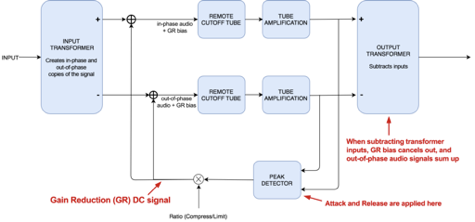
- Uses Tubes to Control Compression Itself, i.e. GR is Applied by Running Through a Tube
- i.e. Vari Mu Employs Tubes to Control the GR Stage, the Input Voltage Laters the Bias of the Tubes which Results in a Smooth Slower Harmonically Rich Style of Compression
- Feedforward Type of Compression, Compressor Unit Does Not Listen to an Already Compressed Signal in the Detector Circuit
– i.e. Leads to More Intense Compression as the Detector Circuit Must Handle Original Signal that May be Very Dynamic
- Vari Mu have No Soft Knee and there is No Ratio Control, the Ratio Increases as the Input Increases and thus Vari Mu is Program Dependent
– Variable Ratio, i.e. has No Dedicated Ratio Setting as the Ratio Gets Higher the Further you Go Past the Threshold, i.e. Lower the Threshold = Stronger Ratio = More Compression
– Earliest Compressor you Find in a Lot of Studios Since 1950s, Hear it on All Beatles Records from Mid 1960s on
- Basically there is Input / Output / Filter Component (Grid), when the Input Increases the Detection Circuit Sends a Negative Charge to the Grid which Allows Less Audio Pass Through the Tube and thus Reduces the Output
– this Process Results in Longer Attack and Release (i.e. Slow Attack and Release)
- Along with Opto one of the Early Compressor Types
- Add Warmth and Cohesion to a Mix
– Program Dependent and Soft Knee Based
- Warmth and Musical, Enhances Harmonic Richness, Great for Glue, Makes Mixes Sound Cohesive
- Too Slow for Controlling Fast Transients, Expensive Hardware
- Jazz / Classic or Genres Requires Smooth Unified Compression, Piano, Vocals (Typically After a FET), Acoustic Guitar
- Low Ratio and Soft Knee, Attack Bit Faster than Opto
- Similar to Opto with the Exception that Tube Comp / Vari MU and Provides a Bit Control Over Attack and Release
– Tube Compressors are Even Slower than Opto
- Warm / Full / Weighty Tone Because of Built-In Tubes and Transformers
– can be Used as Kind of EQ (Even Without GR) Just to Add Glue / Vibe / Warmth Due to the Tube Saturation
- Good for Vocals, Mix Bus, Retro Acoustic Guitars and Warm up Sterile Sounding Synths and Samples
- Slower Response to Transients Relative to Other Compressors, i.e. Slower Attack and Release
- Gives Warmth and Due to the Slower Attack Times they Let Important Transients Intact
– Softens the Sound and Brings Up the Low End which Makes Anything that Goes Through it Sound Warmer Even if No GR is Applied
– Especially Lower Mids Get Warmth but also Brilliance in the Highs Due to Saturation
- Good Choice for Vocals, Guitars and Mix Buss
– also Often used After a 1176, i.e. 1176 Adds Character and Fairchild for Glue
– Recommended to Only Use a Few Tube Comps on Specific Chosen Instruments, i.e. Not Across All Tracks so the 1176 Chosen Tracks Really Stand out in the Mix
- Fairchild 670 (Quasi the Father of Compressors and was First Used to Control / Compress the Stereo Image with the LAT Vert Function Before Vinyl Cutting to Prevent the Needle from Jumping), GEM 670, SPL Iron, Neold V76U73 Channel Strip, MJUC, Lindell MU66, STA Level, Manley Vari MU, Acustica El Rey, Magic Death Eye
VCA
- Voltage Controlled Amplifier
- Uses a Control Signal (Attenuator) to Determine Whether GR is Applied to the Signal (i.e. GR on How Much Voltage it Receives)
– the Amplifier Automatically Decreases the Output as the Input Voltage Increases
- can Handle Great Amounts of Incoming Level and thus can Give the Most GR of All Compressors
- Suited for All Materials (Basic Choice for Most DAW Stock Compressors etc.),
- Good in Pop Rock and Electronic Genres
- Introduced by SSL (Solid State)
- Clean, Adds No Saturation
- Control Dynamics with Precision Without Adding Color
– can Sound Sterile, May Lack Warmth, May Sound Harsh at Extremes
- Similar to Tube Design but Way Faster
- Fast Response Time
- Good for Transient Control
- VCA Type of Compression Introduced the Most Typical Parameters to the Audio World we Know Today, such as Attack / Release / Threshold / Ratio / Knee for More Control Over the Sound
– Since All Above Controls are in the Same Circuit as the GR there is Less Stages between Input and Output (Integrated Circuit)
- therefore Output Signal Remains Precise, Clean, Punchy and Predictable, Transparent with Little Distortion and Low Noise
- Fast Response Time
- Good for Transient Control, i.e Especially High Transients Like in Piano
- the DBX is Ideal for Parallel Processing (Kick / Snare and Bass)
- Good for Brass, Electric Guitar, Multiple Vocals and Especially at Home on Drum Bus / Mix Bus
– also Often used After a 1176, i.e. 1176 Adds Character and VCA for Glue
- DBX 160A, SSL G Bus Compressor (Glue Entire Mix), API 2500 (Drums or 2-Mix Bus), Townhouse SSL, Lindell SBC, Vertigo VSC-2 + VSC-3, Distressor, AMEK Mastering Comp, SSL Channel Comp,
Diode Bridge
- Uses a Diode to Control Gain
- Mostly Found in Neve Console
- Same Benefits as VCA but with a Sound that is a Bit Fuller, Smoother, Creamier
- Pretty Coloured, Thickness, Weight
– Pleasing Saturation
- Not the Fastest but Loads of Punch
– Not as Warm as a Tube Compressor
- Drum Bus, Mix Bus, in General Busses, Weight to Guitars, also Parallel Electric or Acoustic Guitars or Drums
– Lindell 254E, Neve 33609
Leave a Reply