General
– “Musical Texture” is the Way in which Rhythm, Melody and Harmony are Combined (also Known as “Gestures”)
– Refers to the Number of Different Melodies Present in a Given Section of Music and the Relationship between those Melodies
– Basically “How Much is Going On in the Music at Any Given Moment”
– the “Structure of Interwoven Fibres”, which Voice is Prominent and which are Equal
– Thick or Thin, Many or Few Layers, Made Up of Rhythm Only, Melody Line with Chordal Accompaniment, or Many Interweaving Melodies
– Basic Function is to Give the Music a Richer Color and Support the Principle Idea / Melody by Filling it with Harmony
– Typical Textures can be Monophonic, Homophonic, Polyphonic, Heterophonic or Biphonic
– Most Used Textures in Pop, Jazz, Rock or Classic are Homophonic, means there is a Very Clear Melody Line and Other Stuff in the Music that Helps to Support the Melody Line
– you can Distinct between a Monophonic Texture which is Mono, Single (Non Harmonic Content but Only Single Notes) and the Contrapuntal Texture which is the Opposite of Monophonic (Notes that Harmonise Each Other)
– a “Fake Way” of Combining Many Individual Timbres into “Large-Scale-Textures” is to Shape Timbre in Time, i.e. Do Changes in their Global Qualities Rather than by the Interplay of Individual Lines
– using Enharmonic Equivalents (Flats/Sharp Movement) or Scale Extensions (7/9/11 etc) Thickens up a Texture Nicely
– Timbre and Texture are the Foundation for Structure and Form in Spectral Music
Monophonic Texture
– Monophonos = Single Sound (Mono = Single)
– a Single Melodic Line with No Accompaniment at All (Simplest of All)
– Whether it is Sung/Played by 1 Person or Many, as Long as the Same Notes and Rhythms are Being Performed
– Like Gregorian Chant, Unison Singing (Happy Birthday), Composition for Solo Flute
– a Little Limited, 1-Dimensional
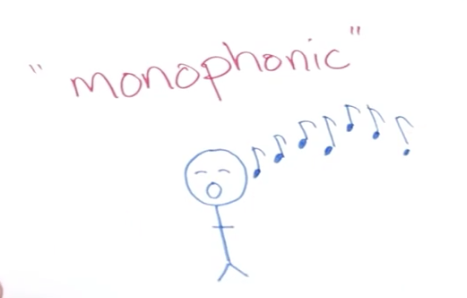
Monophonic Example with Single Melody
Homophonic Texture
– Homophonos = Same Sounds (Homo = Same)
– Homophonic Texture is a Single Clear Dominating Melody and the Rest of the Music is Working Together with that Melody (Supports the Melody with the Same Idea)
– a Primary Melody Line with Accompaniment
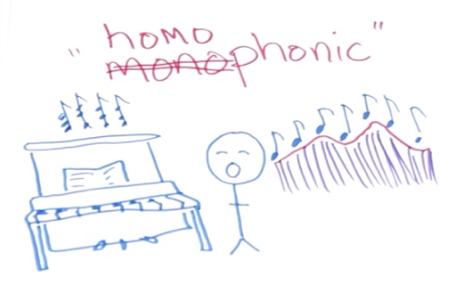
– or Simply Said, Music that has a Clear Single Melodic Line with a Subservient Harmonic Accompaniment (Melody Over Chords)
– Typically, a Single Dominating Melody that is Accompanied by Chords where the Chords Sometimes Move at the Same Rhythm as the Melody
– Other Times the Chords are Made Up of Voices that Move in Counterpoint to Each Other, but the Important Aspect is that the Chords are Always Subservient to the Melody
– Quasi the Monophonic Texture but with an Answer by “Same Interwoven Accompaniments” (Not Different Interwoven as in Polyphonic), which Gives a 2-Dimensional Feeling
– e.g. Melody with Chords (Homophonic)
– or All Chords (Homophonic)
– where the Melody can be Formed in just Chord Tones or a Combination of Chord Tones and Non Chord Tones (Composition 1 / 17-20)
– to Form a Chord Structure based on a given Melody (to “Form” Harmony is what Counterpoint is All about)
HomophonicTextureTechniques
1) Block Chord Accompaniment
– Block Chord is a Chord in which all the Pitches are Played Simultaneously (most Basic Accompaniment)
– i.e. Block Chord Accompaniments State the Notes of Each Chord Simultaneously Using a Repeated Rhythmic Pattern
– Block Chord can be Held until the Next Chord Change
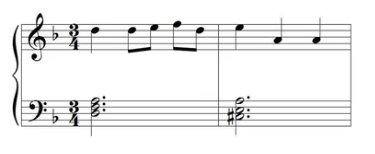
– Block Chord can be Played Repeatedly in Various Rhythmic Patterns until the Next Chord Change
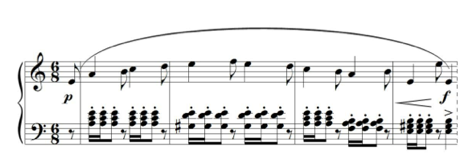
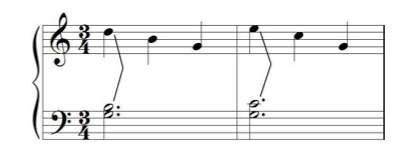
– it is also Common to Not Play all 3 Chord Pitches but only 2, allowing the Listener Ear to “Infer” the 3rd Pitch
– or the 3rd Pitch is in the Melody as in the Following Example
– of course the Block Chord can Hold Inversions (instead same Chord over and over)
2) Broken Chord Accompaniment
– Broken Chord is a Chord in which all the Pitches are Played Sequentially
– also called “Arpeggiated Chords” (Arpeggiare = Play on the Harp)
– Typically Uses a “Low to High” (or High to Low) Order for the Accompaniment Notes
Broken Chord Examples
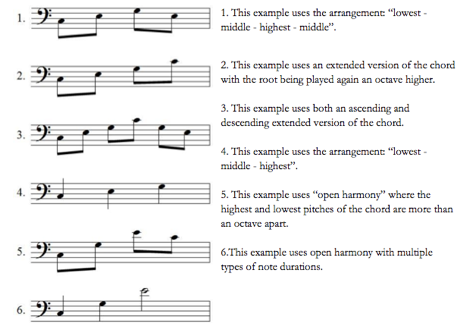
3) Homorhythmic Texture
– also Known as “Chorale Texture”
– Accompaniments have the Same Rhythm as the Melody Line
– i.e. a Homorhythmic Texture Shares the Same Rhythm in Melody and Accompaniment where Slight Variations in Rhythm are Possible
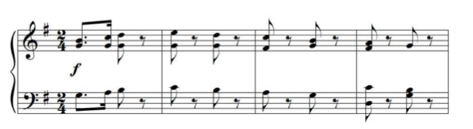
Polyphonic Texture
– Polyphony = Many Sounds (Poly = Many)
– 2 or More Independent Equal Important Melody Lines Performed Simultaneously
– Music with a Polyphonic Texture is Music that has Multiple Melodic Lines able to Stand on their Own and Independent of Each Other, but when Taking together Form the Harmony of a Piece
– the Idea of a “Polyphonic Texture” is Different from Homophonic Types, as Simple Chords or Melody in a Polyphonic Texture Each Voice has its Own Identity
– i.e. Each of these Strands (Stränge) is a Kind of Independent Thing and a Perfectly Satisfactory Melody on its Own, but they Not Necessarily Need to Work Together as Such
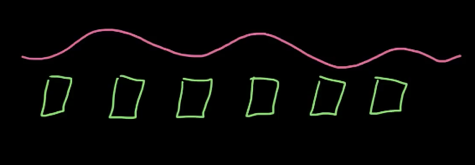
– Below Picture Represents 3 Independent Separate Musical Features, with Different Colors that are Not Really that Related
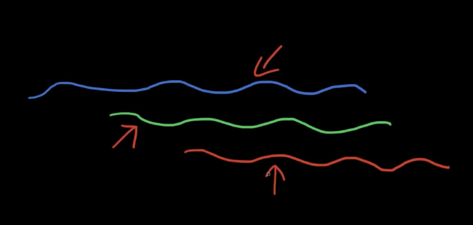
– Quasi the Homophonic Texture but “Different Interwoven Accompaniments”, which Gives a 3-Dimensional Feeling
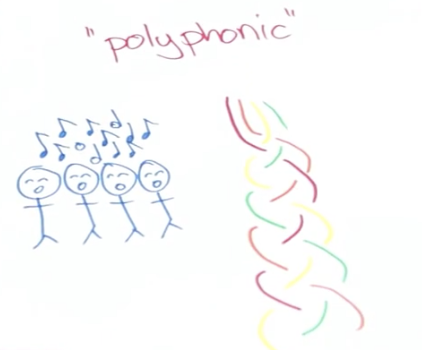
– Notice that Separate Independent Melodies Played Simultaneously is also Known as “Contrapuntal Texture” (Bach)
– “Melody Against Melody Either Both at the Same or at a Different Rhythm”
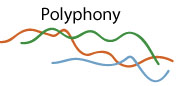
– Bach was Good at that, i.e. Writing Melody against Melody Either Both at the Same or at a Different Rhythm (Technique was Prominent from 1500 – 1800)
– Found in Larger Instrumental Ensembles, Religious Choral Music, Vocal and Instrumental Music from eh Renaissance through the Baroque
– a “Round or Canon”
Polyphonic Texture Techniques
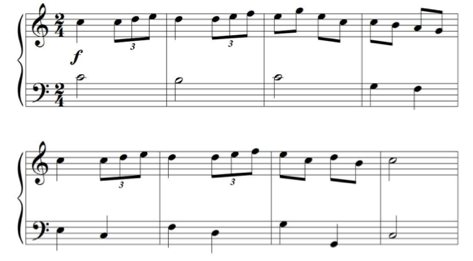
1) Left Hand Mono Melody and Right Hand Chords
– a Simple Example would be Playing Left Hand No Chords, but a Bass Line that is Melodic in Nature and together with the Right Hand they Form a Chord
– 1st Half on Measure 7 both Hand together Form a C Major Chord and the Pitches in the 2nd Half of Measure 7 Form a G Major Chord when Taking together
2) Pedal Point
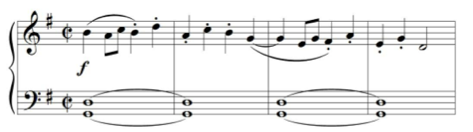
– a Single Pitch that is Held for All or Most of the Piece
– Typically a Tonic or a Dominant Pitch Played in the Bass
3) Double Pedal Point
– there are also Double Pedal Points when 2 Pedal Points Occur Together
– since the Pedal Point Does Not Change Pitch, some of the Notes in the Melody will be Consonant and some will be Dissonant with Pedal Point
4) Round or Canon
– Forms in which the Same Melody is Performed by Different Voices
– but Each Voice Enters a Different Time
– an Effective Way of Creating Complex Interwoven Polyphonic Textures
Heterophonic Texture
– is More Popular in Native American, Middle Eastern, India or South-Africa (and Jazz)
– Multiple Performers Playing or Singing a Single Melody All at Once, but Each Performer is Adding their Own Subtle Variations
– 2 or More Voices Simultaneously Performing Variations of the Same Melody
– i.e. it Consists of a Single Melody Performed by 2 or More Musicians with Slight or Not so Slight Variations from Performer to Performer
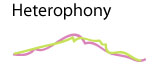
– Usually Result from Ornamentation Being Added Spontaneously by the Performers
Lonesome
Ezelden
Biphonic Texture
– Biphonic = 2 Sounds (Bi = 2)
– 2 Distinct Lines where Usually the Lower Line Sustains a Drone or Pedal Tone
– More Used as a Temporary Function, Rather than a Larger Section
– Evident in “Tuvan Overtone Singing” (South Siberia), i.e. Throat Singing Style in which 1 or More Pitches Sound Simultaneously Over a Fundamental Pitch (Producing a Unique Sound)
– “Ostinati” are Usually also Biphonic Textures
Leave a Reply