General
– “Q” (Quality) Factor Controls the Bandwidth, i.e. Number Frequencies that will be Cut or Boosted by an Equaliser
– the Lower the “Q” the Wider the Bandwidth, thus More Frequencies are Affected
– the Higher the “Q” the Narrower the Bandwidth, thus Less Frequencies are Affected
– Most Equalizer have in Theory a “Q” Range of Somewhere around 0.10 (Wide) to 100 (Narrow)
– in Practical Use, Narrow Q´s Should be used Sparingly as their Over-Use can Cause a Track to Sound Unnatural
– Narrow Q = Surgical Work, Creative Work, Remove Noise Artefacts, Clicks or String Noise ( Q Factor from 2.8 Upwards)
– Wide Q = Typical Usage to Boost and Cut, Q between 0.6 to 1.0 for Natural Response and Results
Partial List of Q Factors Paired with their Approximate Width in Octaves
Factor Bandwidth
0.404 (Low) = 3 Octaves (Wide Selection)
0.511 = 2.5 Octaves
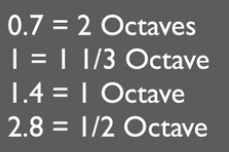
0.667 = 2 Octaves
0.920 = 1.5 Octaves
1 = 1 + 1/3 Octaves
1.414 = 1 Octave
2.145 = 2/3 Octave
2.871 = 1/2 Octave
4.318 = 1/3 Octave (E.G. from E0=20Hz / 25Hz=G0 / 31.5Hz=B0 and 40Hz would be E1 in the Next Octave )
8.516 = 1/6 Octave (E, F, G, A, B, C, E)
17.310 (High) = 1/12 Octave (Narrow Selection, Quasi a Single Note in a Octave)
Importance of Octaves
– usually you Center the EQ at the Octave of the Instrument and use Low / High Cuts to Not Remove Contributing Frequencies
– while a Boost of a Fundamental Note Does Increase the Root Intensity, it Does Not Automatically Boost the Character of a Sound
– i.e. you may Loose Tonal Quality Because Other Harmonics (Beside the Fundamental) are Equal Important and Give a Sound its Character
– to Preserve the Tonal Quality Lean on the Range Originally Played by the Selected Instrument, Limit the EQ Adjustments to the Correspond Scale / Notes and Set the Q to a Range of a Octave
– usually a Q of 1.4 is a good Starting Point
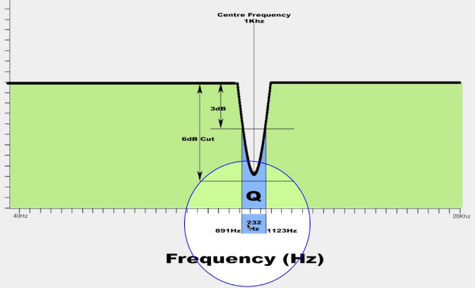
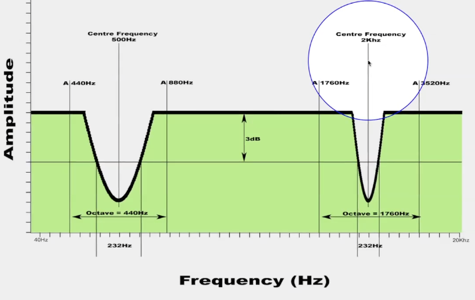
– Measure the Width of a Q (Precisely 3db in to the Boost/Cut of the Centre Frequency will be a Octave Wide or ca. 232Hz)
– the Adjusted Q Bandwidth is Fixed to any dB Amount of Boosts/Cut for the Centre Frequency (without Q Factor at 500Hz would be much Wider than at 2000Hz = Exponential)
– Q= Centre Frequency divided by the Top Frequency Minus the Bottom Frequency (Q= (CF / (TF – BF)) (in Pic 1123 – 891 = 232)
– Pic Shows Centre Frequency of 1 kHz and with the 3dB Cut Reference, you see a Bandwidth of 232Hz (from 891Hz to 1123Hz)
Pic shows 3dB Cut without Q at 500 & 2000
All Common FFT Octave Divisions
Octave (Shows 12 Notes Together)
1/2 (Shows 2 Pairs a 6 Notes Together)
C1 to F#1
F#1 to C2
1/3 (Shows 3 Pairs a 4 Notes Together)
C1 to Eb1
Eb1 to F#1
F#1 to A1
A1 to C2
1/4 (Shows 4 Pairs a 3 Notes Together)
C1 to D1
D1 to E1
E1 to F#1
F#1 to G#1
F#1 to A#1
C to A#1
1/6 (Shows 6 Pairs a 2 Notes Together)
C1 to C#1
C#1 to D1
D1 to D#1
D#1 to E1
E1 to F1
F1 to F#1
F#1 to G
G to G#1
G#1 to A
A to A#
A# to B
B to C2
1/12 (Shows Every Single Note in a Octave)
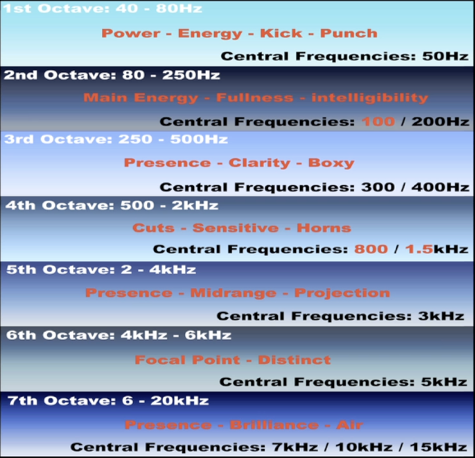
Understanding EQ in the Octave Range
1st Octave = 40Hz – 80Hz
– Central Frequency 50Hz
– Power, Energy, Kick, Punch
– More a Area you Feel than Hear, Too much will make Track Sound Quieter & Muddy
– also Referred to as the Low Bass-Range
2nd Octave = 80Hz – 250Hz (Covers a 1 + 1/2 Octave)
– Central Frequency 100Hz/200Hz
– Main Energy, Fullness, Intelligibility
– Essentially Cut at 100Hz & Boost at 200Hz
– also Referred to as the Bass-range
3rd Octave (1 Octave) = 250Hz – 500Hz
– Central Frequency 300Hz/400Hz
– Presence, Clarity, Boxy
– Female Vox and Bass will Benefit from Clarity
– also the Range to Reduce “Boxiness”
4th Octave (2 Octave) = 500Hz – 2000Hz
– Central Frequency 800Hz/1.5kHz
– Cuts, Sensitive, Horns
– 4th Octave is Rather a “Reducing Range”
– Cuts at 800Hz will often Improve the Sound of an Instrument
– also Cuts at 1.5kHz to “Deharsh”, but Percussion Benefits from Intelligibility
5th Octave (1 Octave) = 2000Hz – 4000Hz
– Central Frequency 3kHz
– Presence, Midrange, Projection
– Lot of Sounds have their Character in this Range (Especially at 3kHz)
6th Octave (1/2 Octave) = 4000Hz – 6000Hz
– Central Frequency 5kHz
– Focal Point, Distinct
– Work with Focal Points to Boost for Presence & Distinct, but Do Not Boost Too Much in this Area or you will “De-Focus” a Track
– also Referred to as the Presence Range
7th Octave (2 Octave) = 6000Hz – 20000Hz
– Central Frequency 7kHz/10Hz/15Hz
– Brilliance , Air
– Boost for Presence of Hats, Cymbals, Leads
Leave a Reply