
- FS = Full Scale, which is the Digital Zero in the Digital World
– Used Only in Digital Systems
– Fast Response with a Integration Time of 5ms
– Intended to reflect when Digital Distortion will occur
– Measures in dBFS
– The Maximum Value in a Digital Scale is 0dBFS
– often a Programs Fader Range goes from 0dBFS Down to -96dB (Wavelab, Dualism etc.)
– in the Digital World we have a “Linear System”, means when the Signal is Peaking at -35dB vs a Signal that is Peaking at -8dB you still have the same Signal (just at a Louder Data)
– Except when you Reach the Full Scale at Digital Zero, which is dBFS = deciBels with Respect to Full Scale (in dB)
– there is Nothing Above dBFS, means what Goes Above is Digital Clipping
– so you Only can Go Down the Scale to the Other Extreme (Towards Minus xxxdBFS, where at a Certain Place the Digital Rounding Errors vs the Sound can Become Audible
– dBFS is Decibels below Full Scale, where Full Scale is a “Signal at” but not above the Point of Clipping (so stays always as the “Top” of any Measurement)
– dBFS is often Used to Describe the Levels of Instantaneous Peaks, but can also be used for Various “Weighted” Peak readings (or even Average/RMS readings)
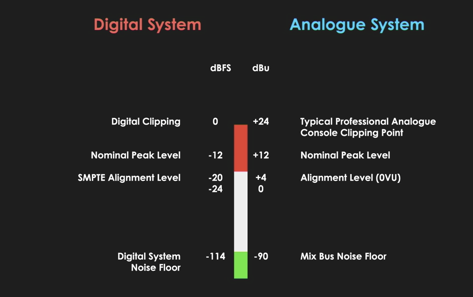
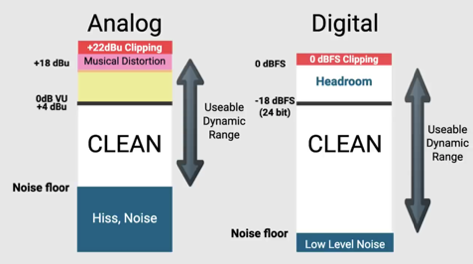
– to Compare dBFS to dBVU we Enter Bit Math, but Most Converters will have from “-18dBFS to -22dBFS” Equals 0dBVU (= 1.228 Volts)
– Notice that Digital Full Scale Translates to About +10 VU in the VU World (which Results in a Distorted Signal)
Leave a Reply