General
– 15th to 17th there was a Lot of “Mean Tone” Tuning Used
– but in the 17th (1680) Werckmeister Developed “Well Temperated” Tunings
– Especially the 18th and 19th Centuries Used “Well Temperated”
– 20th Century Started to Tune to “Equal Temperated” Mainly for Whole Tone Scaled Compositions and Atonal Music
– “Equal Temperated” is Used Today at 80%
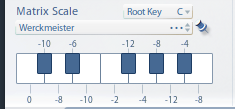
– Werckmeister III (VSL Factory)
Just Tuning
– also Called “Just Intonation”
– Basically you Assign a Relative Frequency, i.e. Treat the A4 as “1” for Example (instead of Talking About 440Hz)
– then use that “1” (which is a Fixed Lowest Note) and then Determine from that the Higher Notes
– Remember Overtones are “Additive”, i.e. in the Simplest Form any Double of a Bottom Note (Hz), for Example 440Hz (A4) + 440 (880 = A5) + 440 (1320 = E6) + 440 (1760 = A6) + 440 (2200 = C#7) etc.
– This Tuning Mode Sounds Well when Playing Along the Fundamental
– but it Does Not Sound Well when Playing “any other Note with any other Note” (especially Ratios of 2/1, 4/3 or 5/3)
All 12 “Just Tuning Fractions”
16/15 (Minor2nd)
9/8 (Major 2nd)
6/5 (Minor 3rd)
5/4 (Major3rd)
4/3 (Perfect 4th)
45/32 (Tritone)
3/2 (Perfect 5th)
8/5 (Minor 6th)
5/3 (Major 6th)
9/5 (Minor 7th)
15/8 (Major 7th)
2/1 (Octave)
Example Math Minor3rd (C) Note of A440 in Just Tuning
1) Minor 3rd has a Fraction of 6:5
– 6:5 because 6 is the 6th Note in A Minor Scale which = F and 5 is the 5th Note from F = C
2) So the Formula is 440 x 6:5
3) 6:5 = 1.2, then 1.2 x 440 = 528
4) So the Minor 3rd is at 528 in Just Tuning (+15.64 Cents vs Equal Temp)
Pythagorean Tuning
– the Focus on Octaves and Fifths with the Smaller Fractions (2:1, 3:2, 4:3 etc.)
– We use 3:2 Fraction as we work with 5ths
– But instead Math All from 1 Fixed Reference, we Start with any Frequency and Math the 5th, take that 5th and Math Next 5th etc.
– means we are “Bootstrapping” 5ths, by Taking any Frequency & Math the 5th of it, then take that Note as the New Reference and Math the Next 5th and so On to get your Scale
– Remember Going Down or Up One Octave is Dividing or Multiplying by 2 (for Example if we have a 5 Octave difference, we need to divide it by 2 to the 5 = 32)
Math Minor3rd (C) Note of A440 in Pythagorean Tuning
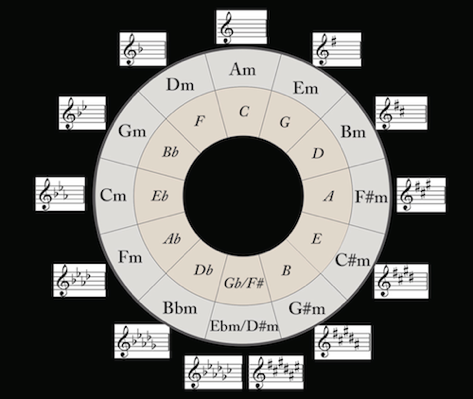
1) First we need to Follow the 5ths from A, until we reach our “Wanted” Note C to get our “To the xx” Factor (see the Circle of 5ths to easily see all Relation)
2) A – E – B – F# – C# – G# – D# – A# – F – C – G – D – A
3) The C is therefore 9 5ths away from A
3) So the Formula is 3:2 to the 9 x 440, then divided by 2 to the Octave
4) Means 3:2 = 1.5, then 1.5 to the 9 = 38.443359375, then 38.443359375 x 440 = 16915.078125 (C10 with +17.59 vs. Equal Temp)
5) Or Bootstrap Step by Step every 5th out of 440 by Multiplying every Next Result with the Scaling Factor of 1.5 (Bootstrapping along every 5th with Fraction 3:2 =1.5)
Means 440
x 1.5 = 660 (E5)
x 1.5 = 990 (B5)
x 1.5 = 1485 (F#6)
x 1.5 = 2227.5 (C#7)
x 1.5 = 3341.25 (G#7)
x 1.5 = 5011.875 (D#8)
x 1.5 = 7517.8125 (A#8)
x 1.5 = 11276.718 (F9)
x 1.5 = 16915.0781 (C10)
x 1.5 = 25372.61718 (G10)
x 1.5 = 38058.925781 (D11)
6) Finally dividing by “2 to the 5” which is 32 (cause C10 is 5 Octaves from A5), which is 16915.078125 : 32 = 528.5961914062
7) Or in manual Steps 16915.078125 divided 5 Times by 2
: 2 = 8457.5390625
: 2 = 4228.76953125
: 2 = 2114.384765625
: 2 = 1057.1923828125
: 2 = 528.5961914062
6) So the Minor 3rd is at 528.5961914062 in Pythagorean Tuning (again +17.59 Cents vs. Equal Temp but the same in Just Tuning)
Equal Temperated
– Close that Differences / Gaps in previous Tuning Problem, by Tempering the Gap (where the Name Temperated comes from)
– in “Equal Tuning”, you Spread that Gap evenly across every 5th which means every 5th in Modern Tuning is equally “Detuned” from and to each other
– So you take that last Gap in Pythagorean Tuning and spread it over All 5ths to not have One Big Gap at the End of the Chain
Math Version 1
– this Method to Math Out a “Wanted” Note in Equal Temp, is simply Divide the Wanted Note from Fundamental by 12 (12 Keys)
– for Example 3/12 if we need the m3rd from D (which is F) , or 5/12 if we need the 5th from D (which is G)
– after Division, Calculate “2 to the Power” and simply Multiply Result with the Fundamental to get the Exact Frequency
– in PCalc “2 to the Power” is

– for Example search Frequency of F, G and Bb from Fundamental F
1) to Find F, 3/12 = 0.25, 2 to the Power 0.25 = 1.189207115, finally 1.189207115 x 293.39 =348.9014754706 (F4 -1.61)
2) to Find G, 5/12 = 0.41666, 2 to the Power 0.41666 = 1.3348336859, finally 1.3348336859 x 293.39 =391.6268551104 (G4 -2)
3) to Find Bb, 8/12 = 0.6666, 2 to the Power 0.6666 = 1.5873277002, finally 1.5873277002 x 293.39 =465.7060739496 (Bb4 -2)
Math Version 2
– what we Want to achieve via Equal Temp Tuning, is that 12 of those 5ths (3:2) are Equal to 7 Octaves
– We therefore divide an Octave into 12 Equal Half Steps (again Multiplicative , Not Additive)
– then each Note should have a Ratio of 2 to the 1:12 (2 Hoch12:1) which is exactly 100 Cents
– for Example search Frequency of Minor3rd (C) Note of A440 in Equal Tuning
1) Means 1:12 = 0.0833333333, then 2 to the = 1.0594630943 which is the Ratio of 1 Semitone in Equal Temp
2) Since we look for the Minor3rd, we have a Distance of 3 Semitones (not counting Fundamental)
3) So the Formula is 440 x 2 to the 3:12
4) Means 3:12 = 0.25, then 2 to the 0.25 = 1.189207115, then 440 x 1.189207115 = 523.2511306012
5) So the Minor 3rd is at 523.2511306012 in Equal Tuning
Well Temperated
General
– Werckmeister Defined the Basic Rules of a Well Temperated Tuning (Around 1680)
– Bach Used the Basic Rules for Himself and Tuned the Piano also “Well Temperated”
– the Goal is to be Able to Compose in Most Minor and Major Keys without Making it Sound Out Of Tune (as the Equal Temperament Does)
– the Result is to Keep the Pureness of the Diatonic Intervals (Natural Intervals of a Major and Minor Scale)
– it is also Called an “Extended Just Intonation”
– Everything Goes Out from the Center of an Instrument, e.g. on the Piano the Center it is the “Middle C” Note
– the Goal is to Tune All Close Surrounding Notes to that “Middle C” and Minimise the “Beating” Inside this Center as Much as Possible
– as we Know, on a Piano we Can Not Tune Every Note in a Pure Fashion to Fit Every Other Note, so the Question is How to Distribute the Beating and Make it Fit a Particular Song
– in a Well Temperated Scale, we Structure it to Make the C Major Interval Harmonious (Not Perfect)
– the More you Go Outwards of the Center, the More Beating you will Get (but these “Outside Notes” will Not Affect the Sound as they are Not Played Much)
– the Slow Down of the Beating or a Faster Beating will Produce Different Color Contrasts and can Make All the Difference in a Song
– in a Well Temperated Scale, the 5ths are Always Temperated Narrow and 3rds are Always Temperated Wide from their Pure State
– i.e. 5ths have a Faster Beating and the 3rds have a Slower Beating
– Try to Define an “Anchor Point” to which the Other Notes are Tuned to and Expanded from, i.e. any Song has its Own “Anchor Point” and you can Extend from the Heart of the Character (That Sound)
Well Temperated Overview
Middle C —>> (C3 which is Set via an Appropriate Tuning Meter to the Standard of 440 or any Desired Base such as 437 for a 18th Century Tuning)
C Octave Below —>> (Tune C2 to C3 = Octave = Pure)
E Above Middle C —>> (Tune E3 to C3 = 3rd = a Little Wider than Pure, About 3 Beats per Second)
G Below Middle C —>> (Tune G2 to C3 = 5th = Narrow, Lowered, Kind of Slow Beating About 6 Beats per Second)
D Above Middle C —>> (Tune D3 to G2 = 5th = Narrow, Lowered, a Little Faster Beating than G to C)
A Below Middle C —>> (Tune A2 to D3 = 5th = Narrow, Lowered, the A Must also Talk to the E)
– So Far, you have the Essentials of the Well Temperated Scale and you Continue Kind the “Flat” Way of the Circle by Using and Tune the Rest of the Notes vs an Already Tuned Note
– Generally, as you Go Down in the Tonality in the Circle of 5ths you Increase the Number of Beats
F Below Middle C —>> (Tune F2 to C3 = 5th = Narrow, Lowered, the F2 Must also Talk to the A2)
Bb Below Middle C —>> (Tune Bb2 to F2 = 5th = Narrow, Lowered, the Bb2 Must also Talk to the D3)
Eb Below Middle C —>> (Tune Eb2 to Bb2 = 5th = Narrow, Lowered, the Eb2 Must also Talk to the G2)
Ab Below Middle C —>> (Tune Ab2 to Eb2 = 5th = Narrow, Lowered, the Eb2 Must also Talk to the C3)
Db Below Middle C —>> (Tune Db2 to Eb2 = 5th = Narrow, Lowered, the Db2 Must also Talk to the F2)
Gb Below Middle C —>> (Tune Gb2 to Db2 = 5th = Narrow, Lowered, the Gb2 Must also Talk to the D2)
B Below Middle C —>> (Tune Bb2 to Gb2 = 5th = Narrow, Lowered, the Bb2 Must also Talk to the G)
Detailed Workflow
1) Tune the Middle C to your Desired Basic A (xxx Hertz) you Want
– e.g. to Fit a Song to the 18th Century Tuning, Tune the Middle C so A Matches = 437 Hz
2) To Set the Framework, you have to Tune to an “Octave” to Begin with
– this Must be Done as Perfect as Possible Because to Later Fill In that Octave Properly with the Other 12 Notes of the Scale
3) So Start to Tune the C an Octave Below to the Middle C to Get a Pure Tune, i.e. “No” Beating at All
– Sing Along and Find Out if the Relation is Sharp or Flat
– also Count the Offsets in the Beating per Second to Get a Better Feel (i.e. How many Times the Beating per Seconds Occur, e.g. 2 or 3 Times etc,)
4) Now you Tune the Relationship between Middle C and E (Major)
– in the 18th Century, this Interval had an Absolute Major Relationship and therefore was Tuned to Reflect “Stillness”
– so the “E” has Kind of a Sweet Roll to Against the “C”
– in the Equal Temperament, this Interval “Beats” a Lot Faster which is Exactly what we Want to Avoid here (means the Beating would be 6 or 7 Times per Second Instead of 2 or 3 Times)
– but Again, in a Well Temperated Scale we Structure the E to Make the C Major Interval Harmonious (Not Perfect)
5) Now we Need to Get the Rest of the C Major Triad in Tune, which Means the “G”
– in the Equal Temperament, i.e. Right Now the “G” Sounds Beautiful to the Note C (Pure)
– but we can Not Continue Leave it “Pure” as we Move Along in 5ths
– i.e. from the “D” (which is a 5th from G) to the “A” (which is a 5th from D) and then to the “E” (which is a 5th from A) which we Tuned so Nice to the Middle C, will Produce More and More Gaps
– this is Because 3rd and 5th Intervals are Like Cats and Dogs from a Mathematical Point of View
– so to Find the Overall Balance, we Tune “C to G” we Temperate this Interval a Little More than the Initial C to E and Instead of Making it Pure, we Lower the “G” just a Little Bit vs the “C”
6) Now Continue to Tune the “D” to the “G”
– Always Get the Whole Picture, means the “D” is an Inverted 5th of G or you can See the “G” as the 4th of “D”
– Remember that 5ths are Always Temperated Narrow and 3rds are Always Temperated Wide from their Pure State, so
– so Find the Pure Tone First and then Temperate the “D” Narrow to the “G”
– i.e. Lowering the Note, just as we Did with the “G” Before, but we Need to Lower it More in Order to Maintain the Initial “C to E” Relationship
7) Now Continue to Tune the “A” to the “D”
– Same as Before, Find the Pure Tone First and then Temperate the “A” Narrow to the “D”
– i.e. Lowering the Note, just as we Did with the “D” Before
– also Compare the Relationship of the “E” (which we have Temperated Already) to the Current “A” at this Stage
8) Now, you have the Essentials of the Well Temperated Scale and you Continue Kind the “Flat” Way of the Circle by Using and Tune the Rest of the Notes vs an Already Tuned Note
9) So Down the Circle of 5ths, the Very Next 5th Below “Middle C” is the “F”
– So Start to Tune the F an Octave Below vs the Middle C
– Generally, as you Go Down in the Tonality in the Circle of 5ths you Increase the Number of Beats
– the “F” Should be Beating at 4 to 5 Times a Second which is a Sweet Relationship
– also Check the “F” vs the “A” (as the “A” is the Major 3rd of the “F”)
10) Now Check the Next 5th Below the Current “F” which is “Bb”
– Tuning between “F” and “Bb” Should be Already at a Good Spot
– Always Check a Current Note´s Tuning also to Another Important Reference Note that is Already Temperated
– e.g. “Bb” vs the Already Tuned “D” which Reflects a Major 3rd Interval
11) Now Check the Next 5th Below the Current “Bb” which is “Eb”
– Get it to Sound Pure Against “Bb” and also Check it Against Already Tuned G (which Again, Reflects the Important Major 3rd Interval)
– Notice that the Higher you Pitch the “Eb” Against the “Bb”, the Slower it will be Against the “G”
12) Now Check the Next 5th Below the Current “Eb” which is “Ab”
– Compare it by Check the “Double Relationship” it Creates when Playing First ”E & Ab” (use Ab as G#) and then Play “C & E”
– “C & E” Creates More of “Calm Keys” (Slow Beating) and ”E & Ab” More of “Bright Keys” (Fast Beating)
13) Now Check the Next 5th Below the Current “Ab” which is “Db”
– Tune it as a Pure 5th to “Ab”
– also Check it as Major 3rd Relationship in “Db” Major Against the Already Tuned “F”
– Make the “Double Relationship” Check Again, this Time the Bright “Db & F” Versus the Calm “C & E”
14) Now Check the Next 5th Below the Current “Db” which is “Gb”
– Tune it as a Pure 5th to “Db”
– also Check it as Major 3rd Relationship in “Gb” Major Against the Already Tuned “D”, i.e. How it Sounds as the F# in D Major (Beating at About 4 or 5 Times a Second)
– Again, if you Check it vs the “C & E”, it will Beat Faster and Sounds “Bright” which Gives a Great Contrast Against the “Calm” C Major (which is Always the Anchor Point)
15) Now Check the Last 5th Below the Current “Gb” which is “B”
– Tune it as a Pure 5th to “Gb”
– also Check it as Major 3rd Relationship in “B” Major Against the Already Tuned “G”
T.Y. Well vs Equal Temperated Table
– a Table Based on by Thomas Young´s Well Temperated Tuning, that Shows the Detuning between the 2 Scales (1799)
– the Number are the Factor´s you use to Multiply the Current Hertz Value to Get the Thomas Young´s Well Temperated Interval
– i.e. C to C with All the Intervals have a Unique Factor (m2, M2, m3, M3, 4th, Tritone, 5th, m6, M6, m7, M7 and Octave)
– e.g. you are on A=440 and Search Thomas Young´s Well Temperated Semitone, you Multiply 440 x 1.055730636 = 464.52147984 which is a Bb -6 Cents
– or e.g. you are on A=440 and Search Thomas Young´s Well Temperated Tritone, you Multiply 440 x 1.407640848 = 619.36197312 which is a Eb -8 Cents
Note
T.Y. ratio
E.T. ratio
Interval Quality
C
1
1
Fundamental
C#
1.055730636
1.059463094
m2
D
1.119771437
1.122462048
M2
Eb
1.187696971
1.189207115
m3
E
1.253888072
1.259921050
M3
F
1.334745462
1.334839854
4th
F#
1.407640848
1.414213562
Tritone
G
1.496510232
1.498307077
5th
Ab
1.583595961
1.587401052
m6
A
1.675749414
1.681792831
M6
Bb
1.781545449
1.781797436
m7
B
1.878842233
1.887748625
M7
C
2
2
Octave
– or this Table Shows the Tuning Offset Per Note if you Tune a Equal Temp to a Well Temp
– e.g. 2 to the Power of 6/1200 to Tune C Equal to C Werckmeister, which Means for a C3 at 261.626:
a) 6/1200 = 0.005
b) 261.626 x (2 to the Power of) 0.005 =
Note
Cent Offset
C
6
C Octave Below to Make it Pure
C#
0
D
2
Eb
4
E
-2
F
6
F#
-2
G
4
Ab
2
A
0
Bb
6
B
-2
Leave a Reply