General
-The Focus is on the Sonorous Nature Of the Sound / Spectrum (Not on Harmonic Progressions or Tone Rows)
– Makes use of FFT (Fast Fourier Analyser) to Analyse Partials occurring in the Overtone Series of any Sound
– It is a Journey build by Modulating from Spectrum to Spectrum (included Relation to different Articulation Styles as Muted, Open String, Sforzando etc.)
– The Basic Building Block is a “Timbre-Chord” which is the Spectral Music meaning of the Fusion of Timbre (Sound Colour from any Source) and Harmony (the Overtones that Sound generates)
– “Timbre-Chords” are finally Harmonies and Replace Traditional Themes, or Motives and is Orchestrated in a Particular Way, regardless of whether the Chord is Struck simultaneously
– And if a “Timbre-Chord” is Re-Orchestrated a Spectral Composer treats it as a significant Departure from the Original
– Partials at a Lower Register are Closer together compared to the Critical Band
– Usually Pitch is Rounded to Quarter (25 Cent) or even Eights (12.5 Cents)
– Uses any Partials of a Given Sound and Discover from there Infinite Possibilities to Continue
– the Microstructure of Sound & Ever-Changing Relationships between the Pitches of a Sound’s Overtone Structure as it develops in Time.
Q: What difference is there between the Spectrum of a Note associated with a Timbre and the Spectrum of a Chord considered as an Element of Harmony?
A: simple Note is a Collection of Spectral Components, thus a Chord. A Chord is a Collection of Partials, thus a Timbre. Sound Synthesis allows the Organisation of the Note itself, introducing Harmony into Timbre and reciprocally Sound Analysis can introduce Timbre as a Generator of Harmony
– If Harmony and Timbre are so intimately linked, the “clear-cut” traditional Classification of Chords between Perfect Consonances, Imperfect Consonances and Dissonances may become Irrelevant
– so Timbre Manipulation opens up the Possibility to look for a continuous Scale that could reproduce, in some Respects, the Expressive means associated with the Tonal Notions of Consonance and Dissonance’
– Grisey says its about Sound, using “Beats” as Colour (No Math or Philosophy)
– Dalbavie talks only about Timbre and Texture
– Using “Auditory Illusions” is also Added by Certain Spectral Music Composers
Historical Examples
Wagner’s Rheingold
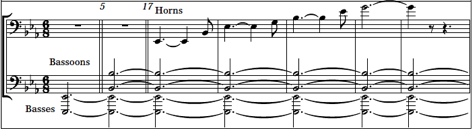
– Rheingold Prelude has a Low Eb1 Pedal in the Bass while the Bassoons and Horn play the Overtones over the low Eb1 (although Wagner had nothing to Do with Spectral Music this is a simple Example of following Overtones and Orchestrate them)
Varese
– To me, Orchestration is an essential Part of the Structure of the Work. Timbres and their Combination – or better, Quality of Tones and Tone-Compounds of different Pitch,
– instead of being Incidental, become Part of the Form, Coloring and make Discernible (Erkennbar, Wahrnehmbar) the different Planes and Sound Masses, and so creating the Sensation of non-blending
Varese’s Hyperism
Time: 4:00
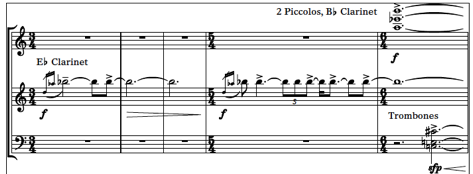
The first of Varese’s classic “Liberated” works. Very short and tightly knit work for 16 percussion instruments and 9 winds (fl., cl., 3 hn., 2 tp., 2 tbn.,). Only 2 woodwind against 7 brass & percussion.
Key work for study and analysis – illustrates foundational structure and style (atomisation, crystallisation, intensity, non-blending, sound masses, and projection). A clear example of atomisation can be heard in the first 11 measures of the score where Varese finds 32 different ways of filling a single quarter beat.
Can be analyzed as a work in 9 sections or 3 larger sections:
1=m.1-19
1=m. 1-28
2=m. 20-30
2=m. 29-58
3=m. 31-39
3=m. 59-90
4=m. 40-48
5=m. 49-62
6=m. 63-68
7=m. 69-76
8=m. 77-84
Vareses Analytical Elements
– Music is a spatial phenomenon and therefore Functions in three dimensions
– Rhythmic, harmonic, and melodic material undergo constant variation. This material is linked to form “sound masses” with connecting strands of melodic material
– Rhythm is “the generator of form,” that which holds the work together
– Vertical and horizontal material are interchangeable
– Timbre is as important as pitch and will distinguish one sound mass from another
– Sound possesses inherent intelligence
Scelsi (1950)
– described by as “…radically Static…focusing upon narrow Pitch Bands (often Single Notes or Octaves), [with an] Emphasis upon Timbre for its own sake, [and makes] Frequent use of Microtones
– Again the Surface Discourse is the changing Timbres of a Single Note or Chord and Movement is Driven by Timbre
– Entirely based on 1 Note or the Motion between 2 Notes
– for Example “Quattro Pezzi pre Orchestra” where each of the Four Movements is based on (and around) 1 Note (F, B, Ab and A#)
– Microtonal Trills as well as Glissandos are moving away from the Note (Fundamental) which the Movement is based on, to Escape Tonal Centre occasionally
– Usage of “Extremely” Limited Pitch Material, Slow evolving
Grisey “Partiels” (1980)
– “Partiels” is Based on the Simulation of a Trombone Low E
– Double by the Bass as First Model with a Harmonic Overtone
– then he uses the Bell as a Model to Re-Produce an Overtone with a In-Harmonic Partial
– as a 3rd Model he uses any Electronic Device for Frequency / Ring Modulation, Algorithmic Changes etc.
How to Build a Song with Spectral Theory Conditions
Example From the University
1) Choose a Instrument “Model” to build the Foundation (as Piano, Violin, Voice etc. in a desired Tuning System)
2) Play a Pleasant Note or Chord around the Middle of Register
3) Analyze your Sound with a Spectrograph to see the Characteristics of the Timbre
4) Orchestrate the Spectrum Found in the Analyze, i.e. assign the Spectrum’s Harmonics to every Instrument of the Orchestra
5) The Goal is to choose the Best Fitting “Model” for each Overtone to Match the Overtone as close as Possible (this Procedure differs from Popular Orchestration in a Traditional Way since the Instruments as Bass, Strings are now No more freely available by the Composer but considered only as a “Double” for the dedicated Overtone)
6) Since the Spectral Composer works in a “Narrow Band” a 5 Second Model from Traditional Orchestra can be a 5 Minute Piece Stretched & Expanded by the Composer
7) It´s Quasi Re-Producing the Spectrum Analysis from a Sound with individual “Models” (Instruments) that Match individual Overtones as close as possible Rounded to Quarter Tones and Eight Tones (PB = 25 or 12.5) Cents)
8) To Re-Produce Harmonic Overtones you may use a Lot of “Models” (Bass, Cello, Strings etc.), for In-Harmonic Bells are Great (or Noise, Percussion), to Enhance overall use Electronic Devices as the 3rd Model in the Box
9) Form of the Sounds Envelope is used as the Formalization of a Piece,
10 So back to the Sustained Note, see the Behavior of every Component is different in the Analyzer, means some Overtones are First Dominant, then Disappear and Appear again but less Sound
11) In other Words Dynamics of the Song are taken through the General Shape in Duration from the Fundamental Sustained Sound regarding Climax and Quiet Moments of the Overtone Series
12) The “Beats” can be taken then to Construct Small Rhythmic Parts, where the Compression in Time of the Behavior of Single Components can Inspire a Instrumental Line (or Viceversa)
13) It’s about Slow “Melting” of the used Models where the resulting Timbre leads “Anonym” to different Pitches (for Example a Bell Sound turns slowly into a Trumpet in 10 different Intermediate Transition Points)
14) This Automatically leads you to Pitch Changes (use Semitones for Ligeti Style)
15) Remember, although all these Conditions are Interesting, make Music (there is Not more Spectrum in Spectral Music that in other Music:)
Leave a Reply