
General
– A Technique where you Assign a “Syllable” to Each Note in a Musical Scale
– Solfeggio is Based on Do-Re-Mi-Fa-Sol-La-Ti and Adds “Functional Sound-Names” to All 12 Keys (Respective Scale Notes)
Scale Degree 1 = Do
Scale Degree 2 = Re
Scale Degree 3 = Mi
Scale Degree 4 = Fa
Scale Degree 5 = Sol
Scale Degree 6 = La
Scale Degree 7 = Ti
(Scale Degree 8 = Do)
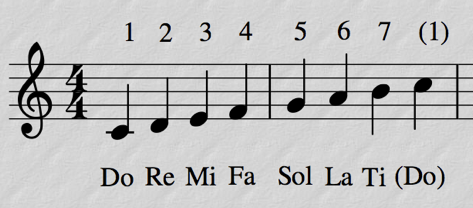
– Helps to Hear where Exactly we are in a Scale and is a GreatRelative Pitch Ear Training
– i.e. to Recognise in Functional Harmonic Terms any of the 12 Notes of the Piano in any Key Centre (means to Memorise what a Note has to to with the other Played Notes “By Ear”)
– The First Syllable is “Do” and Always Begins the Solfege Scale
– The Idea is Going through All Keys Note by Note within a Diatonic Scale, while always Coming Back to “Do”
– Always the Oldest Key of a given Triad is Releasing at a cCertain Point, so the Next Key builds another Triad in the Diatonic Scale
– Timing of “Release” and Crossing Points between Notes are Giving the “Extras”, the Rest is Logical
– However, the Trick is One Key gets released and another Key in Diatonic Scale is Replacing it (Here in Example we Move Step by Step through C Major Scale)
– The Trick is to always Start from C3 to D2 to E3 to F3 in First Circle, but when you are Back to C3 and start Over you C3 to D2 to E3 and Now F2 (instead F3)
– a Learnable System cause it is Based on Listening / Feeling the Emotional Response related Keys give to you, rather than just Hearing Music
– This has Nothing to Do with “Interval Listening”, it´s about to “Match” the Unique Pitch Class of any Given Note to your Brain
2 Types of Solfege
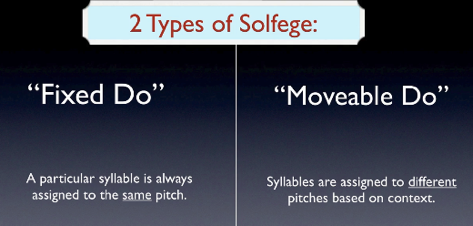
– there are 2 Types of Solfege, a “Fixed Do” or a “Moveable Do”
Fixed Do
– the same Syllables are always Assigned to the same Pitches, Regardless of what Key you are in
– means C is Always Do, F is Always Fa, D is Always Re, E is Always Mi etc.
– i.e. these Syllables are Always Fixed to these Notes
Moveable Do
– the Syllables are Assigned to Different Pitches, Based on Context
– i.e. the Moveable Do Looks for the Relationship of the Notes to the Tonic
– means if we are for Example in F Major, F is Becoming the New “Do” = New Tonic
– and the Notes After that Falls into Relationship of this New Do
– so in F Major “A” is Becoming the New “Mi” (as in C Major “E” was “Mi”), in F Major “C” is the New ”Sol” (as in C Major “G” was “Sol”) etc.
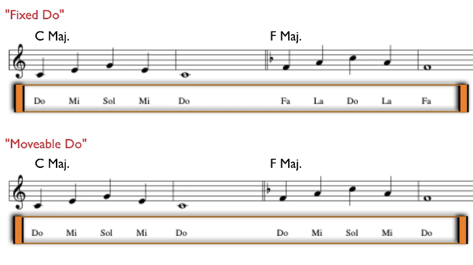
– Today we use Solfege in a “Movable System” for Better Ear Training & Recognise Relationships, by always Start from Do in Every other Key
– take simple Songs and Play them with the Solfege System
Sight Singing
– the Practice of Singing or Playing a Piece of Music that you are Reading for the Very First Time
– Basically to Learn your Ears to Connect with What you See on the Page
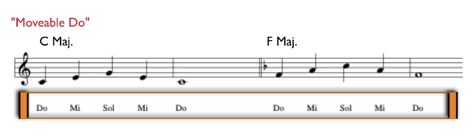
– Try to Sing these Intervals:
Sol – Do
Do – Sol
Do – Mi
Mi – Sol
Sol – Mi -Do
Solfege Recognition
Black = Major Solfege (same for Ascending and Descending)
Green = Chromatic Solfege Ascending Extra Notes (Di is C#, Ri is D#, Fi is F#, Si is G#, Li is A#)
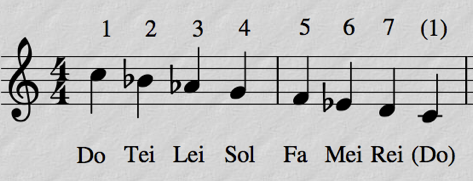
Red = Chromatic Solfege Descending Extra Notes (Te is Bb, Le is Ab, Se is Gb, Me is Eb, Ra is Db)
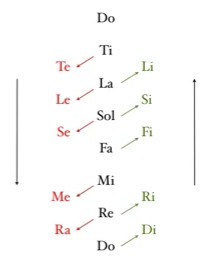
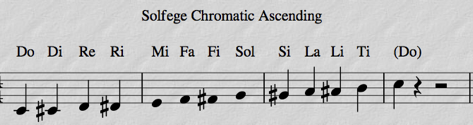
Ascending Chromatic
– Do Di Re Ri Mi Fa Fi Sol Si La Li Ti Do (Major C-C)
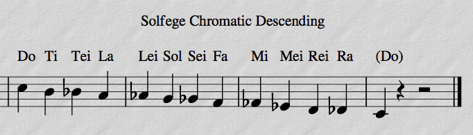
Descending Chromatic
– Do Ti Tei La Lei Sol Sei Fa Mi Mei Rei Ra Do (Backwards C-C)
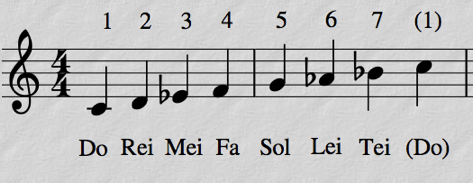
Minor
– Do Rei Mei Fa SolLei Tei Do (Minor C-C)
– Do Tei Lei Sol Fa Mei Rei Do (Minor Backwards C-C)
Solfege Practice: 3 Step Process
1) We Need to Place Something on the Piano, that Clearly Establishes the Key Centre
– to Remember the Sound and Feeling of a Key Centre in Our Minds Ear
2) We then Play any Random Note on the Piano
– without Knowing what that is in Advance
3) Listen and Feel to the Impact that Sound has to Our Minds Ear
– if you can Recognize that Sound in Functional Harmonic Terms and Try to Name its “Solfege” Syllable
– then, Depending on what Key we are In, we are also to Name using its Letter Name
Practice Example in the Key of C
1) Get C in your Ear by Singing / Humming it a X Times
– or Detect Its Class by Roman Numeral Progression V-VII- I (here via G Dominant 7th to One)
– in C Major press Notes G3, D4, B4, G4 for its Dominant 7th, Back to C3, E4, 43, C4 as Our Key Centre C
– means simply “Check” via Dominant 7th of any Key to have a Reference Class to Compare
2) Now Press (Add) any other Note with your Eyes Closed
– Do Not Look at the Key!
Examples:
C and Ab2
C and B2
C and Db4
3) Play and Listen the New Key several Times
– Try to Match the Note with One from Solfeggios Do-Re-Mi-Fa-So-La-Ti-DO
4) If you Stuck to Recognize that Note
– get Closer by Humming
– Sing something you Know
5) If you Stuck Again!
– Open your Eyes & Make something Good from Something Bad , use the Opportunity to Learn something
– by “Memorise that specific “Strange” Key Related to the C Major, this will Train your Ears Weakness just Right
– Exaggerate by Playing that Key in All Octaves again to C Major Scale
Practice Example in the Key of G
– Get G in your Ear by Singing / Humming it a X Times
-in G Major press Notes D3, Gb4, B4, D4 for its Dominant 7th, Back to G3, B4, D4, G4 as Our Key Centre G
and so on….
Example Building Solfeggio
1) Start on a Single C3 (1 Note from Scale C)
2) Overlay with Next Note in Diatonic Scale which is D2 (a Octave Lower) at Custom Time, so 2 Notes C3 and D2 playing together (2 Notes from Scale C+D)
3) Add E3 Custom Time, so 3 Notes C3, D2 and E3 playing together for a Short Time (Triad 1) (3 Notes from Scale C+D+E)
4) Release C3 (the Oldest in this Triad as the “Do”) soon, but Add immediately F3, (4 Notes from Scale C+D+E+F)
5) So again 3 Notes D2, E3 and F3 playing together for a Custom Time (Triad 2)
5) Release D2 (as the Oldest in this Triad), but immediately Add G2 and keep E3 & F3 (Dissonance by E3 & F3) (5 Notes from Scale C+D+E+F+G)
6) So again 3 Notes E3, F3 and G2 playing together for a Custom Time (Triad 3)
7) Release E3 (as the Oldest in this Triad), but Add immediately A3 and keep F3 & G2 (5 Notes from Scale) (6 Notes from Scale C+D+E+F+G+A)
8) So again 3 Notes F3, G2 and A3 playing together for a Custom Time (Triad 4)
9) Release F3 (as the Oldest in this Triad), but immediately Add B2 and keep G2 & A3 (7 Notes from Scale C+D+E+F+G+A+B)
Notice we use B2 instead of B3 to Prepare for C3 cause we want the “Do” be a Fixed Reference
10) So again 3 Notes G2, A3 and B2 playing together for a Custom Time (Triad 4)
11) Release G2 (as the Oldest in this Triad), but immediately Add C3 and keep A3 & B2 (again Dissonance by B2 & C3)
12) So again 3 Notes A3, B2 and C3 playing together for a Custom Time, Notice we have “C3” Back as a Note to prepare the Circle (Triad 5)
13) Release A3 (as the Oldest in this Triad), but immediately Add D2 and keep B2 & C3
14) So again 3 Notes B2, C3 and D2 playing together for a Custom Time (Triad 6)
15) Release B2 (as the Oldest in this Triad), but immediately Add E3 and keep C3 & D2
16) So again 3 Notes C3, D2 and E3 playing together for a Custom Time (Notice we Come Close the “C3” Back as a Note in Triad 5)
17) Release C3 (as the Oldest in this Triad), but immediately Add F2 and keep D2 & E3
18) Now, “F”, in Contrast to Step 4 above where we Release C3 and added F3, we now Release C3 and use F2 -Octave Lower (Next Notes will Follow that Path)
19) So again 3 Notes D2 & E3 & F2 are Playing
20) The Concept can be adapted to any Key and you may be reach other Octaves
Leave a Reply