
General
– the Musical Equivalent of a Phrase is a Sentence
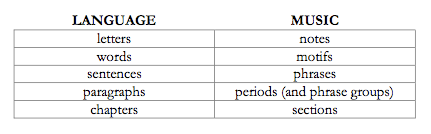
– a Phrase is a Series of Notes that Sounds Complete, Even if it is Not the Actual End of a Specific Section
– a “Phrase” Consists Commonly 4 Measures and is the Average, of course this Varies on all Kinds of Music
– the First Phrase is called “Question” (Antecedent) Phrase and the Second Phrase is called the “Answer” (Consequent) Phrase
– Second Phrase is Anticipating Question from the First Phrase
– often you Repeat Material to Create a Link between the 2 Phrases of a Period
Three Types of Rhythmic Phrases
1) Those that Suggest Continuation (Antecedent Type)
2) Those that Suggest a Temporary Repose (Antecedent Type)
3) Those that Suggest Finality (Consequent Type)
Example
Original Phrase

Make it a “Continuation” Phrase
– by Placing Short Notes at the End, such as 8, 16 etc.

Make it a “Temporary Repose” Phrase
– by Place Rests at the End of a Phrase

Make it a “Temporary Repose” Phrase
– and / or by End on a Weak Beat

Make it a “Finality Phrase”
– Make the End a Note with Longer Duration
– and / or make the End on a Strong Beat

– you can Build Phrases On “Stable” and “Unstable” Tones
Tonic = Most Stable Tone in any Particular Key
Dominant = 2nd Most Stable Tone in any Particular Key
Mediant = 3rd Most Stable Tone in any Particular Key
All other Tones are Considered as “Unstable”
Musical Phrase
– Stands alone as a Complete Thought or Idea
– typically 4 Measures Long (Cannot be Smaller than 2 Measures)
– Repetition a Common Tool to Introduce a Phrase to the Listener and to Establish Motifs as a Primary Motif
The Period
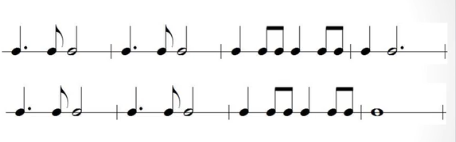
– A Period Consists of Two Phrases, that have the Relationship of Antecedent and Consequent
Antecedent Phrase
– Ends “Weakly” and Precedes the Consequent Phrase
– uses either Continuation or Temporary Repose Form of Phrasing
Consequent Phrase
– Ends “Strongly” and Follows the Antecedent Phrase
– uses Finality Form of Phrasing
Example
– 1st Phrase Ends with Dotted Eight on a Weak Beat (Antecedent)
– 2nd Phrase Ends with a Whole Beat on a Strong Beat (Consequent)
The Phrase Group
– When Two Phrases do Not have a Antecedent and Consequent Relationship, it is called a Phrase Group
– basically when 1st Phrase Not Ends Weakly and 2nd Phrase Not Ends Strongly
– Phrase Groups can have more than 2 Phrases
Example
– this is just a Repeated Phrase
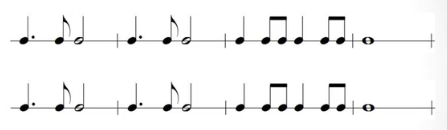
– more than 2 Phrases
– All Phrases End Strongly
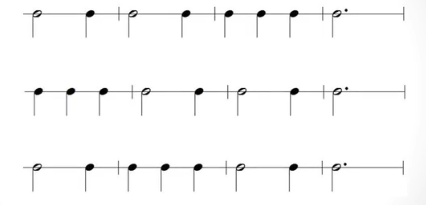
Melodic Phrase
– based on the Rhythmic & Melodic Motif Development Techniques, we can Develop Melodic Phrases which are Made up of a Number of different Motifs
– in the Essence we are about to Make a Sentence, which is a Phrase in Music
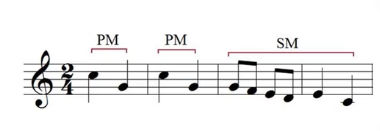
– as we know from Rhythm, Notes make Up Rhythmic Motifs and Rhythmic Motifs make Up Phrases using a Combination of Primary (PM) and Secondary (SM) Rhythmic Motifs to Enhance Variety
– Most Melodic Phrases are typically 2-4 Measures Long and Divisible by 2
– Combine the Motif Development Techniques the same Way to Create Multiple Motifs and Form Multiple Phrases (Sequence, Expansion, Compression, Oct Transfer of Tonality Change)
– the Repetition of a Motif may appear in another Part of the Piece and Does Not need to Repeated in the same Phrase necessarily
Primary and a Secondary Motif to Build On Melodic Phrases
– Measure 1+2 are repeated but 3+4 are different in this Phrase (maybe the 3 Measure 3+4 appear somewhere else in the Arrangement)
Transposition of Multiple Motifs to Build On Melodic Phrases
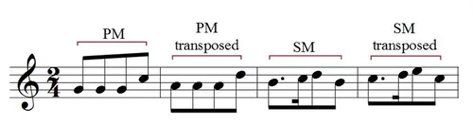
– as in Rhythm, there are 3 Types of Melodic Phrases
1) Those that Suggest Continuation (Antecedent Type)
2) Those that Suggest a Temporary Repose (Antecedent Type)
3) Those that Suggest Finality (Consequent Type)
Leave a Reply