
- General
- Minor Scales
- Cycle of 5ths and 4ths
- Whole Tone Scales
- Pentatonic Scales
- What Key we are in?
- Melody
- Diatonic Intervals
- Minor, Diminished and Augmented Intervals
- Inverting to add up to a 9
- Harmonising
- Chords / Triads
- Inversions
- Diatonic Triads in a Major Scale and their Inversions
- Chords Harmonic Progression & Deceptive Cadence
- Intro to 7th Chords & Diatonic 7th Chords
General
– Black Notes are nothing Special, just 5 more Keys/Pitches
– Going down the Piano we call Flats (named by the very next right Key with a “b”)
– Going up the Piano we call Sharps (named by the very next left Key with a “#”)
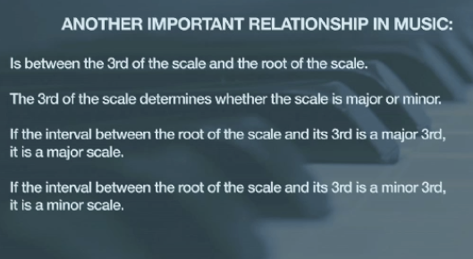
– Scales have usually 7 Keys that included Pitches define a certain Character
– Tonality is the Type of “Home”
– often Bridges include Diminished or 7 Chords that can resolve easier in several Keys
Minor Scales
– Different Types of Minor (Natural-Harmonic-Melodic)
– the first 5 Notes of a Minor Scale are Stable (Rarely Change)
– 6th and 7th Notes Change the Style
– Natural = Ends with = G# – A# (both down half step of Major Scale)
– Harmonic = Ends with = G# – B (7th note same as Major Scale. Sounds a bit Middle Eastern Style)
– Melodic = Ends with = A – B (like Major Scale)
Relative (Minor) Scales
– from Major go down 3 Half-steps to get Relative Minor
– from Minor go up 3 Half-steps to get Relative Major
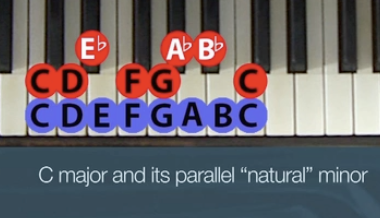
Parallel (Minor) Scales
– means simply the Minor Version of a Major Scale
– runs same Tracks – means starts and ends on the same Notes as Major Scale (C to C for example)
– lower the 3rd, 6th and 7th Note get Parallel Minor (E=Eb, A=Ab,B=Bb)
Major Scales with Sharps or Flats
– C Major Scale is the only Scale without Sharps or Flats
– basically we have 12 Major Scales for every Note
– technically we have 15 Major Scales because
13) C# can also be called Db
14) F# can also be called Gb
15) B can also be called Cb
Major Scales with Sharps detailed
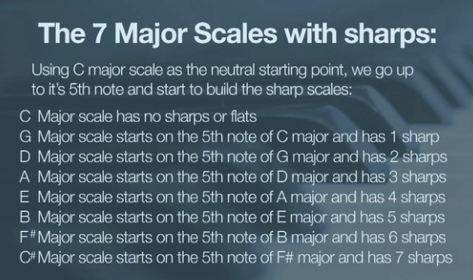
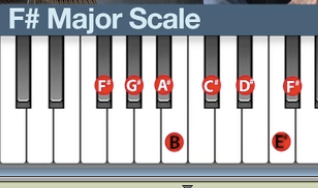
– F# Major Scale has also the F in the Scale – because of the Rule that every Note-name can only be used once in a Scale – we fix the Note F with an E#
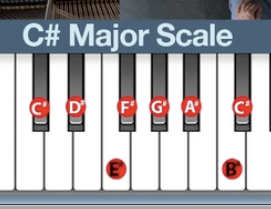
– C# Major Scale has only Sharps in the Scale (7) – again, because of the Rule that every Note-name can only be used once in a Scale – the F is fixed as an E#
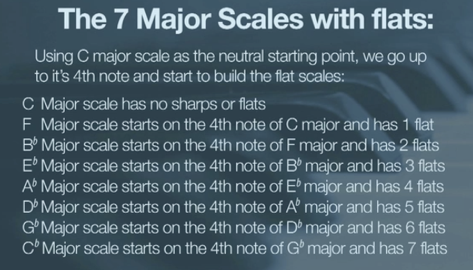
Major Scales with Flats Detailed
– starting from F as a neutral Starting point F-Bb-Eb-Ab-Db-Gb-Cb – every new Key until C#/Gb introduces a new Flat
– Cb Major Scale has only Flats in the Scale (7)
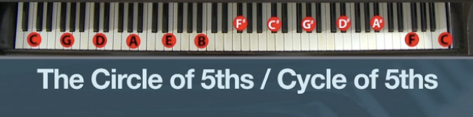
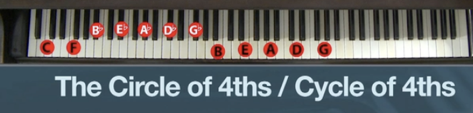
Cycle of 5ths and 4ths
– run through the Keyboard in 5ths in one giant circle to get all Sharps
– run through the Keyboard in 4ths in one giant circle to get all Flats
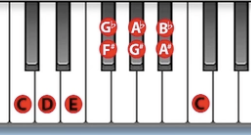
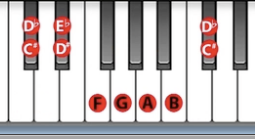
Whole Tone Scales
– there are 2 of them
Pentatonic Scales
– playing the 1, 2, 3, 5 and 6 of a Major Scale
– People love this scale because there are no Half-Steps in between (Less mistakes when playing)
– it´s the same as playing all Black Keys
– has a Cousin – the Blues Scale playing the 1, Min3rd, 4th, Sharp4 or Dim5th, Min7th
What Key we are in?
– listen to what Key it falls when it comes “Home” or to the End of Song
– play the Scale of that Home Note to detect if its more in Major or Minor
Melody
– mostly Notes from within a Scale – but still 1 or 2 Notes can be added from Outside a Scale
– most Melodies start from the Root, the 3rd or the 5th of a Scale
– usually the Melody comes back to Root / the 1 of a Scale
Diatonic Intervals
– the Intervals have names regarding a order and Ambience they make when played in 2 Note Grouping with the Root together (means C with D, C with E or C with F etc)
– the names in Major Scale are: Prime/Root, Maj2nd, Maj3rd, Perfect 4th, Perfect 5th, Maj6th, Maj7th, Perfect Octave
– Diatonic in conjunction with Intervals means “In The Key” – say in C Major Scale all Black Keys are Non-Diatonic
– can be played Harmonically (for Chords) – means Notes together make up a Interval/Melody
– or Melodic (1 head of time) – means the Notes are played chronologically to make up a Interval/Melody
Minor, Diminished and Augmented Intervals
– the names in Chromatic Scale are: Prime/Root, Min2nd, Maj2nd, Min3rd, Maj3rd, Perfect 4th, Augm4th or Dim5th, Perfect 5th, Augm5th, Dim6th or Min6th, Maj6th, Min7th, Maj7th, Perfect Octave
– when played Gb in a C Major Scale – because Gb is not in the Scale by default it´s called a Dim5th (Gb because you flatten the 5th)
– you can also call it a Augm4th which is the exact Midpoint of a Octave and makes up the Tritone

– same when played G# in a C Major Scale – because G# is not in the Scale by default it´s called a Augm5th (G# because you raise the 5th)
Inverting to add up to a 9
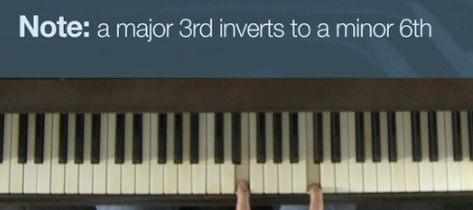
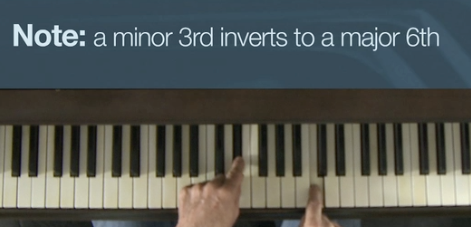
– if you play the C of a Maj3rd a Octave higher (1st Inverse) – you also make up a Min 6th (viceversa a Min3rd inverts to a Maj6th)
– when you invert a Interval it always adds up to a 9 (Augm to Dim, Major to Minor, Perfect 5th to a Perfect 4th and viceversa)
Harmonising
– basically play / move a bunch of other notes in a Scale parallel together – to make a Melody more harmonious, nicer and richer
– for example add the 6th below C which is a E and play E,F,G parallel with C,D,E
– or the 3rd above which happens to be also the 6th below but a Octave higher – C,D,E parallel with E,F,G
– or adding a “Static Note” (doesn’t move) on top or underneath of the Original Melody – for example G plays along with C,D,E
– or by adding Octaves of course
Chords / Triads
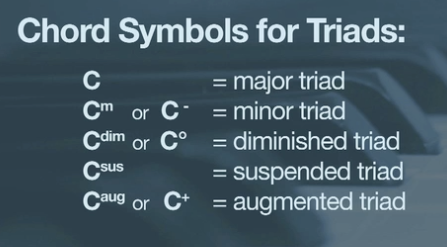
– there are 5 Triads in a Scale – Major, Minor, Diminished, Suspended, Augmented
– in Pop Diminished and Augmented are rarely used
– Suspended (kind of “Hanging”) Triad tend to fall down to either a Minor or Major Triad
– Augmented Triad tend to go up to either a Minor or Major Triad
– Diminished (kind of “Friction”) Triad tend to fall anywhere
Inversions
– C,G,E is Root Position (or 1st Position) – E,G,C is 1st Inversion (or 2nd Position) – G,C,E is 2nd Inversion (or 3rd Position)
– Inversions allow you to move smoother between different Chords
Diatonic Triads in a Major Scale and their Inversions
C Major Scale
I = Major
II = Minor
III = Minor
IV = Major
V = Major
VI = Minor
VII = Diminished
C Major Scale 1st Inversion
E,G,C (I)
F,A,D (II),
G,B,E (III)
A,C,F (IV)
B,D,G (V)
C,E,A (VI)
D,F,B (VII
C Major Scale 2nd Inversion
G,C,E (I)
A,D,F (II)
B,E,G (III)
C,F,A (IV)
D,G,B (V)
E,A,C (VI)
F,B,D (VII)
Diatonic Triads in a Minor Scale and their Inversions
– the lowered 3rd, 6th and 7th are Diatonic Triads as we usually find in a Minor Scale (E=Eb, A=Ab,B=Bb)
C Minor Harmonic Scale
I (C) = Minor,
II (D) = Diminished
III (Flat 3 E=Eb) = Major
IV (F) = Minor
V (G) = Major or Minor (classically speaking more Major but in Dance more Minor 5 Chord)
VI (Flat6 A=Ab) = Major
VII (Flat7 B=Bb) = Minor
– in a Harmonic Minor the 5th is automatically a Major Triad (B instead of Bb)
C Minor Scale 1st Inversion
Eb,G,C (I)
F,Ab,D (II)
G,Bb,Eb (III)
Ab,C,F (IV)
Bb,D,G (V) in Dance Music or B,D,G in Classical
C,Eb,Ab (VI)
D,F,Bb (VII)
C Minor Scale 2nd Inversion
G,C,Eb, (I)
Ab,D,F, (II)
Bb,Eb,G, (III)
C,F,Ab, (IV)
D,G,Bb, (V) in Dance Music or B,D,G in Classical
Eb,Ab,C, (VI)
F,Bb,D, (VII)
Chords Harmonic Progression & Deceptive Cadence
– Cadence = A Harmonic Progression of 2 or 3 Chords that come to an obvious Conclusion – usually landing on the I Chord (I -V – I)
– Deceptive Cadence = if you go somewhere else than a expected (I -V – VI – I)
– VI (6) is a very nice place to go in Major (its the Relative Chord) – Cmaj to A Minor
– most used Progressions in Major are I, IV, V, VI, followed by II and III, rarely used is VII,
– V Chord is often Suspended in Pop – play I – VI – V Susp – then anywhere or V Normal or IV – I
– for any Key there are over 50 Chord Possibilities that Support that Note – means beneath all C Chords (Min, Augm, Susp etc) a Am, F, G# or even Dm (cause available in a CMaj Scale) etc. support the Key C
– I – VI – II -V – I is also a very often used Progression
Intro to 7th Chords & Diatonic 7th Chords
– where as a classic 3 Note Chord is “clean”
– when we add a fourth Note we double the Content of Harmonic Information hitting our Brain in Terms of Relationship and the Chord itself
– basically you add the 7th Note of a specific Scale up from the Root
C Major 7th Scale
I = Major 7th
II = Minor 7th
III = Minor 7th
IV = Major 7th
V = Major Dom7th, (only one of its Kind)
VI = Minor 7th
VII = Diminished Min7th/b5 (or Half Diminished Chord)
Leave a Reply