
General
- the Human Sensory Apparatus is Inherently Logarithmic, means we are Better at Perceiving Large Changes than Incremental Changes
- whether it is Vision, Hearing, Touch or Temperature etc., we can Sense the Difference More than Precise Values
- e.g. if you Look at the Box Below you Immediately Know which One has More Dots in it
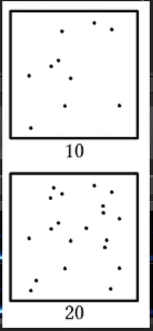
- you can Say that Bottom Box has 10 More Dots than Top Box (Linear Way of Thinking), or you can Say it has Twice as Much as Top Box (Logarithmic Way of Thinking)
- but as Examples Get More Complicate, you will Not be Able to Tell Immediately which Box has More Dots in the Next Example
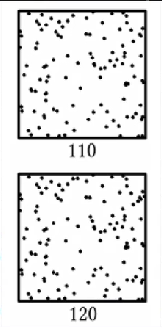
– thus to Make any Big Range more Manageable, we use a Logarithmic Scale
– this is True for Any Kind of Scale, but here Especially Explained in Relation to Music
– e.g. in Measuring Amplitude, as you Multiply the Change in Air Pressure, you only Add Numbers to the Loudness Scale with a Logarithmic Scale
– a Logarithmic Scale is Exponential Because the “x” is in the Exponent, means “y = 2x” (thus the “x” is the Exponent, thus an Exponential Function)
– i.e. in a EQ, the Numbers are Getting Closer as they Go from 1-10, from 10-100, from 100-1000 etc.
– these Blocks are Know as “Decades” Since they have 10 Divisions, i.e. the Distance between All Octaves is the Same
– e.g. the Distance between 100Hz and 200Hz is the Same as the Distance between 200Hz and 400Hz, or the Same as the Distance between 400Hz and 800Hz, or the Same as the Distance between 1000 Hz and 2000Hz or Even between 10000Hz and 20000Hz
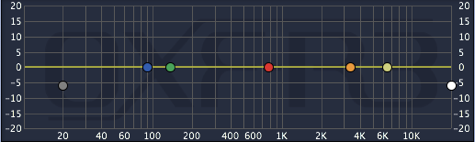
– so a Logarithmic Scale on a EQ Works Well Along the Piano, Since Each Octave has Equal Representation
– Every Next Overtone is Closer to the Previous One on a Piano Due to “Multiplicative Math” (i.e. when Multiplying by 2)
– thats why we Talk about a Logarithmic Scale, we Measure in Ratio (Not in Differences as from -4 to 4)
– Piano uses a “Logarithmic” Scale, meaning the Distance is Calculated in Ratio, Not in Differences (due to Unequal Spaces on Piano)
– 1000 Hz More or Less Middle Gives a Better Log
Exponential Function
– a Logarithmic Scale is Exponential Because the “x” is in the Exponent, means “y = 2x” (thus an Exponential Function)
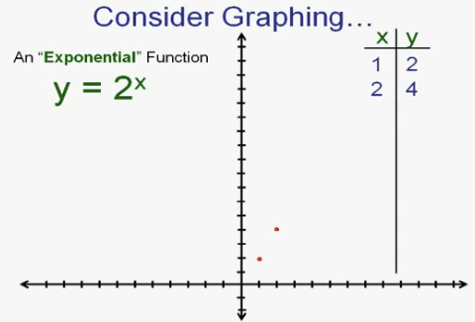
– e.g. “y = 21” means “y will Equal 2 to the 1” which is 2 (2 x 2 = 4, and the Red Dot on the Graph Shows you the Point)
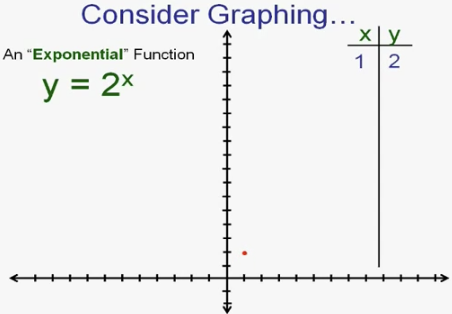
– e.g. “y = 22” means “y will Equal 2 to the 2” which is 4 (and the Red Dot on the Graph Shows you the Point)
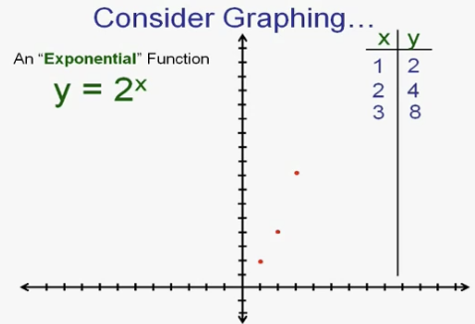
– e.g. “y = 23” means “y will Equal 2 to the 3” which is 8 (2 x 2 x 2 = 8, and the Red Dot on the Graph Shows you the Point)
Simple Example Linear vs Logarithmic
– Say you Want to Draw a Scale from 0 to 1 Million
Linear
– usually we Draw that Linear, means the Space between Numbers Must be Equal
– but if you Want to See the Difference between 5 and 2 Million, this Scale Gives No Information

Logarithmic
– the Other Way is to Draw the Scale in “Grössenordnungen”
– i.e. to Make a Big Range more Manageable, we use a Logarithmic Scale

Advanced Linear vs Logarithmic Example
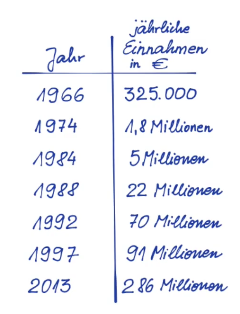
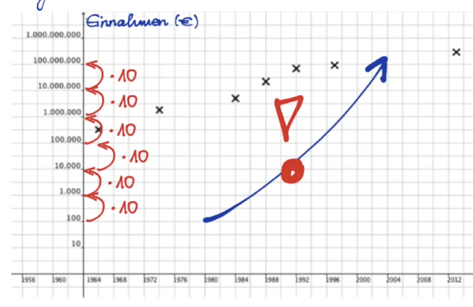
– Say you Want to Illustrate the DFB Income from 1966 to 2013
– so Draw in the Time on the X-Axis and the Income on the Y-Axis
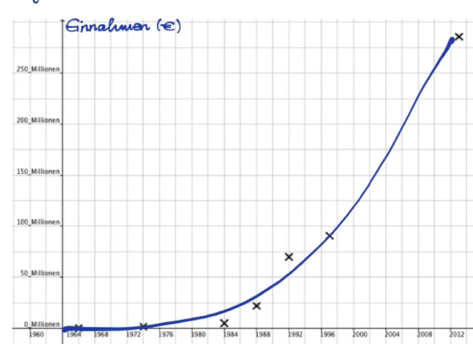
Linear
– you See the Fast Growth of the Income Right Away, but you can Not Read Exact Values of the Early Days
– Because the Income is Getting Bigger by a Specific Value (0 – 50 – 100 – 150 – 200 – 250)
Logarithmic
– in this Scale, you can also See the Small and the Bigger Values
– the Fast Growth is Not as Clearly Readable than in the Linear Scale, but you can Imagine that
– this is Because the Income is Not Getting Bigger by a Specific Value, that is Always 10 Times More than the Previous Value
Leave a Reply