General
– similar Phases will Cancel each other Out, the Less Equal a Phase is the more Natural it Sounds and the more Energy is coming through
– to Fast Correct Phase Issues therefore often a Polarity Switch is available, which Inverts the Selected Wave, whereas a More Advanced Method is to Move Waves in Time so the Phases are Aligned
– e.g. a Drum Set Recorded with 8 Microphones will Surely have Phase Issues, because the same Signal is Recorded several Time but with slight Differences in the Time Domain (i.e. by the Fact that the Position of the Snare Top Mic and the Snare Bottom Mic is different and therefore the Recording Distance is different)
– Phase Issues occur often with Drastic Boosts or Cuts, especially Noticeable in a lot of Low End Energy Material with Hard Transient Attacks
– Phase Issues are more Dramatic on Bell and LP/HP Curves with Steep dB per Octave such as 48dB (as the Bell Filter Affects Transients Before + After the Bell Position and the LP/HP creates a Steep Notch at the Cut Off Frequency)
– a “Phase Response” Meter (PC Vst Analyser) can Help to Visualise the Phase Behaviour when EQ Material
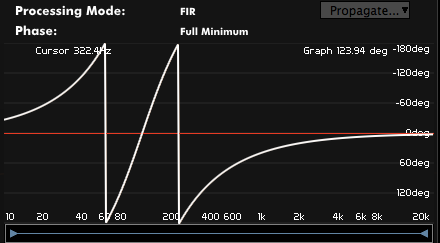
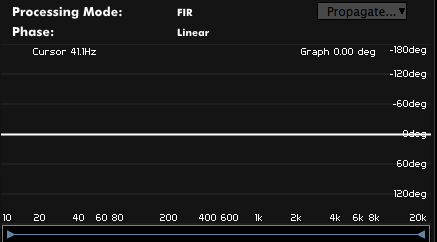
– Equilibrium has an Internal Graph which Visualises the different Curves (here a Visual 48dB HPF Slope Comparison in Minimum Phase and in Linear Phase)
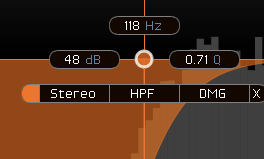
– see the Minimum Phase HPF creates a Steep Notch at the Cut Off Frequency which is a Drastic Change in the Phase Relationship between Correlated Signals
– as you would Expect from a Linear Phase EQ, No Change in the Phase Relationship between Correlated Signals
Minimum Phase
– Minimum Phase is often the Default and Sounds most of the Time better, especially on Low Energy with Hard Transient Attacks
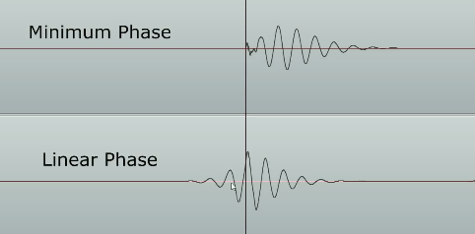
– Minimum Phase causes a “Post-Ringing Effect” which seems to be Less Noticeable than the “Pre-Ringing Effect” of Linear Phase
– i.e. One can look at the “Pre-Ringing Effect” being the “Post-Ringing Effect” Reversed (Linear/Zero = Bi Directional Filtering)
– Minimum Phase is Changing the Phase Relationship between Correlated Signals, which is Not necessarily a Bad Thing as it may “Glue” Sounds together
Linear Phase
– the Linear Phase creates more Predictable Results by avoiding Changing the Phase Relationship between Correlated Signals and is used for that Application
– as the Linear Phase Process Introduces an overall Delay to the Signal, the DAW Plugin Compensation will Compensate for the Latency which means that it Corrects the Transients Place so it Sits before the Actual Sound (see Picture below)
– this causes the known “Pre-Ringing Effect” which Introduces a “Smearing Effect”
– a Linear Phase EQ is a “Bad Thing” on the Kick, but may be the Ticket for a Top / Bottom Snare
Leave a Reply