
General
– works more like our Ears work
– has Psychoacoustic Effect Build-In, means the System is Not based on simple “Metering”
– Shifts the Metering Scale Down, so the “Zero” Point (0dFS) you Concentrate on lies at the Specified Level (-12dB,-14dB, or -20dB)
– The Top of the Scale stays 0dBFS, so reaching that Level still means you get to the “Clipping” Boundary
– the Idea is to Set a Particular Scale while Mixing (or better in Production already), and then Aim roughly for the “0” (as if you would Do with an Analog VU Meter) for both, with “Peak” and “Avg”
– means the Peak as well as the Avg Meter should Sit Near the Zero
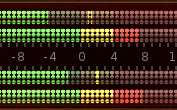
– it is Recommended to Leave enough Headroom for Mix and Master, means you can for Example Mix at K-20 and then Go for the Target Scale K-14 in Mastering (with “20dB” Headroom)
K-12
– The 0-point lies 12 dB below full scale (-12 dBFS)
– dedicated for Broadcast Material
– which results in a Headroom of 12 dB for Peaks
– Material’ RMS values should range around 0, with an Amber Zone up to +4 dB for “Fortissimo” Passages
K-14
– The 0-point lies 14 dB below full scale (-14 dBFS), which results in a Headroom of 14 dB for Peaks
– dedicated for Home Theatre use and typical Pop and Rock Music
– Material’ RMS values should range around 0, with an Amber Zone up to +4 dB for “Fortissimo” Passages
K-20
– The 0-point lies 20 dB below full scale (-20 dBFS), which results in a Headroom of 20 dB for Peaks
– dedicated for Wide Range, High Fidelity Music, Large Theatres and for the Future Production of all kinds of Dynamic Music
– Material’ RMS values should range around 0, with an Amber Zone up to +4 dB for “Fortissimo” Passages
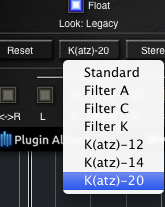
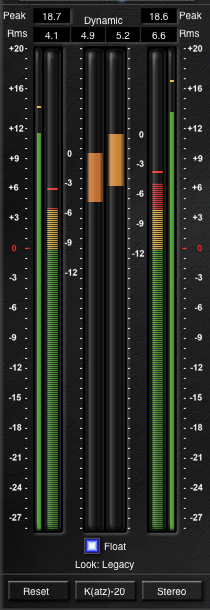
Example K-20 Scale
– Outer 2 Lines = Peak Level (here Max. Peaks 18.6 which in K20 Scale are still under 0dBFS))
– Inner 2 Lines = RMS Level Live (here a Overall / Avg of 4 -5 dB over the K20 Scale therefore Red)
– Centered 2 Lines = Dynamic Range (here a DR of around 5dB)
Leave a Reply