
General
– distinct between a “Theme” which is a Longer more Flowing Melodic Idea, and a “Motif” which is a more Short Rhythmic Idea (such as Beethoven´s 5th)
– so when you Compose a Melody, you can then Build Up on that a Theme or Motif
– 4 Measure per Phrase is the Average, of course this Varies on all Kinds of Music
Preparation
1) Empty Measure Framework
– Use a Empty Sheet with a 8 Empty Measure “Framework”
– all the Things you see on this Framework is called a “Period”
– Musical Sentence = Standard “Period” of a Typical Melody= 8 Measures
– so we have 2 Phrases with each 4 Measure (2 x 4 = 8) Long in this Example and each Measure is called a “Phrase”
– so all these Phrases and Measures combined Make Up the “Period”, in this case a 8 Measure Period of Music (Musical Sentence with 2 Phrases a 4 Measures = 8 Measure Period of Music)
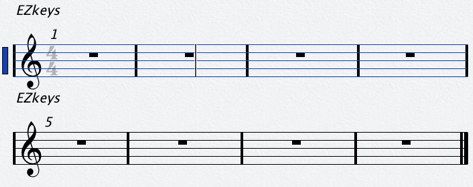
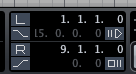
– in the DAW, this 8 Measures Translate to a 8 Bar Cycle
2) Phrase
– again, each Measure is called a “Phrase” and Consists commonly a 4 Bar
– the First Phrase is called “Question” (Antecedent) Phrase and the Second Phrase is called the “Answer” (Consequent) Phrase
– Second Phrase is Anticipating Question from the First Phrase
– often you Repeat Material to Create a Link between the 2 Phrases of a Period
3) Music is all about Tension and Release
– use this Information to Insert a Note with either a High, Moderate Tension or No Tension at all (Tonic)
– that is why every further Scale Degree has a Particular Degree of Tension and a Meaningful Name applied
(I) Tonic = Chord on the 1st Degree
– Most Stable Tone in any Particular Key
– the Tonic is the Key which builds on the Relationship of all the other Notes and Acts as the Point of Release
– so if you Complete your Musical Sentence, Go Back to Tonic (Going Back Home)
– in other Words the Tonic Scale Degree Creates a Feeling of “Stability” and “Resolution”
– but also kind a “Stops” the Motion
(ii) Supertonic = Chord on the 2nd Degree
– won´t give you the “Rest” Quality as the Tonic gives you
– still gives a Need to Forward Motion, but Not as Strong as Dominant, Subdominant and Subtonic
– therefore a Moderate Level of Tension
(iii) Mediant = Chord on the 3rd degree
– 3rd Most Stable Tone in any Particular Key
– won´t give you the “Rest” Quality as the Tonic gives you
– they will still give you a Need to Forward Motion, but Not as Strong as Dominant, Subdominant and Subtonic
– therefore a Moderate Level of Tension
(IV) Subdominant = Chord on the 4th degree
– Forward Motion
– therefore a High Level of Tension that needs to be Resolved to Tonic
(V) Dominant = Chord on the 5th degree
– 2nd Most Stable Tone in any Particular Key
– Forward Motion
– therefore a High Level of Tension that needs to be Resolved to Tonic
(vi) Submediant = Chord on the 6th degree
– won´t give you the “Rest” Quality as the Tonic gives you
– they will still give you a Need to Forward Motion, but Not as Strong as Dominant, Subdominant and Subtonic
– therefore a Moderate Level of Tension
(vii°) Subtonic (Leading Tone) = Chord on the 7th degree
– Forward Motion
– therefore a High Level of Tension that needs to be Resolved to Tonic
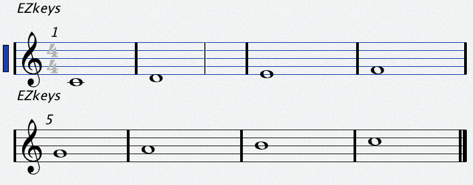
C Major Scale (C3 to C4) with its Diatonic Scale Degrees
4) Tools to Build the Melody
– most Melodies are a Combination of Steps and Leaps with Rhythmic Variations
– often you Repeat Material to Create a Link between the 2 Phrases of a Period
Steps
– any Movement using Half or Whole Steps
– this will Build the Melody in “Conjunct Motion”, which means everything moves very smoothly from One Note to the Next
– if you Make Steps, try to go Somewhere (with a Sense) and go Back (Twinkle Twinkle is a Example of a Step Melody)

Leaps
– any Movement using Intervals Larger than a Whole Step
– this will Build the Melody in “Disjunct Motion”, which means everything Shifts and Bounces around between different Notes
– if you Make Leaps, make a Sense of Direction

Repetition
– use Repeated Material to Create a Link between the 2 Phrases of a Period
– use Repetition to Create a Musical Sentence with Strong Related Phrases
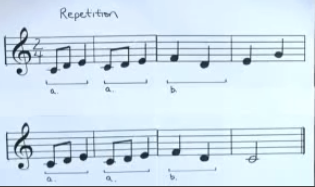
– Picture shows a Combination of Steps and Leaps with simple Repetition on Phrases (only Last of each Phrases Measure is different)
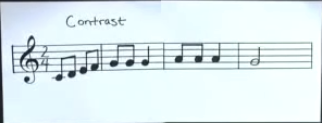
Contrast
– Write 2 Phrases that Contain Contrasting Material to Create Tension and Interest
– that is causing Tension because you are doing something different
– Picture shows a simple Contrast Sentence with Steps in Phrase 1 and as the Contrast Leaps in Phrase 2
Variation
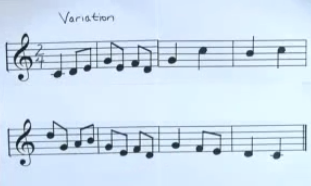
– Half Way between Repetition and Contrast
– the 2 Phrases include some Recognisable Material and some Varied Material
– there are 2 Types of Variation, one that can happen between the two 4 Measure Phrases and one that can happen within the whole 8 Measure Sentence
– Picture shows a Sample with Variation where we Find Repetition & Contrast within a 8 Measure Sentence
Workflow in the Practice
Building the Framework
– again we go Back to 1) with the Empty Sheet and actually Start to Build the Framework
– means simply that we Do it in a specific Order to avoid Mess or a Nonsense Sentence (as you Start to build a House with a Framework (Wireframe) of the Fundament before actually Model Walls)
– as we Define a definitive Key, consider that the Tonic only can be Recognised as the Point of Release if you give it some Time and Work out well the Relation by Tension and Release
– means depending on Signature and Measure Length, a too soon repeating Tonic may Not be recognised as a such because the Listener has yet No Clue of overall Priority of Tension and Release Notes
– you can Overcome this by Inserting Extra 1/8 or more Short Notes, that just come before a Tonic Note
1) Define the Tonic in Order to Make Clear to what Root, Tension and Release are Referred to (here Key of C)
2) Set your Measure per Beats e.g.Time Signature (here 2/4)
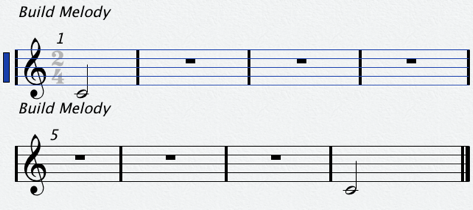
3) Draw a Tonic Quarter Note at the Start 1 1 1 0
4) To Stop the Motion and Resolve, we Set another Quarter Tonic at the End on 8 1 1 0
Connect the Framework between Phrases
– it is always a good Idea to Start with the Link between Phrase 1 and Phrase 2
– means what Type of Notes (Tension or Release) do we use between the Measure 4 and Measure 5
– say if we would Put another Tonic at the 4 and another to 5, we would have Twice a “Closed Phrase”, where each of them would Stand alone
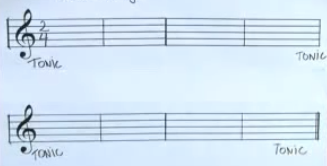
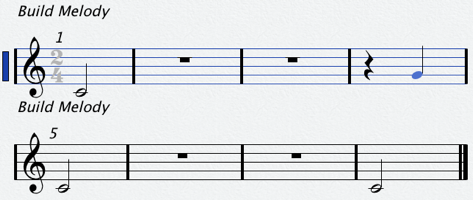
1) To avoid a Closed First Phrase, use the Dominant (G) at the End of the First Phrase (4 2 1 0), so the “High Tension” Dominant Level then resolves to Tonic at the 5 1 1 0 (Start of 2nd Phrase)
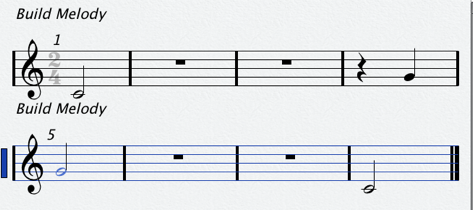
2) To avoid a Closed Second Phrase, use also the Dominant at the Start of the Second Phrase (5 1 1 0)
– which will Continue the Motion Started at the End of First Phrase
– or use any other Scale Degree with High Tension that Moves you to the Tonic at the End of this Sentence (Subdominant or the Subtonic/Leading Tone)
Make further Decisions on the Emotional Response
– where you Place the Scale Degree Notes is of course related to the Emotional Response and where you want to Create Tension, where Release
– in Our Example we go towards High “Tension”
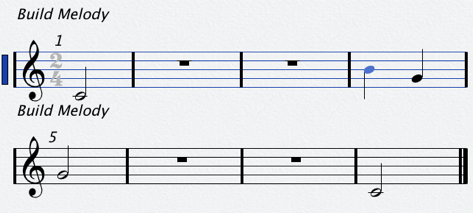
1) Set another High Tension Note such as the Subtonic/Leading Tone (B) in First Phrase at 4 1 1 0 before the Last Note G (4 2 1 0)
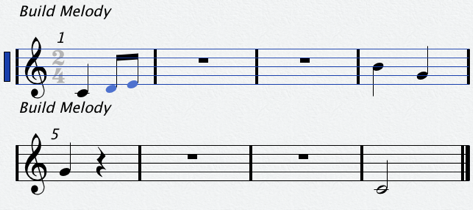
2) Use Step Technique and Create Two Connected 1/8 Notes (D Supertonic and E Mediant both apply Moderate Tension) in Bar 1 after the Initial Tonic Quarter Note
Fill the Last Gaps in Phrase 1
– we are Done with Measure 1, 4 in Phrase 1
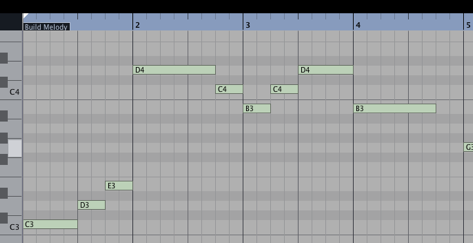
1) we Continue with a Leap in the Form of a Dotted Quarter Note on Measure 2 1 1 0 on a D as Supertonic with a Moderate Tension (which is quiet a Jump)
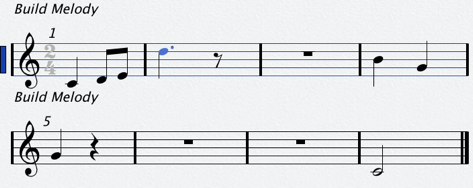
2) Followed by a Half Step Downwards to C (Resolve the Previous Big Jump to Tonic)
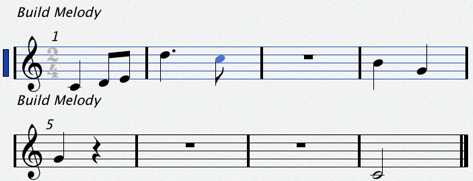
3) We decide to Follow that with some Steps again in Bar 3
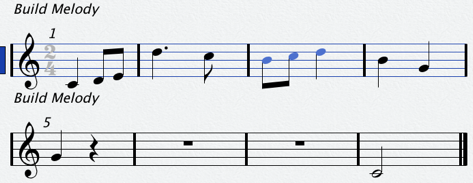
4) And finally we add Interest to the already Fixed Fourth Measure in Phrase 1 by Turning the Leading Note on 4 1 1 0 into a Quarter Dotted Note with an Eight Rest
– means in this Case that we Leave away the Dominant by putting a 1/8 Rest instead (since the Dominant follows anyway in Phrase 2 on 5 1 1 0)
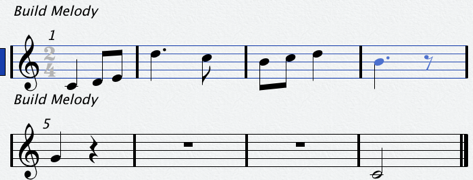
– the Midi Piano Roll Translates Phrase 1 as follows
Fill the Last Gaps in Phrase 2
– we´have Done the the Phrase 1 (Question if you will)
– we only need to Fill in Bar 6 and 7 in the Phrase 2 and Think about the Answer with either the Form of Contrast, Repetition or Variation (both)
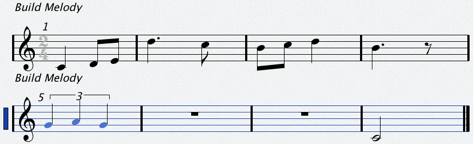
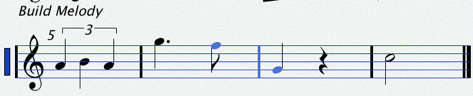
1) As we Experiment, we Extend First the Bar 5 with 2 Triplet Notes, on a Submediant and Dominant
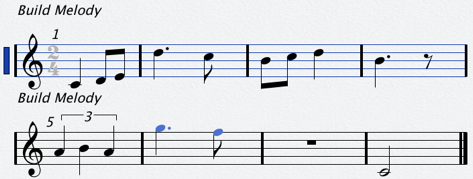
2) As we Introduced suddenly “Contrast” with Triplets (which is quiet a Difference in Rhythm), we decide to Resolve it with Repetition and Mimic the Jump to the 7th from Bar 2 in Phrase 1 to Bar 6 in Phrase 2
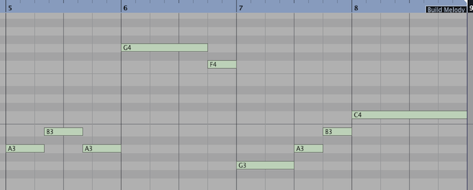
– Jump from an A3 in Bar 5 to a G4 in Bar 6 & then again a Half Step Downwards to F
– this reminds us of something and gives a Feel of Overall Tension and Release
3) We only have Measure 7 to Fill with Notes
– think about the Way Back Home to Tonic at Bar 8 from Last Note F in Bar 6
– since we are more in a High Range in the Staff with previous Notes, we probably Want to Set the Final Tonic Note a Octave Higher than Started

– therefore First set Last Tonic Note a Octave Higher
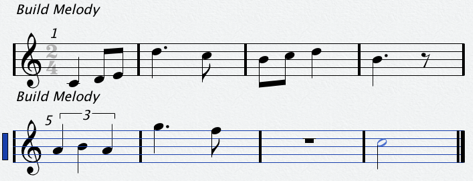
4) Now that the “Bridge” is prepared, we Try another 7th Leap but in the Opposite Direction by Putting a Quarter Note on 6 1 1 0 (Downwards from F to G)
– followed by 2 Eight Notes Stepwise Up to A (7 2 1 0) then B (7 2 3 0) where the whole Sentence finally Resolves to Tonic (from the Supertonic “B”)
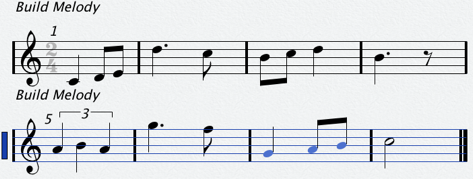
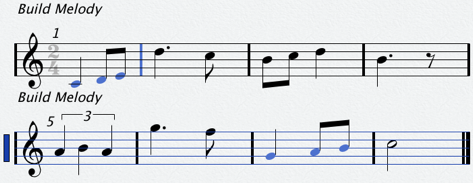
– Notice that also this Bar 7 (in Phrase 2), Mimics the Bar 1 (Phrase 1) Rhythmically and in Motion (which makes a Melody as a Whole more Logical)
– the Midi Piano Roll Translates Phrase 2 as follows
Leave a Reply