General
– Refers to the Use of 2 (or more) Keys at the same Time
– can also be Characterised by the Mutual Co-Existence of 2 Tonal Centres
– makes also use of “Hybrid Scales”, where you Quasi Mix or Alter Scales that Best Sound to your Ears and Serve as a Bi-Tonal Part
– can be used to “Irritate” the Listener, Draw Attention but also for Smooth Tonal Centre Movements
– for Example Play with the Left Hand a C Chord and perform with the Right Hand on D
– the further you move Away with the Right Hand from a Root Scale, the more Dissonant it will Become
– basically means in a C Major Scale, B would be the most Dissonant Bi-Tonal Major Scale to Play against C (Circle of 5th shows that these Scales Share only 2 Notes)
– but without Regarding if a Note is in a Scale or Not (as Stravinsky Noted & used in Petrushka), the Augmented 4th Major Scale above any other Major Scale is the Furthest away
– you can basically Notate that Technique with 2/1, 3/1, b5/1, b6/1 and 7/1 where 1 is the Root Chord and the First Number the Scale Step
Examples
C Major with any other Major Scale
Left Hand
– based on C Major
– switches between C, D, E and C, D, F
– optionally with a G as Bass as Note Played always between the C, D, E and C, D, F
Right Hand
– performs Melody in a E Major (or any other Major Scale)
C/Ab in a Bi_Tonal Example
– a C/Ab Symbol can Denote either a Triad over a Bass Note or a Triad over another Triad
– so in Bi-Tonality a Musician can use Notes from the C or Ab Major Scale,
– or a Combination of the 2
– or even a Scale that Approximates the Chord Sound (as F Ascending Melodic Minor in C/Ab)
Assign Scales to Particular Ranges
– usually Octaves
– for Example from C3 to B3 Play C, from C4 to B4 play Ab etc.
Petrushka Chord
– the 2 Chords that are the Furthest from Each Other are Any Major Chord and the Major Chord an Augmented 4th Above it
– from this Came the Chord C Major on the Left Hand and the F# Major in the Right Hand (which is Known as the Petrushka Chord)
Em and Gm
– Pitch G can be Exploited as a Pivot Point Between the 2 Keys
– also A or C and Sometimes D are Possible Points of Convergence
– Once you Tried Em and Gm, Try “Em and Ab”, or “E and Gm”, or “G and Ebm”
Awkward Sound
– are Keys a m2 Apart
– e.g. Try to Stay in C Major in Lower Registers and Having a Melody in B Major (Key m2 Below) or C# Major (Key m2 Above)
– you can also Try Both Minors, or Mix them Up
Practice
1) Play a Simple Traditional / Tonal Melody
2) Play so Every Melody Note is Accompanied by a Major Chord, with Current Melody Note as the Key for the Major Chord
Stacked Major 3rds
– Chords Stacked at the Interval of Major 3rds have a “Moving” Relation between Consonance and Dissonance
Giant Steps
– has just 3 Basic Tonal Centre B-G-Eb, if you Stack any 2 of those together you Hear the Effect (for Example B-Eb-F# Stacked with G-B-D)
– Each Chord has a Common Tone but Introduces two Half-Step Clashes (F#+G and D+Eb)
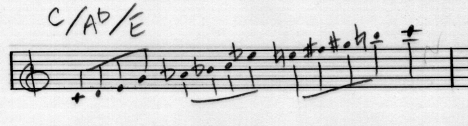
C/Ab/E
– is another Wonderful Example of a Stacked Major3rd
– has a Strong Symmetry and Leaves you with a Lot of Possibilities for Lines / Phrases
Stacked Minor 3rds
Gm/Em
– is a Example where both Keys Share a lot of same Pitches but each had something that would be Dissonant with Portions of the other Scale
– then you can use the Pitch “G” as the Pivot between the 2 Keys
– but also A, C and sometimes D are possible as Points of Convergence
Stacked Minor / Major 3rds
Em/Ab
G/Ebm
Leave a Reply