General
– a very Common Way is to use “Borrowed Chords” which are Chords taken from the Parallel Key (Parallel Key are Keys that Share the same Root i.e. C Major/C Minor Share both Root “C”)
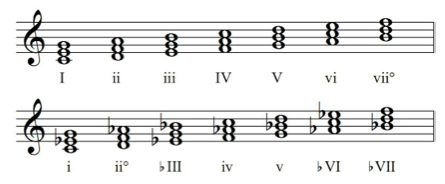
– see all the possible Parallel Chords of C which Share the same Root C and/or have 1 or 2 Keys in Common
– Note that Roman Numerals under the Chords in the 2nd Line are how the Chords are Named when they are used in the key of C major (Not C Minor), therefore the 3 Chord for Example is Called “Flat III” because its Root has been Flatted
– in the Key of C Minor this Chord would simply be Called “III”
Examples
– the Diagram shows also that Chords Directly Above or Below each other can easily be Substituted for one another (Borrowed)
– Borrowed Chords that Share the same Roman Numeral Name are able to Share the same Function
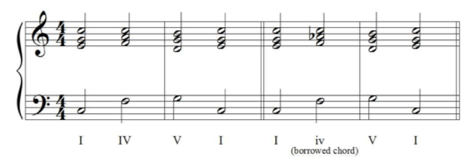
– for Example a iv Chord from C Minor could Substitute for a “IV” Chord in C Major and it would Continue to Function as “IV” (PD)
Example Borrowed Chords in Key of C Major (First without then with)
– it is more Common to Borrow Parallel Minor Chords from within a Major Song, than Borrow Parallel Major Chords in a Minor Song because of the 3 different Minor Versions (Natural, Melodic and Harmonic)
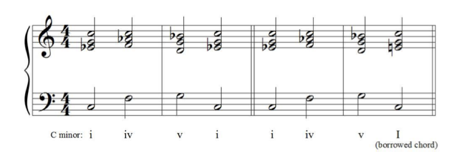
– for Example in Melodic Minor (C,D,Eb,F,G,A,B) we can Form all of the Chords found in C Major with the Exception of the Tonic Chord (C-E-G)
Example Borrowed Chords in Key of C Minor that Borrows the “I” Chord from C Major (First without then with)
Leave a Reply