
General
- On Vocals, Never Add Too Much High End and Cut Too Much Low End (will Make Any Mic and therefore Vocal Sound Cheap)
- for Vocal Chain, Consider Compression (6 to 10dB GR fror Natural Compression) ->> Tone / EQ ->> Reverb / Delay ->> Saturation
- for Big Vocal Reverbs / Delays Use Ducking, i.e. Whenever Vocals are Playing the Reverb / Delay Gets Ducked
- for Warmer Vocals Start with:
1) EQ by Adding Low End
2) Use Compression, Opto + FET = Natural, VCA + FET = More Aggressive, Tube + FET = Warmth
3) Use Saturation Especially Tape for Warmth and Round Up the Highs
Fix Buried Vocals
- Compression on Vocals
- EQ and Tone of Vocals
- Fix the Competing Elements by Turning Down Their Level / Unmask / Play in Different Octave / Panning Competing Elements
Final Vocal Level
- To Set the Vocal Level Simply Turn Down the Monitor / HP so you can Barely Hear the Elements, then Adjust the Vocal Level so you Hear the Words / Lyrics, if you Go Back to a Normal Monitor / HP 90% of the Time the Vocals will Sit Perfectly with this Trick (Else Just Go Back and Forth to Adjust)
- if you Constantly Raise and Lower the Vocal Level and the Vocal Still Does Not has No Space there is 99% Another Element (Synth etc.) that Occupies the Volume, to Fix Simply Mute Other Elements to Find the Culprit and then Lower the Volume of the the Culprit and Adjust the EQ Balance
- if a Vocal is Too Dark and the Track Too Bright the Mix will Sound Disconnected (or Viceversa)
- to Fix Adjust EQ of Both so Neither is Too Dark or Bright and Try a Glue Compressor on the Sum (1-2 GR),
- also to Match Vocals Against Instrumental be Sure to:
1) Have Natural Compression on Vocals
2) Setup the Tone of the Vocals (Should Match the Tone of the Track)
3) Use Space / Reverb on Vocals that Match the Space of the Overall Track
Track Vocals Perfectly
- to Track Vocals Perfectly
1) Do Never Clip the Pre Amp
– i.e. Get as Loud as Possible Without Clipping
2) Use the Most Dry / Dead Sounding Room you have Access to
3) Always Use a Pop Filter to Avoid Pops
4) Play with the Proximity Effect
- i.e. Closer you Get to a Cardiac Pattern Mic you Get Additional Low End Bump which can Sound Warm and Full
5) If a Word or Passage is Not Right then Record this Part Again but Don’t Rely Too Much on Fixing it Afterwards,
6) Also Lean In a Little (Less Distance to Mic) on Soft Notes and Lean Out a Little (More Distance to Mic) on Loud Notes
Vocal EQ Mistakes
1) Big Vocal EQ Mistake is the Guess Approach by Just Opening a EQ and Sweep Around
- Instead be Intentional and Address the 4 Characteristics for Any Vocal Tone, that is Low = Body / Warmth (100hZ to 500Hz) , Mid = Presence (1kHz to 5kHz), High = Brightness (5kHz to 10kHz), Super High = Airiness (Above 10kHz)
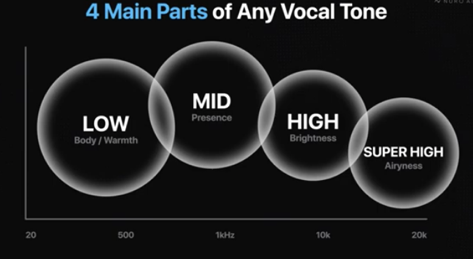
– i.e. Insert Just 1 Band (e.g. Body) and Sculpt the 100hZ to 500Hz Range, then a 2nd Band to Sculpt 1kHz to 5kHz etc., but Notice that you Only Need to Add Bands if there is Something to Enhance, also Use an EQ that Supports the Given Vocal and Song (e.g. Using Either a Clean EQ Tone or a Vintage EQ Tone)
2) EQ the Vocals in Solo Mode is Another Mistake, Leads to Adjustments that Do Not Make Sense in the Mix
– to Make Informed Decisions, First Ask “How Does the Vocal Sounding Comparison to the Rest of the Mix”?
– then Ask “How Do i Need to Change the Overall Tone to Make the Vocal Fit with the Rest of the Mix”? (e.g. Needs to be Brighter and Less Muddy, or Needs to be Warmer and More Full)
– then Use those Answers and Start to Address the 4 Vocal Characteristics Discussed Above (Low = Body / Warmth (100hZ to 500Hz) , Mid = Presence (1kHz to 5kHz), High = Brightness (5kHz to 10kHz), Super High = Airiness (Above 10kHz)
3) Another Mistake is “Fix It” Approach by Immediately Fix a Certain Resonance or Problem Without Listening to the Overall Tone which can Lead to Hollow Spots in the Vocal Tone
– the Answer is to Shape and Not Fix, Again by First Balance the Overall Vocal and then Eventually Fix Resonances or Problems
Leave a Reply