General
– “Tintinnabuli” (Lat. for Bell) is a Technique, where “Custom Resonances” are Applied to a Single Note
– the Idea is Based on Different Sounding Timbres of Bells
– These Resonances Do Not Derive from the Original Sound, but are Based on a Previous Defined Triad Picture
– the “Tintinabulli” Composition Itself is a Combination of Several “M-Voices” with Accompanied “T-Voices”, where the Results are Often “Homophonic” Textures (Homophonic Texture = a Single Dominating Melody that is Accompanied by Chords)
– i.e. his Pieces / Sections Hold Two Voices where One is Made Out of a Single Triad that Marks the Centre of Interest and One is a Melodic Line (or Lines) which Counterpoint the Triad
– The Continuity of these 2 Simple Elements is Achieved by Leading the Melodic Line Step by Step
– the Triad Tones Rotate, Depending on where the Melodic Line is (Never Unison or Octave)
– means the Individual Single Notes of a Triad Accompanies the Melody so it´s Always Another Single Note of that Triad that follows the Melody Constantly (Triad Inverts Constantly to Match the Melody Position)
– He Uses the Name “T-Voices” = Triad (Tintinnabuli) and “M-Voices” = Melody
– M-Voices follow More or Less Strong a Minor / Major Scale and the T-Voices then Accompany the M-Voices, so the Melody is the “Constraint” and Saves the Composer from Loosing Control Over the Work
– Intervals and Position of M-Voices can Vary, for Example Larger Intervals Below T-Voices or Smaller Intervals Above T-Voices
– Mostly Both, M & T Voices are Taken from One Key, but in “Fratres”, M-Voices are Harmonic D Minor and T Voices are in A Minor (which Leads the Piece to Play in a Constant Motion between C & C#)
– Basic Rules are also in a Constant Change by Adding Colour with Timbres, for Example in “Profundis” there are Extreme Deep M-Voices in Contrast to Extreme High T-Voices
– His “Collage” Technique includes Minimalism, Spiritualism, Romanticism but also Sacred Music
– It is About Make Sound Simultaneously a Church Mode Based Melody and a Constant Broken Triad Chord
– Signatures are Chosen in Repetition, means one Phrase in 7/4, then a Phrase in 9/4, then in 11/4 and Repeat All again
– Usage of Widely Spaced Pitches, Open Intervals, Great Calmness, Simplicity, Tonality and Long Pedal Tones
– He Later Added More Dissonance to Enrich the Harmony while the Harmonic “Tintinnabuli” Basis has Remained Unchanged
– Also he Later Revealed that the Centre of Interest is More a Triad, Rather than Tonality
– He searched for a Way of “Sustaining” a Triad Sound while Making it Possible to Move through its Powerful Traditional Gravity
– Also the Need of “Constraints” to Not “Fall” into Nothing (Without Discipline, Freedom is Dangerous)
– Pärt Does Not Use “Chromaticism” (Keys out of a Scale) or “Modulation” (Key-Changes) and the Harmony Does NOT Include Functions of Traditional Concepts (but he Mixes Modes of Course)
“I have discovered that it is enough when a single note is beautifully played. This one note, or a silent beat, or a moment of silence, comforts me. I work with very few elements – with one voice, two voices. I build with primitive materials – with the triad, with one specific tonality. The three notes of a triad are like bells and that is why I call it tintinnabulation.”
Pärt Statements
– The Melodic Lineal Always Signifies the Subjective World, the Daily Egoistic Life of “Sin and Suffering”
– i.e. Most Compositions are Based on 2 Distinctive Counter Melodic Lines Where 1 = Complex (Sin) and the Other = Simple (Suffering), Complex = More Rhythmic Variations and More Notes While the Answer = Simple in Rhythm with Less Notes
– The Tintinnabuli Voice, Meanwhile, is the Objective Realm of Forgiveness
– The Melodic Line may Appear to Wander, but it is Always Held Firmly by the Tintinnabuli Line
– This can be Likened to the Eternal Dualism of the Body and Spirit, Earth and Heaven
– The Two Lines are in Reality One, a “Twofold Single Entity”
Example Arvo Pärt Composition
– The Key is to Compose a “Two-Sided Texture”, where One Texture Side Holds the Melodic Line & the Other Texture Side Holds the “Tintinnabuli” Line which Presents the Pitches of the Tonic Triad
– Melodic Line (M-Voice) can be Composed in Accordance to the Textural Pattern or as Completely Abstract Musical Procedure (but seldom freely)
– However, the Melodic Line is Composed so that the Tintinnabuli Voice Fits in a Way that is Never Arbitrary, but is Guided by One Principle which can be applied on Various Ways
– Tintinnabuli Voice is Always One of the Pitches of the Tonic Triad that is “Inter-Wined” with the Melodic Line in Constant and Specific Manner (Never Unison or Octave)
– Once the Relationship between Melodic Line & Tintinnabuli Voice is Set, it Does Not Change and it is Applied Constantly
A) Apply a Pärt Melodic Line
1) Melody Line is Composed with more Freedom than Tintinnabuli Voice
– the Notes may Come from the Simple Scale Patterns that Move Step by Step, to Any Small Variation of the Scale
2) However, the Melodic Line can be categorised in Four Modes which are Simple Ascending or Descending Scales that have Directions of Arriving to the Central Pitch
a Ascending from the Tonic
b Descending from the Tonic
c Descending to the Tonic
d Ascending to the Tonic

3) To preserve Natural Balance when Composing one to another, the Relation between Different Modes is Immensely Important
4) Therefore Modes 1 & 2 Impose as a Pair, the same goes for Modes 1 & 3, 3 & 4 or 2 or 4, where the Central Pitch is usually the Tonic of the Triad and Melodic Scales are supposed to Ascend or Descend to this Pitch
– Mostly it is the Tonic, but can also be also be One of the Remaining Pitches of the Tintinnabuli Triad
– So to Create the Melody Mostly Mode 1&2 or Mode 1&3 are Combined (Mode 1&4 or 2&3 rarely)
5) By Varying the Melodic Line to these very Simple but Strict Compositional System, we can then see the Immense Creative Possibilities
B) Apply a Tintinnabuli Voice
1) Picture shows a Example of a “Alternating” Tintinnabuli Voice / Triad Single Note Pitch, that Flows around the Melodic Line,
First above and then below the Melodic Line = Alternating (see Empty Circles)

2) Tintinnabuli Voice can be Placed in One of 2 Positions Relative to the Melodic Line
– It may remain “Above” or “Below” the Melodic Line respective also Combined like “Alternate Above and Below” as in Our Example (Never Unison or Octave)
3) So the “Positioning” of a Single Tintinnabuli Pitch is either:
a the Pitch in the Triad which is Closest to the Melodic Line (1st Position)
b the Pitch which is Next, But One in the Triad (2nd Position)
4) Now it becomes evident that there are 3 Possible Ways of applying the Tintinnabuli Voice to the Melody Line
a “Alternating” = Above & Below the Melodic Line
b “Superior” = Above the Melodic Line
c “Inferior” = Below the Melodic Line
– where Pärt uses Superior & Inferior very often
5) Following Picture shows the Application of some of these Positions of the “Tintinnabuli Voice” to a simple Ascending A Minor Scale Melody Line
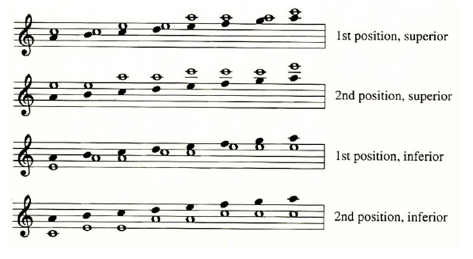
6) In Practice 1st Position is often used as “Alternating” and the 2nd Position is used as “Superior” or “Inferior”
7) The whole Concept is based on “Symmetry”, therefore Leaves throughout an Option of Alternating any Sequence from Above or Below
8) Once the Relationship between Melodic Line & Tintinnabuli Voice is Set, it does Not change and it is applied Constantly
Tintinnabuli Example “Für Alina”
– “Für Alina” Marks the Basics of Tintinnabuli
– Based on Algorithmic Patterns with the Number of Notes per Phrase Cycling around a Series from 1 to 8 Notes and Back
1) Two Lines “Constrained” One on the Other
2) One Line is Moving freely but Gradually in Small Steps
3) Second Line Fills the Pitches of the „Tonic‟ Triad
4) There is No Chromaticism or the Change of Tempo or Tonality
5) Often in a Descending Aeolian Mode
6) Tintinnabuli Voice is Always One of the Pitches of the Tonic Triad (Never Unison or Octave)
Leave a Reply