
General
– No Note Dominates in 12 Tone Music or is More Important than the Other (that is why it is called Atonal or Pan-Tonal Music)
– Avoid to Use Scales
– Rely on a Tonal Centre
– He did that by Using All the Notes with Equal Frequency
– Tone Row is Sort of a Foundation of a Series of Notes
– Use Each Piano Note in a Tone Row Once
– Think in Modular Octaves Using Each of the 12 Notes Once, but we Let Open from which Octave for Example the “A” might come from
– Then Looking from where the C might come from in a Serial Way
- Melody Approaches a High Point or Climax through a Series of Intermediate Lesser Points, Interrupted by Recessions
– Upward Movements are Balanced by Downward Movements
– a Good Melody Generally Remains within a Reasonable Compass, Not Straying Too Far from a Central Range
– A Composer Does Not, of Course, Add Bit by Bit as a Child Does in Building with Wooden Blocks, he Conceives an Entire Composition as a Spontaneous Vision
– Like Michelangelo who Chiseled his Moses Out of the Marble without Sketches, Complete in Every Detail, thus Forming his Material
Teaching of Musical Composition
1) Harmony
– the Study of Simultaneous Sounds (Chords) and of How the May be Joined with Respect to their Architectonic, Melodic and Rhythmic Values
– also their Significance and Weight Relative to One Another
2) Counterpoint
– the Study of the Art of Voice Leading with Respect to Motivic Combination (and Ultimately the Study of the Contrapuntal Forms)
3) Form
– Disposition (of the Material) for the Construction and Development of Musical Ideas
Atonal or Pan-Tonal Example
– with 5 Notes (instead 12):
1) Mathematically we think of “Modulo 5”
– so Divide 5 by 5 will let you Work with 0, 1, 2, 3, 4)
2) Randomly Order these 5 Notes
– for Example to 2, 3, 1, 0, 4
3) Now Transpose and Add 3 to Each Note Starting from 0
– i.e. “0” is Now “2” in our First Tone Row
3 + 2 = 5 and since we work with Modulo 5 it will be “Zero”
3 + 3 = 6 which gives us a “One” in Modulo 5
3 + 1 = 4 which gives us a “Four” in Modulo 5
3 + 0 = 3 which gives us a “Three” in Modulo 5
3 + 4 = 7 will be “Two” in Modulo 5
4) Now Rate Down the Transposition of this
– Either Original, Inverted (Transposed), Retrograde or Retrograde Inverted (Transposed)
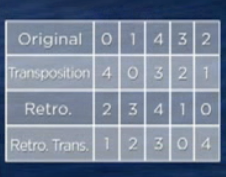
5) Finally, Translate the Numbers into Notes
– e.g. Setting “A” as 0, “B” as 1, “C” as 2, “D” as 3 and “E” as 4
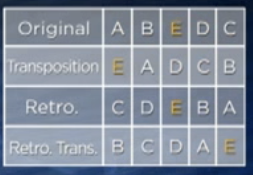
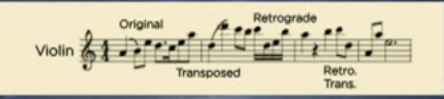
6) Now we have to Choose Things as the Note Lengths, which Octave to Pick these Notes from or Rests
7) Now the Composition uses each Note exactly on Time in each of the 4 Rows
Leave a Reply