General
- Simple Melodic Lines and Adds Notes, often 1 at the Time and Later Subtracts 1 at the Time (Glass Influence)
- Overlap Patterns in Canons, Sty in 1 Harmony Region for a Long Period Before Suddenly Switching Over to Another (Reich Influence)
- i.e. “Gates” which Derives from Audio Gate that is a Sudden Switch from Negative to Positive, thus Nothing else than a Abrupt Modulation
- i.e. Repetitive Patterns Slowly Change Over a Regular Pulse
- the Harmony Region can be Organised Around the Cycle of Fifths
- e.g. he Used Lydian vs Phrygian (Light vs Dark)
Oscillating Triads
– He Later Started to Stretch Out a Simply Triad (Oscillating Triad), i.e. Usually by Oscillating the Notes within It to Give it Sense of Activity or Instability
– e.g. in Shaker Loops there is D Major Triad, then a E is Added, then the F# Shifts Back in 2 to the G# (Alternating between F# and G#), Allowing the Initial Signal D Major Chord to Stretch Out in Time
Common Tones Modulation
– Modulation Through the Use of Common Tones (also Called Enharmonic Modulation)
– i.e. Modulating between 2 Harmonic Areas
– e.g. Eb Major, then Inverting, then Move to F, then to E Minor 1st Inversion while G Note Holds Continuity between the 2 Chords
Extended Chords
- He Later Extended the Triad Chords, e.g. Eb Minor with a F Minor Above it (in Jazz Called Ebm13)
– in General, Jazz Caught his Interest Regarding Harmony and Melody
Shaker Loops
- are Basically Not Much More than 2 o 3 Melody Phrases Repeated Over a Long Series of Chord Changes
- but Bass Undermines Chord Stability by Alternating between 2 or Unstable Notes
- Winds Provide a Static Minimalist Texture Chord
- and then in the Melody, Added Notes Change the Color and Introduce Kind a Parallax Movement Together with the Long Series of Chord Changes
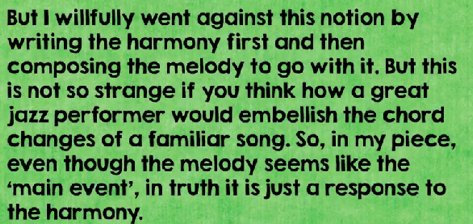
Chromatic Approach
- Later he Started with Chromatic Approach (Influenced by the Book “Thesaurus of Scales and Melodic Patterns by Nicolas Slonimsky”
- Even Coltrane Stole Giant Steps from Slonimsky and Soon Jazz Guys Started to Improvise in 12 Tone
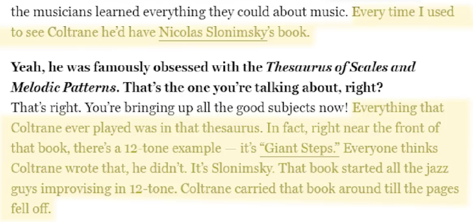
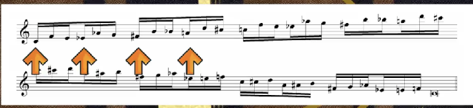
– First Part of the Book Deals with Patterns that can be Repeated at Regular Intervals Over Several Octaves
- e.g. a Pattern Going up Every Minor 3rd, while 2nd Phrase is Retrograde
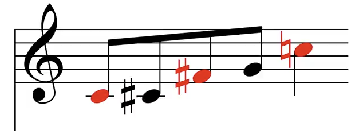
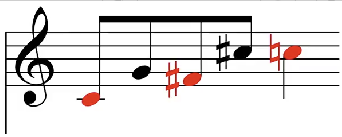
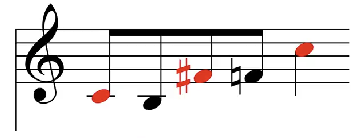
– Slonimsky Called Gave it Fancy Names Such as Interpolation, Ultrapolation and Infrapolation, means Adding a Notes Sits In-Between the 2 Others or Adding a Notes Sits Outside the 2 Others
- >> e.g. Basic = C – F# – C
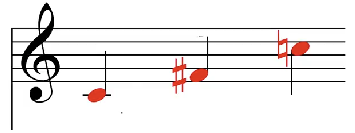
- >> Interpolation is Adding a Semitone After Each Note = C – C# – F# – G – C
- >> Ultrapolation the Semitone will Rise Above the 2nd Note Before Falling Back Down = C – G# – F# – E# – C
- >> Infrapolation Falls a Semitone Below the 1st Note Before Rising to the 2nd Note = C – B – F# – F – C
- of Course you can Make any Number of Alternatives by Combining a Few of these, or Changing Intervals, or having More than 2 Original Notes
Adams About Stravinsky
Leave a Reply