General
– a Way of Combining many Individual Timbres into Large-Scale-Textures which are Shaped in Time by Changes in their Global Qualities (and Not by the Interplay of Individual Lines)
– Ligeti’s “Cloud-Clusters” are Always in Movement, Blending into each Other in Different Colours, Begins with a “Nebulous” Note and Ends in “Nothing”
– Ligeti’s Clouds are of Higher Quality Because they Evolve Constant but Seamless, i.e. Clouds are Not Just Calculated “Events” with Limited Extend (Always an Evolutionary Aspect and NOT Static Clouds)
– the Things that Differs to Other Composers is the “Micro-Structure” that Sit Inside the Cloud and Constantly Evolves Over Time
– i.e. Pitch, Timbre and / or Voicing of Every Note Changes Constantly but with Precious Control (Not with a Bold Pen)
– The Texture Often Results from a “…Simultaneity of Different Lines, Rhythms and Timbres (a Timbre without a Clearly Surface)
– he also Found a Rhythmic Sonority Along his Semitone which was Typical for him
– Ligeti used the Time Signature 4:3 in the 3rd Movement of Piano Concerto with Repetitions on Beat 28 (he often used 3:4 Patterns towards African 12 Beat Groups)
- Ligeti Later also Experienced with Other Scales than Equal Temp, such as the Partch Micro Scale, or Passacaglia Ungherese (1978 in Mean Tone), or Single Instruments can Play Only Pure Intervals or in Sonate for Viola Solo (1994 in Pure Scale)
– in Choral Pieces, the Way he Handles Part Entrances and Exits is by “Simply” Fading Parts In & Out as if Manipulated by a Mixing Desk (which is an Electronic Music Studio Application)
– or Gradual Shifts of Tone Color is Yet Another Application which Makes use of Band Pass/ Reject Filters
– or Move (Offset) the Individual Voices on Top of Each Other Rhythmically Between 1/8, Triplets, 1/16, Quints and 1/16 Triplets (Like a Cloud that Moves Faster than Another Cloud)
- Tremolo or Trills are Very Effective Techniques for Movement in a Micro-Structure
- Ligeti was Very Inspired by Boulez 3rd Piano Sonata and Luigi Nono “Il Canto Sospeso” (Suspended)
- Uses Complex Chords Such as min9 (Instead Perfect Oct or Perfect 5th)
- Uses Mostly m2 (Minor 2nd) or M2 (Major 2nd) to Blur Harmonies
- also Uses m6
- Lontano Consists of 3 Canons while the 3rd Canon is Divided at the Middle
- Uses High vs Low Register
- Soft Dynamics for Moving Textures (Background) vs Strong Dynamics for Front Happenings
- Plays with Timbre, Bowing Style, Tuning
- er verzichtete auf wahrnehmbare Rhythmik und Harmonik und stellte die ganze Konstruktion in den Dienst der Klangfarbe und differenzierte diese mittels struktureller Satztechniken auf nie gehörte Weise
- Ligeti arbeitete mit auskomponierten, endlos verästelten Flächen und nannte diese Technik „Mikropolyphonie“, d.h. Häufig umspinnen sich die Stimmen in Proportionskanons – also Kanons in unterschiedlichen Tempi gleichzeitig -, so dass sich im Ganzen eine chromatisch oder manchmal auch eine diatonisch geschlossene Fläche ergibt
Ligeti Statements
– „Ich habe keine Kunsttheorie. Deswegen sind viele Leute enttäuscht. Ich habe keine message, die ich verkünde. Man kann mich nicht festnageln auf eine einheitliche, verbal ausdrückbare kompositorische Theorie. Sondern ich versuche immer neue Dinge auszuprobieren. Deswegen habe ich es einmal so dargestellt: Ich bin wie ein Blinder im Labyrinth, der sich herumtastet und immer neue Eingänge findet und in Zimmer kommt, von denen er gar nicht wußte, daß sie existieren. Und dann tut er etwas. Und er weiß gar nicht, was der nächste Schritt sein wird.“– Ligeti, 1993
-„Die Frage war, entweder zurückzukehren zu helleren, diatonischen Konstruktionen oder vorwärts in Richtung einer vollkommenen Verwischung. Ich wählte den zweiten Weg. Die verschiedensten rhythmischen Strukturen werden so überlagert, dass sie zusammen eine homogene Klangmasse bilden.“ „György Ligeti in conversation with Péter Várnai“, 1983, S. 39
– „Die Gesamtform des Stückes ist wie ein einziger, weit gespannter Bogen zu realisieren, die einzelnen Abschnitte schmelzen zusammen und werden dem großen Bogen untergeordnet (Atmosphere)“
– „alle Stimmen sollen zu einer zarten Klangwolke verschmelzen (Atmosphere)“
– “a continuous web of finely-woven lines or repeated patterns in a constant, interactive process of transformation of one or more parameters, such as pitch, rhythm, texture, dynamics, or timbre (net structure)”
- there are Walls, 1 is the Past and the Other is Avantgarde, i Want to Break Out of from Both
Micro-Polyphony
– Many Different Lines Travel at Different Tempos and Rhythm
– Micro-Polyphony usually Involves Thick, Densely Packed Textures created from Chromatic Clusters which Remove Melody, Harmony and Rhythmic as Distinct Features (a Timbre without a Clearly Surface)
– Ligeti was One of the First who Replaced at that Time the so Often Used Dissonant “Big Interval Chords” and Turned these into much More Audible Reduced Interval Polyphony (Micro-Polyphony)
– the “Micro-Polyphony”, a Technique that Emphasise Sustained Sounds of Extremely Fast Repetitions Phrases that usually End in a “Sound Mass”, Avoid a Sense of Pulse & Stagger Instrumental Entrances
– The Texture often results from a “…simultaneity of different Lines, Rhythms, and Timbres”
– Constant Re-Articulation of One or More Mostly Sustained Notes Guided by Timbral Development and Pitch Expansion
– he Creates so Many Multiple Lines Playing Simultaneously that the Overall Sound is Misconstrued
– the Musical Parts Get so Dense and Interwined that the Clarity of the Individual Lines Do Not Exist and Resolve in a Cloud Like Texture Result
– he Says Himself, “Such a Dense Tissue that the Individual Parts Become Inaudible and Only the Resulting Intermingling Harmonies are Effective as a Form”
– he Says Himself, “the Complex Polyphony of the Individual Parts are Embodied in a Harmonic-Musical Flow, in which the Harmonies Do No Change Suddenly, but Merge into One Another”
– he Says Himself, “One Clearly Discernible Interval Combination is Gradually Blurred and from this Cloudiness, it is Possible to Discern a New Interval Combination Taking Shape”
– Micro-Polyphony Suspends Pulse and Harmony by Using “Clusters of Adjacent Sounds” to Achieve Slow and Seamless Changes (Harmonically and Rhythmically the Same Principle)
– a High Volatile and Active Micro-Structure, a Lot is Going On on Note-to-Note Base and Lots of Notes All the Time
Ligeti Techniques
– he Used a Variety of Compositional Techniques, but “Micro-Polyphony” (Study Ligeti Etudes) and “Meccanico” (Study 100 Metronomes) Mostly between 1960 and 1970 Create the Ligeti Typical “Net-Structured Work” (Spiderweb)”
– Such Techniques (or “Applications”) also Derive from his Electronic Music Studio Background (Back at WDR), in Which Case he Adapts these Techniques to Orchestral Writing
Contrast – How To
– Ligeti also Used the Principles of Classical Music to Create Contrast (in Any Art it is About Contrast)
– he Said All Students Should First Learn Bach Rules and Proper Counterpoint Before Even Think About Making Music
Classical Way
1) Establish a Key Signature with Some Common Chord Progressions
2) Moving to Some Tension Away from the Key
3) Resolving by Coming Back to Key
Ligeti Way
1) Same Idea but the Process is “Muddier and Blurrier”
2) Resolving Things by Clearing the Up the Mud, i.e. Get Rid of Note by Note and Slowly to Resolve to Key (or Not to Key)
Meccanico – How To
Ex 100 Metronomes, Continuum, Coulee, 5th Movement of 2nd String Quartet
– Later Works Combine the “Micro-Canon” and Pattern-Meccanico” Techniques, Such as “Ramifications”, Chamber Concerto, “Selbstportrait” Movement of Three Pieces for 2 Pianos” (1976), 2 Fantasien nach F. Hölderlin (1982)
1) Layer “Extremely Technical Passages” Without Worrying About How Tonal the Overall Sound is
2) In Fact, it is Probably Preferable to have a Non-Tonal Result
3) Peter Adds Passages in the Form of Sound Effect Layers (Field Recording) or Programmed Synth Sounds (also Rhythmic Add Ons), but Hardly Have a Tonality
4) Kind a In-Harmonic Contrast and Because of the High “Technical Aspect” it is Accepted by the Listener
5) More Common in Very High Register but also Crossing the Whole Spectrum (also Glissando-Like)
6) Ligeti also Says “a “Malfunctioning Machinery”
7) Can be Single Pitch Repetitions, thus Very Reduced Polyphony but the Sound can be Full of Overtones
8) e.g. Left Hand = Mechanical Progression of a Tritone and the Right Hand = Something Equally Machine-Like (2 Little Machines Play)
9) Another Person Says “Micro-Canon” = textures formed from a pitch succession set canonically in many voices at short time intervals
Micro-Polyphony – How To
Ex Atmosphere, Lux Aeterna, Lontano, 9th Movement of “10 Pieces form Wind Quintet” (1968)
– Later Works Combine the “Micro-Canon” and Pattern-Meccanico” Techniques, Such as “Ramifications”, Chamber Concerto, “Selbstportrait” Movement of Three Pieces for 2 Pianos” (1976), 2 Fantasien nach F. Hölderlin (1982)
1) Write for Each Section of an Orchestra Such that there are Separate Ideas Occurring within the Section
2) Every Instrument within Each Section has a Melodic Line as Equally Important as Every Other Instruments Melodic Line
3) this Creates Polyphony Both, Within a Section and Again on a Larger Scale
4) The Effect is that Too Much Occurs for he Human Ear to Decipher, thus the Sound will be Heard as a Whole and Replicating the Entangling “Net-Structured Work” Mentioned
5) i.e. a Lot is Going On on Note-to-Note Base and Lots of Notes All the Time
6) 9) Another Person Says “Pattern-Meccanico” = Textures in which Several linear strands, each constructed from small groups of pitches repeated mechanically, are overlaid to create a contrapuntal texture.
Multiple Canonic Lines – How To
Ex Lontano or Requiem II Kyrie
1) Repeating an Idea Over and Over Again
2) Each Repetition Played by a Different Instrument
3) By Displacing their Starting Point, the Idea / Motif Becomes Layered Over Itself and Yet Each Instrument Never Plays the Idea / Motif in Unison with Another
4) The “Parallel Canons” are Composed in a Way that they are Not Recognisable Like Classical Canons but Rather to “Blur” the Picture while Still having Repetitions
Step Wise Voice Leading – How To
Ex Lux Aeterna
1) Much of the Music Written by Ligeti Explored Gradual Chromatic Movement with Multiple Parts
2) So when Many Parts are Layered to Create a Dense Sonic Field, Utilising a Broad Register Range and Timbre Diversity, it is Possible for the Duration of Each Note to be Quite Substantial
3) i.e. Changing In-Frequently (Not Regular Progressions), while Still Achieve Harmonic Diversity Due to the Vast Amount of Layers
4) This Creates a Rich Timbre Texture and One where the Harmonic Structure Gradually Transforms by the Use of Chromatic Movement
5) The Changes However are so Subtle that the Listening to the Work is Like Watching the Sun Set or the Clouds Move
6) It is Difficult to See the Changes One by One, but 2 to 5 Minutes Later it is Completely Different and Due to the
7) By Creating Such a Dense Sonic Field which Changes Slowly Over Time, a Strong Sense of Pulse or Driving Rhythm is Eliminated
8) As well as a Strong Tonal Centre is Eliminated by the Use of Chromatic Steps and Fine Graduations of Pitch (Kind a Warped Polyphony)
Fast Repetitions – How To
Ex Continuum for Harpsichord
1) Each Player Tries to Play as Fast as he Can
2) So Fast that the Individual Tones can Hardly be Perceived but Rather Merge into a Continuum
3) the Result is Kind a Series of Different Trills and Tremolo, but Completely Notated
4) in Order for this to Happen, the Notes Need to be Played Very Evenly and Without Articulation of any Sort
Net Structure – How To
Ex Ramifications, Chamber Concerto, 5th Movement of 2nd String Quartet (1968)
– Net Structure Techniques can be Divided into 4 Categories:
a) Identifying Basic Characteristics
b) Each Category is Illustrated by Close Analyses of Small-Scale Harmonic Features of Sections of the Works
c) Then he Considers Longer-Range Connections in these Movements which he Investigates Using “Reductive Techniques”
d) He Concludes with a Consideration of Symmetry and Formal Balance in the Large-Scale Form of these Compositions
1) A Continuous Web for Finely Woven Lines or Repeated Patterns in a Constant Interactive Process of Transformation of One or More Parameters
2) Parameters Such as Pitch, Rhythm, Texture, Dynamics or Timbre
3) Changes in Harmonies are Created by “Chromatic Fluctuations or Intervallic Expansion and Contraction”
Harmonic Process – How To
Ex Ramifications (Mix of “Micro-Canon” and Pattern-Meccanico” Techniques)
– in All Music, One Would Partition (Segmentation) Each Instruments Flowing Melodic Line of Pitches with Brief Durations into Small Repeated Units or Patterns
Typical 20th Century Partitioning / Segmentation (Contemporary)
– are Typically Discontinuities in One or More Aspects of the Musical Texture
1) Rests (and Long Rests)
2) Abrupt Changes of Range
3) Separation of Melodic Strands
4) Duration Markedly Longer or Shorter than Preceding or Following
5) Changes in Timbre
6) Changes in Articulation
7) Repetition pf a Sequence of Pitches or Durations
1) Ligeti Partitioning / Segmentation
– Not Much of Above Types (as he Went a Different Way than the “Big Wide Dissonant Interval” Approach of Stockhausen etc.)
1) Rests are Possible, but Not More than the Notated Beat Unit and Never Break the Flow (Very Short Rests if Any)
2) Separation of Melodic Strands
3) But Formation of the Texture by Weaving of Individual Instrumental Parts is Typical, thus Making the Initial Partition the Separation of Individual Parts
4) the Criteria for Partitioning this Type of Texture, Depends on Recognition of Repeated Melodic Units or Patterns (i.e. Too Recognisable Melodic Units will be Judged as “Critical”)
5) Each Melodic Unit is a Series of Ascending (or Descending) Steps or Skips, which is Separated from its Repetitions
6) An the Separation is by a Skip from the Highest to Lowest (or Lowest to Highest) Boundary Pitches of the Pattern (the Largest Skips in the Melodic Line)
Kammerkonzert
- Kammerkonzert Opening Encloses Only a Distance of a Major 3rd, i.e. from Gb to Bb the Notes are Opening 1 by 1
- in Kammerkonzert he Uses Instruments with a Pure and Transparent Overtone Spectrum, e.g. Uses Flute = Low Register, Clarinet = Mid Register, Bass Clarinet = Mid / High Register, Cello + Bass = Only for Harmonics
Atmosphere
– the Orchestra is Divided in a Lot of Single Voices, where the Single Voices per Instrument Play Very Close Intervals Such as Semitones (or Even Closer)
– the Result of the Melted Pitches is a Cluster
– as the Single Voicesare in Constant Movement, so is theCluster
– i.e. Inverted, Augmented, Diminished etc. (as if they were Pushed into a Bottle)
– the “Movement of Cloud” Type Comes from the Fact that the “Little Clouds” ) that Join or Leave the Big Picture Seamless
– i.e. All Single Voices (with a Few Exceptions), Come and Go Out and Out from Nothing (Ligeti Says, “Even Quieter as Possible)
– the Blending Types between the Single Pitches (Clouds) can be Different
– Imagine Different Colors per Cluster / Instrument Group that All Blend in All Variations but Never Quite the Same (e.g. Strings = Orange-Brown, Brass = Gold, Woodwinds = White)
– Beside the Movement of Tones, the Rhythm / Tempo also Varies Constantly
Volumina
– Volumina is the First Piece of Ligeti that Clearly Introduces Lines that Come Out of the Cluster (i.e. Single Melody Lines / Voices)
– Before Volumina here Rarely Exposed Single Lines
Lontano
- Lontano Intro Consists of 3 Canons while the 3rd Canon is Divided at the Middle
- “Lontano” by Ligeti shows how adding multiples Timbres (of same Fundamental) with Short Breaks in between build Up Tension to then slowly into Sounds Mass (where you loose Key Relation as in Small or Big Cluster Textures)
– Pitch is Important for Ligeti, but for him the Pitch Choice and Density is Magnified by the Timbres and their Transformation (i.e. Follows the Actual Spectral Content Rather then a Defined Pitch)
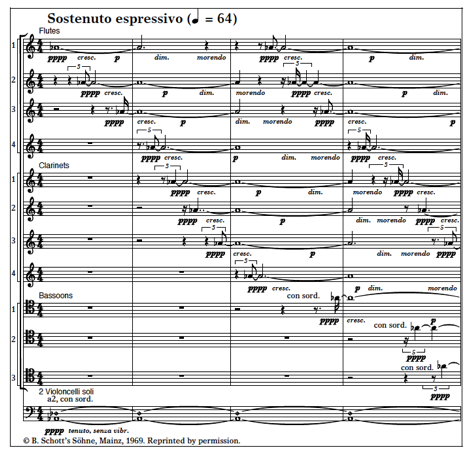
– Lontano also Introduces Segments with Forms
– Form is a Blurry Slow Motion Movement with Diatonic & Chromatic Melody Changes per Voice
– i.e. Layered Voices “Each” Play their Own Diatonic & Chromatic Melody and are then Embedded Back Again in the Dense Texture as “Proportion Canon”
– Melodies are Distributed and Doubled to Over Large Octaves
– to Create a Seamless “Motion Blur Effect”, Stockhausen Used Rhythmic “Formant Spectre” to Blur In/Out Voices (Gradual Shifts of Tone Color via Band Pass/ Reject Filters which are also Used by Ligeti)
– but Ligeti also Moved the Individual Voices on Top of Each Other Rhythmically Between 1/8, Triplets, 1/16, Quints and 1/16 Triplets to Vary and Melt Together Too Obvious Anchor Points as Much as Possible
– and of Course also Simple Volume Fade In & Out
– for Example here, the Same Diatonic/Chromatic “Lamento” Kind of Melody First Descends Down from the D and Later Ascends as Inversion from G
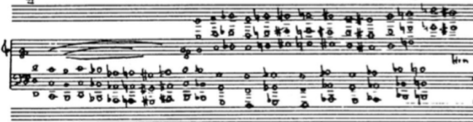
Lontano Passage xxx
– Ligeti Sustained Overlapping Choir starts on A2 + A3, then comes D#2 + D#3 (Tritone from A), then over to D2 + D3 (4th from A), finally C2 + C3 adds in (Minor 3rd from A)
– the 2 Notes from the 2 different Octaves Sources are Tuned differently, means for Example A2 can be at -32 and A3 at +16
Lux Aeterna
– Single Movement Composition
– May be Sung by Using 16 Soloists or by a Larger Choir Divided into 16 Sections
– but Ligeti Wrote it for an Unaccompanied Sixteen Part Mixed Choir
– the Special Sound of the Piece is Down the Way Ligeti Treats the Cantus Firmus
– Each Section of the Standard SATB Choir is Further Divided into Four Parts
– 4 Parts (Voices) in the Soprano Section
– 4 Parts (Voices) in the Alto Section
– 4 Parts (Voices) in the Tenor Section
– 4 Parts (Voices) in the Bass Section
– Uses a Rather Traditional “Canon” as Counterpoint Technique
– Each Part Sings the Same Line / Sequence of Notes, but the Lengths of the Notes Differ by Defined Time Intervals and the Entries are also Staggered by Small Time Intervals
– so Each Voice has a Specific Augmented Duration to Their Notes, so when Voice Sings an 8th, then Voice 2 Sings an 8th+1/3 of an 8th, and Voice 3 an 8th+2/5 of an 8th etc. (Similar to “Gradual Increasing Dotted” Offsets)
– this is also an Example of his “Micro-Structure”
– Piece Uses Mostly Polyphonic Texture = Polyphonic Texture is Music that has Multiple Melodic Lines able to Stand on their Own and Independent of Each Other, but when Taking together Form the Harmony of a Piece
– 2 Places where Homophonic Texture are Used (a Single Dominating Melody that is Accompanied by Chords)
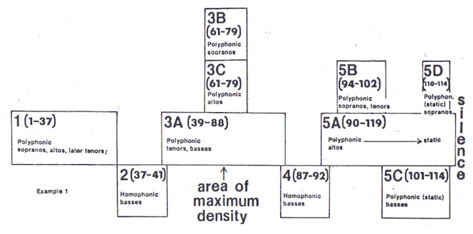
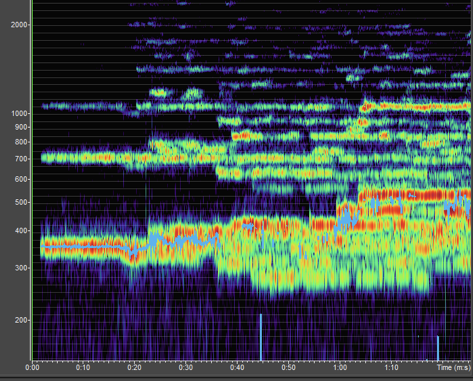
– Spectrogram of First Minute / Lux AeternaChoir Version
Leave a Reply