
General
– Take a Song or a Group of Notes in Whatever Key its In and Put it In Any New Key in the Chromatic Scale
– can be to Accommodate the Song to a Key that Works well for the Singers Voice (Tessitura)
– or to Express the Emotion of a Song better through Changing the Timbre (Tonal Shift)
– e.g. you are Happy with your Chord Progression and Tempo & Melody, but still Not with the Overall Mood, then Transpose a Song
– Effectively Changes its Character to a Brighter, Darker, More Cheerful, Snappier, Thicker Sound
– Allows you to Work in “Impromptu” (On-The-Fly) Musical Situations (Jam Sessions especially with Jazz Musicians where Impromptu Musical Settings are the Name of the Game when performing Standards in a other Key)
– Use it as a Learning Tool since Transposing in to different Keys will teach you about “Intervalic Relationship” as well as Strengthen your Ear
How to Transpose
– for this we Take our Roman Numeral Analysis (a Simple System which uses Roman Numerals to represent Chords)
– Think in Terms of Chordal Relationships (rather than the Specific Key that they´re in)
– Learn all the Intervals / Train your Ear with Practical Examples
– Don´t let other Song Elements (Drum, Percussion, Bass-line etc.) confuse your Ear while Focusing the Movement a Series of Chords make
Example 1 Transposition with Roman Numerals
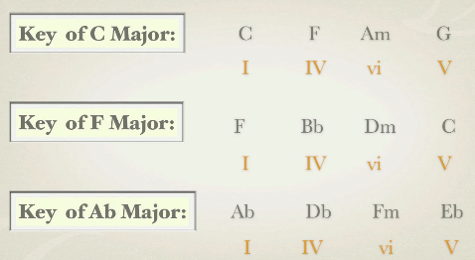
– let´s say you have a C Major Progression with the Chords C (I), F (IV), Am (vi), G (V)
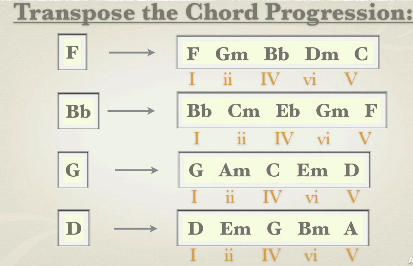
– simply adapt the Position of Chords via Scale Degrees I, IV, vi, V to any other Key
Example 2 Transposition with Roman Numerals
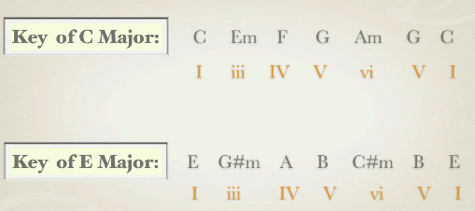
Practice Single Note Transposition
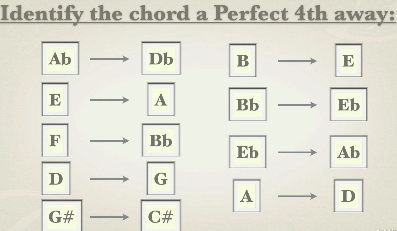
– Identify & write down the Chords a Perfect 4th away (then Step by Step any other Scale Degree / Chordal Relationship)
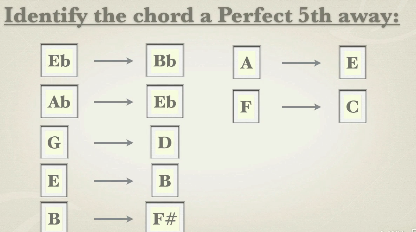
– same Exercise with Chords a Perfect 5th away
Practice Transposition with a Series of Chords (Progression)
– Identify & write down a Series of Chords then Transpose into any other Key
Leave a Reply