
General
– Introduction to “Set Theory” which is an Non-Diatonic Approach of Composing
– the Goal is a Means for Analysis and Comparison that can Reveal Interesting Phenomena in Music Not Based in Diatonic Scales and Functional Harmony
– Integer “0” is the Fundamental (Same Principle as Counting Partials where 1 is the 1st Partial)
Basic Assumptions
– Equal Temperament
– Pitch Class / Octave Equivalence
– Aurally Relevant
Pitch Class / Octave Equivalence
– a “Pitch Class” is Simply the Term for Same Notes in the Staff, Regardless of the Octave Used
– i.e. All C´s Across Keyboard are the Same PC = C, you Do Not Think About C2 or C3
– e.g. Picture Shows on the Right Side 3 Times the “A” = Pitch Class A
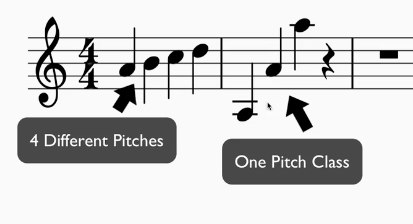
– it Helps you to Distinct between Available Pitches and Pitch Classes in a Sheet
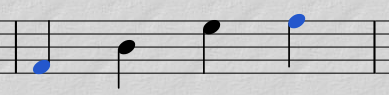
– e.g. Below Picture Shows 4 Pitches = F, B, E, F, but Only 3 Pitch Classes = F, B, E Because F is Twice and Counts as 1 Pitch Class
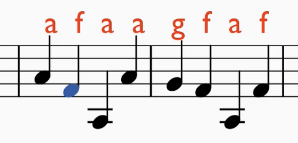
– or these 2 Bars have 8 Pitches in Total but Only 3 PCs
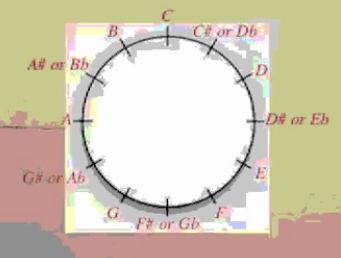
Clock Face
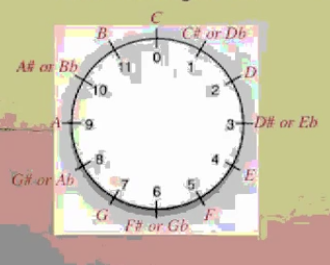
– “Pitch Class” can Nicely be Represented on a Clock Face
Integers
– you can Represent “Pitch Class” with Integers 0-11
Melody
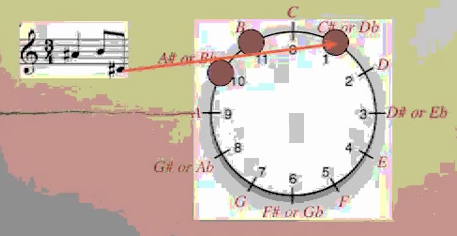
– you can Represent the Melody on the Clock Face as well
Sonority
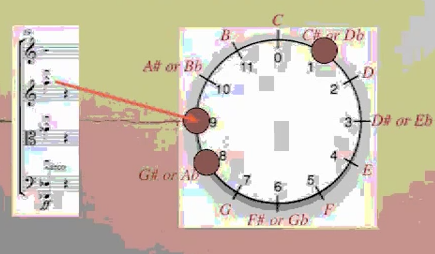
– you can Represent the Sonority on the Clock Face as well
Types on Intervals
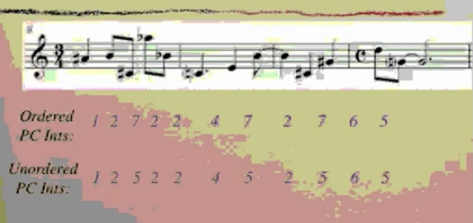
Ordered Pitch Interval
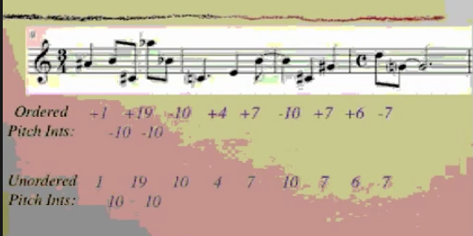
– Order and Direction are Considered
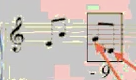
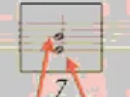
– e.g. from this E to this B is an Ordered Interval of +7 (Simply 7 Notes Above)

– or e.g. from this G to this Bb is an Ordered Interval of -9 (Simply 9 Notes Below)
Un-Ordered Pitch Interval
– Order can Not be Determined, thus Direction is Not Relevant
– e.g. from this B to this E is an Un-Ordered Interval of +7 (Simply 7 Notes Above)
Ordered Pitch Class Interval
– an Ordered Pitch Class can Not be Higher than 11 (as there are Only 11 Integers)
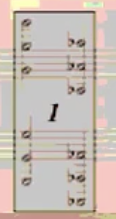
– e.g. if you Go from a G to Ab, the Interval is 1
– Simply Use the Clock Face and Go from First PC (in this Example G), Clockwise to the Second PC which is Ab
Un-Ordered Pitch Class Interval
– Un-Ordered Pitch Class = “Interval Class”
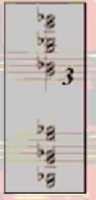
– the Largest Un-Ordered Pitch Class Interval is 6
– Use the Shortest Interval
– e.g. Bb is and Interval Class of 3 Apart from G
Finding Intervals
Basic Operations
MOD 12 Arithmetic
– Is Like Telling Time (Clock Face)
– Except 12 o’Clock is Replaced by 0 (Fundamental)
Addition
– is the Same as Transposing Up
– Remember, an Ordered Pitch Class can Not be Higher than 11
– if the Result of the Operation is Greater than 11, Subtract 12 Until the Number is between 0-1
Subtraction
– is the Same as Transposing Down
– Remember, an Ordered Pitch Class can Not be Higher than 11
– if the Result of the Operation is Less than 0, Add 12 Until the Number is between 0-11
Transposition
– to Transpose Up, Add an Interval
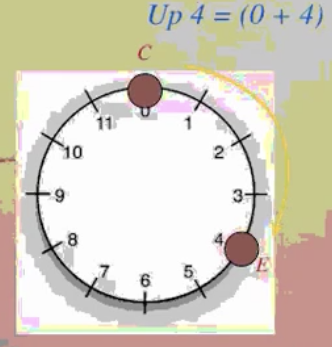
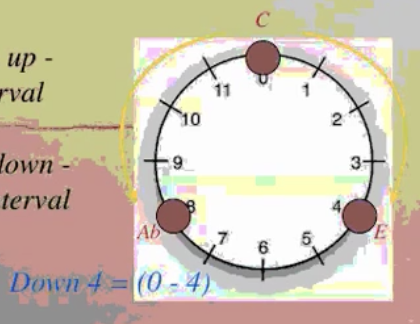
– to Transpose Down, Subtract an Interval
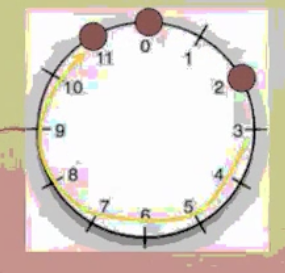
Example Transpose Up a Group of Notes by 8 Semitones:
a) 3, 4, and 6 (Current Position of Notes)
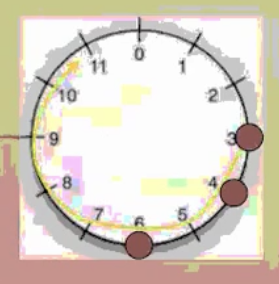
b) Plus 8, 8, and 8 (Desired Transposition in Semitones)
– Rotate Each Note Clockwise on the Clock Face by 8 Notes
c) = 11, 0, and 2 (Resulting Notes)
Example Transpose Down a Group of Notes by 5 Semitones:
a) 3, 5, 7 and 10 (Current Position of Notes)
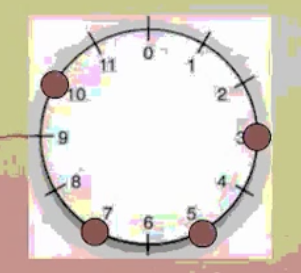
b) Minus 5, 5, 5 and 5 (Desired Transposition in Semitones)
– Rotate Each Note Anti-Clockwise on the Clock Face by 5 Notes
c) = 10, 0, 2, and 5 (Resulting Notes)
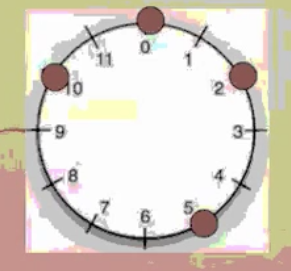
Inversion
– to Invert a Pitch Class, Start to Subtract from 12
– e.g. Invert D which is PC 2 on the Clock Face, Subtract 2 from 12 = 10
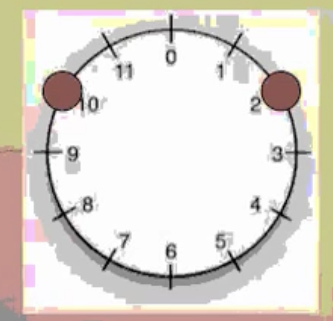
Example Invert Multiple Notes (Same Procedure as with Single Note)
– e.g. to Invert Notes D#, E and F#, Find D# = PC 3 E = PC 4 and F# = PC 6
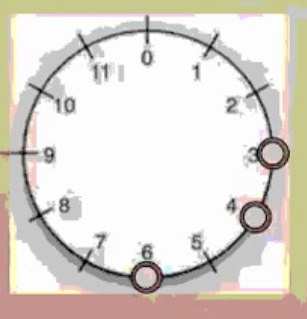
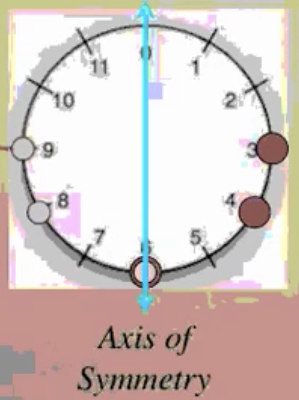
– so Subtract 3, 4 and 6 from 12 Respectively = 9, 8 and 6
– which is a Mirror Image
– i.e. 9 Matches 3, 8 Matches 4 and 6 Builds Axis of Symmetry
Example 2 Invert Multiple Notes D, E, G and A
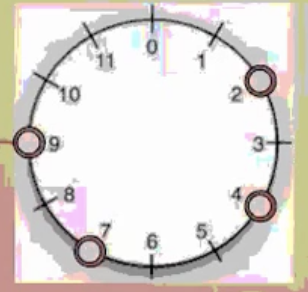
– which is 2, 4, 7 and 9
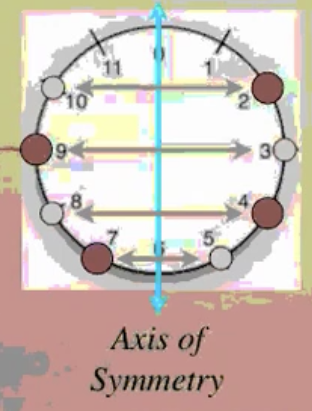
– so Subtract 2, 4, 7 and 9 from 12 Respectively = 10, 8, 5 and 3
– this Inversion also Creates a Mirror Image
– Horizontal Lines Visually Show How the Inversions Matches Up
Leave a Reply