General
– Indicates a “Superimposition” of 2 or More Chords, with Full Voicing and Disallowing the Omission of Any Notes
– Basically 2 Tonalities Played at the Same Time, i.e. Stacked on Top of Each Other
– Very Often (90%) the Chords are Triads (2 x 3 Notes Together)
– 1 Chord in a Lower Register and 1 Chord in a Higher Register (Distinctive Octaves)
– but there can be More than 2 Smaller Separated Chords, More than 3 Notes and the Keyboard Register can be Divided into More than Just 2 Distinctive Octaves
– a Rather Dissonant and Unstable Chord (as you Go by a Feeling and Not by Fixed Scales)
– can be Used to Modernise your Sound or Create Abstract Changes in Voicing (Frequently Used in Jazz and Modern Classical Music)
– Great to Define the Texture you Want as when All Notes are Played Together, as Any Result will be Different and Gives a Very Personal Feeling to Match Any Emotion
– also Very Effective to Avoid Attribution of any Harmonic Function when there is No Strict Tonal Context Desired (e.g. Cluster, Non-Tertian Chord or Passing Chord)
– of Course All the Inversions Do also Apply to the Poly Chord Technique, for Better Voice Distribution
– i.e. can be Voiced in Any Way you Want such as Open, Close, Interlocked or Not to Define the Specific Texture you Intend to Create
– a Very Good Approach to Get Poly Chords is to Use a Melodic Idea to Define “Chord 1” and Use the Same Melody but with Any Other Notes to Define “Chord 2”
– Difficult to Play on a Guitar as 4 Fingers Should Trigger 6 Strings, so a Guitar Player Drops Certain Notes to be Able to Execute the Poly Chord (Often One of the 2 Available 5ths Gets Dropped)
– Polychords will Cross into “Bi-Tonality” as Not All are Poly Chords Anyways Regarding Theory (Bi-Tonality is Usually A Triad Over a Bass Note and also Known as Slash Chord)
– Notice that a Poly Chord is Written Like this , which is “F -Fraction- C” and Means “F Chord Over a C Chord” (to Distinguish from Slash Chords where this Would be a F Chord Over a C Bass)
there is a Big Advantage on the Writing/Reading of “Polychords” (Opposite to “Extended Chords”), as it is Much Easier to Read foe Example “Ebm7 Over G (than to Read “Gmaj7 (#9#11b13)
– also it is a Statement to Look at the Composition with Chord Superimposition in Mind (and Not Chord Alterations)
– Result-Wise, the Polychord Technique Happens More in Modern Classical Music (whereas Extended Chords Happen More in Jazz)
Simple Examples
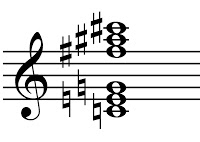
– a Poly Chord can be a C Chord Under a B Chord
– G – C – E Below and on Top B – D# – F#
– or a Poly Chord can be a G Chord Under an A Chord
– G – B – D Below and on Top A – C# – E (where for Example the D from the G Chord is Left Out / Dropped by a Guitar Player to be Able to Execute the Poly Chord on the Guitar)
– More Examples
C Major/E-flat Major
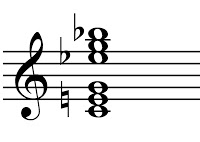
D/Bbm
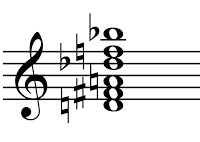
C Augmented/G7 Augmented
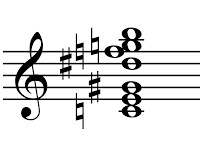
C Major/F# (Used in “Petrushka” from Stravinsky)
Melodic Idea to Poly Chords Example
1) Create a Melody Over Maximal 4 Notes to Define “Chord 1”
– e.g. G-A-B-E
2) Use the Same Melody but with Other Notes to Define “Chord 2”
– e.g. D#-F-G-A#
3) Creates Chords Around the Patterns
– Apply Inversions for Clever Voicing
Leave a Reply