- General
- Simple Example
- Primary Motif (PM) & Secondary Motif (SM)
- Practical Tips for ”Motif" Melodies and Introduce Dynamic Variations
- Motif Composition Tools / Techniques
- Change of Tonality
- Diminution
- Displacement
- Expansion
- Harmonic Change
- Intervallic Compression & Expansion
- Inversion
- Mirror Inversion
- Octave Transfer
- Repetition
- Retrograde
- Retrograde Inversion
- Sequences
- Transposed Inversion
- Transposition
- Truncation
- Final Motif Development Example (Single Pitches)
General
– just as Letters Make Out a Word, Notes Make Out a Motif (and Motifs make Up Phrases)
– Motif is a Combination of Notes that Form a Short Re-Occurring Musical Idea (or Theme) which Characterises a Piece (or Section)
– Motif (Motive) = a Few Notes that are Rhythmically Charged and Provide the Framework for the Melodies (Keep it Simple)
– i.e. a Short Musical Idea that might be Harmonic, Melodic, Rhythmic or a Combination of these
– Typically Made of Intervals, i.e. Series of Pitches and Rhythms
– Can Provide the Seed of which the Rest of the Composition may Grow
– often a Composer Evolves on a Response to the Basis Motif which is Called a “Countermotif”
– Shorter Motifs are “Better”, i.e. Create Motifs Generally anywhere from 2 to 8 Notes in Length
– Motifs are usually Best when the y Contain at Least 2 (or More) Different Note Durations
– Rather Short Notes are Used, Generally anywhere from 2-8 Notes in Length
– usually Best, when they Contain at Least 2 (or more) Different Note Durations
– Motifs can be Rhythmic, Melodic or Harmonic (in Nature)
– think about, Beethovens 9th first couple Notes which provide the Motif e.g. Framework for the whole Composition (or again Faithless)
– Note that the Motif is Not Concerned with the Pitch but the Rhythmical Terms (means you may use the same Motif but with Pitch Changes to avoid Repetition)
– Typically the Motif is Represented by an Instrument
– but also a Voice can Hold the Motif (For Example Chords change E to F# in the first Motif & then to A and finally E in the 2nd Motif while the Motif itself stays on the same in Pitch)
– Distinct between a “Theme”, which is a Longer, more Flowing Melodic Idea and a “Motif”, which is a more Short, Rhythmic Idea
Simple Example
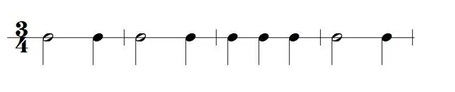
– Look at this this Rhythmic Phrase where the Rhythmic Motif reoccurs 3 Times (on Measure 1, 2 and 4) in the Form of a “Half Note to Quarter Note” Pattern
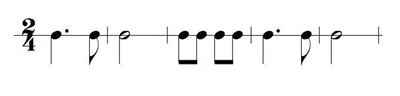
– Look at this this Rhythmic Phrase where the Rhythmic Motif reoccurs 2 Times (on Measure 1&2 and 4&5) in the Form of a “Dotted Quarter Note to a Eight Note to a Half Note ” Pattern
Primary Motif (PM) & Secondary Motif (SM)
– it is Important to Not Repeat a Primary Motif over and over but establish a Secondary Motif
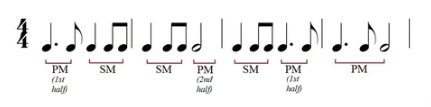
– these 2 Motifs allow for Creation of a Musical / Rhythmic Phrase
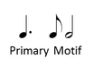
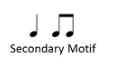
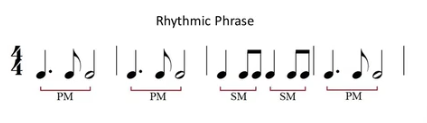
– or Cut the PM in 2 Halfs and Combine in different Ways
Practical Tips for ”Motif” Melodies and Introduce Dynamic Variations
General
1) Keep the Up & Down Contour for More Memorable Motifs
2) Use Slight Note Offsets for More Human Feel
3) Set an Eye to Note Duration
4) Accent Certain Notes
5) Increase Velocity Near the End of Each Motif for Example
6) Change Pitch but Leave Rhythmic Pattern
7) Overlap Certain Notes together via Pitch Bend or Portamento Style
8) Arvo Pärt Motifs are Transformed by all Possible means of Variations, then Placed in Multiple Layers
9) Glass & Reich used Triplets at around 100 Bpm for Repetitive Motifs
Building Melodies from Motifs
– Melodies can be Build Out of Motifs and their Variants
– when you Go trough your Motifs, Look for Complement Shapes
– always Discover what you have Done so Far
Schönberg
– Melody Approaches a High Point or Climax through a Series of Intermediate Lesser Points, Interrupted by Recessions
– Upward Movements are Balanced by Downward Movements
– a Good Melody Generally Remains within a Reasonable Compass, Not Straying Too Far from a Central Range
Rhythmic Mood
– Longer Note Durations and 4/4 Time Result in Less Intense Emotions (Less Rhythmic Variations can be Done)
– Shorter Note Durations and 2/4 Time Result in More Intense Emotions (More Rhythmic Variations can be Done)
– also Consider other Rhythmic Mood Factors such as Articulations, Odd Meters, Rests, Tempo or Dynamics
Motif Composition Tools / Techniques
Augmentation
– Usage in Rhythmic, Single Motifs or Multiple Motifs / Phrases Development
– this Technique originally applies to Rhythm, but since Melody is Connected to Rhythm the Changes affect the Melody as well
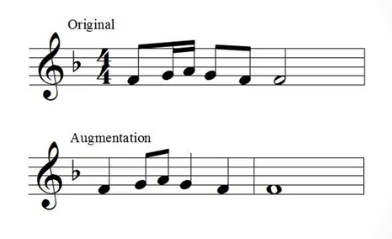
– Augmentation is Taking a Motif (or an Entire Phrase) and Increasing the Duration of Each Note by the Same Proportion
– usually by Doubling the Length which is called “Strict Augmentation”
– also Triple or Quadruple the Notes is possible but less Common
– Quadruple would Take too much Time and the Motif would Not be good Recognisable by the Listener
– Triple would Change the Pulse of the Rhythm and needs to be Written Out in an Entirely different Meter
Example
– Observe how in the Second Line each Note is Doubled in Duration (Doubled = “Strict” Augmentation)
– since we Maintain the exact same Notes, we Create a Sense of Unity between the Melodic Ideas but bring Variety due to Changes in Note Durations
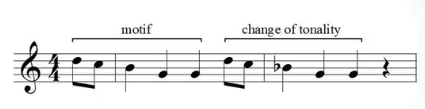
Change of Tonality
– Single Motif Development (Thought for Melody)
– Simple and Effective Repetition with a Change from Major to Minor (if we are in a Major Key)
– or from Minor to Major if we are in a Minor Key
Example
– shows a Original Motif in G Major and repeated with a Tonality Change in G Minor (Flatten the 3rd B to Bb)
Diminution
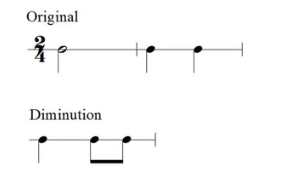
– Diminution is Taking a Motif (or an Entire Phrase) and Decreasing the Duration of Each Note by the Same Proportion
– usually by Halving the Length is called “Strict Diminution”
– We can also Reduce Note Duration by a Third or a Fourth but this is less Common
– again, Reducing a Note to a Third would Change the Pulse of the Rhythm
Example
– Original Consists of a Half Note followed by 2 Quarter Notes
– if we Half the Duration of Each Note we get 1 Quarter Notes and 2 Eight Notes
Displacement
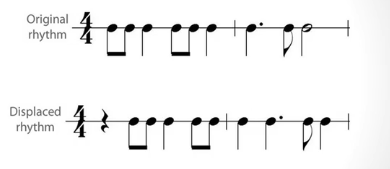
– Rhythmic Displacement is accomplished by Shifting a Motif or a Phrase Over, so that it Begins on a Different Beat
– Based on Music Theory (Counterpoint) we Know that in 4/4 Time, Beat 1 + 3 is Strong and Beat 2 +4 are Weak, by Shifting the Content you Change the Entire Feel and the Actual Sound of the Rhythm
Example
– We Shifted the Entire Rhythm Over One Beat so that it Begins on the Second Beat
– Here the Last Note (Half Note) has been Replaced by a Quarter Note, so that it Fits into 2 Measures
Expansion
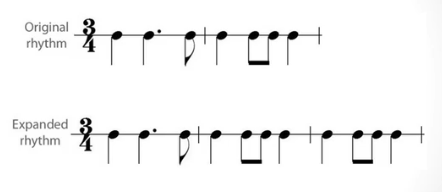
– Expansion is when any Part of a Motif or Phrase is Added On to the End of the Original Rhythm (Opposite of Truncation)
Example
– We Take the Last 4 Note of the Original Rhythm and Add them to the End of the Expanded Rhythm
– we could have Add as much or as little as we Want it, as Long as you Use Material from the Original
Harmonic Change
– Bach Introduces a Harmonic Change in his Prelude with the Technique “Push & Pull” to Play with the Listeners Expectations
– i.e. Rhythmic Motif Stays the same but is Introduced at slightly Different Tempos, Dynamics and with Change of Pitches / Harmony
Intervallic Compression & Expansion
– simply the Repetition of the Melodic Motif using Larger Intervals
– Usage in Single Motif Development
– Contraction is the same as Compression
Intervallic Compression Variations
– also Called Intervallic Contraction
– simply the Opposite of Expansion
– means we are Altering the Intervals of the Melody by making them Smaller
– has also 3 Options as the Single Interval May be Compressed, Multiple Intervals May be Compressed or All Intervals May be Compressed
– Intervallic Relationships within a Melody are Made Smaller (sort of Diminish the Intervallic Distance)
– this only affects the Melodic Interval but the Contour and Rhythm stays the same
Intervallic Expansion Variations
– the Exact Opposite of Contracting Intervals and Involves Repetition of the Melodic Motif using Larger Intervals
– means we are Altering the Intervals of the Melody by making them Larger
– Kind of Augment the Intervallic Distance
– Varying the Shape of a Melody by Creating Widening Intervals between Notes
– this only affects the Melodic Interval but the Contour and Rhythm stays the same
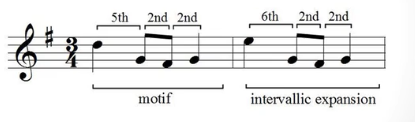
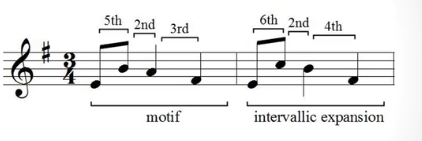
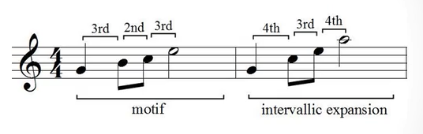
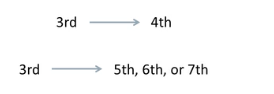
– when Using Intervallic Expansion, the Intervals can be Made Larger by any Amount, Not necessarily by a Single Number (means a 3rd doesn’t have to become a 4th, but can become a 5th, 6th or 7th)
Examples
– Both, Compression & Expansion have 3 Methods
– “Intervallic Compression” is the Exact Opposite of Intervallic Expansion
– i.e. simply the Repetition of the Melodic Motif using Smaller Intervals with the same 3 Options
a) A Single Interval may be Expanded
b) Multiple Intervals may be Expanded
c) All the Intervals may be Expanded
– Expansion can be at any Interval, Not necessarily by a Single Number (3rd can also become a 5th, 6th or 7th)
Example Expansion Ascending Mode
1) For Example in Am, instead going Stepwise the Melody A-B-C, in Expansion Mode you Play A-C-E
– so to Expand in Ascending Mode, you generally Take the Nearest Note to Root and Placed that at Two Intervals above the Final Destination Note in Range of Theme or Part of it
Example Expansion Descending Mode
1) instead of Descending Stepwise the Melody B-A-G as Original, you Expand the Interval and Use D-B-G
– so to Expand in Descending Mode, you generally Leave the Final Destination but Replace the Start Note (First Note of Descending Melody) with a Larger Interval above it
Contraction Ascending Mode
1) For Example in Am, we have the Melody A, B, C, but in Intervallic Contraction we use Note Bb instead of C and Play A-Bb-B
– means we Shorten the Intervallic Distance by Taking the Destination Note away and Replace it with another Note available in the Range of Melody or Part of it
– you basically Check what Notes in the Total Range of the Melody (or Part) are available (Not used) and “Replace” a Note with a New On available while Keep the Contour
– since in this Example from A to C only Bb is available we Use that and Replace the C with Bb
– Notice we Do Not Replace the B with Bb since A-Bb-C would make the Interval Not Smaller but Staying the same
Contraction Descending Mode
1) For Example in Am, we have the Melody B, A, G, but in Intervallic Contraction we use Note Bb instead of G and Play B-Bb-A
– means we Shorten the Intervallic Distance by Taking the Destination Note away and Replace it with a Closer Note and only Bb makes the Interval Smaller in this Case
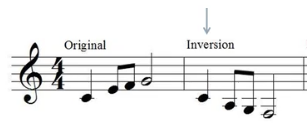
Inversion
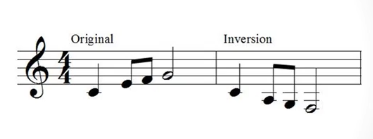
– Inversion is the Restatement of the Motif (or Phrase) with all its Intervals Moving in the Opposite Direction
– for Example if the Motif is Moving a 3rd Higher in the Pitch, then the Inversion would be a Third Moving Lower in Pitch
– Inversion is therefore also called “Turning everything Upside Down”
Example
– Below you See the Motif after Inversion with a Falling 3rd, followed by 2 Falling 2nds (means C-E-F-G becomes C-A-G-F)
Mirror Inversion
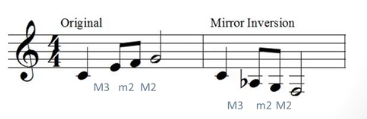
– a Mirrored Inversion Maintains the Exact Interval Size, this Involves the Usage of Keys Not found in the Original Key
– Usage in Single Motifs or Multiple Motifs / Phrases Development
Example
– Mirror Invert the following Original Motif (or Phrase) C (M3) -E (m2) -F (M2) -G, would become C (M3) – Ab (m2) – G (M2) – F
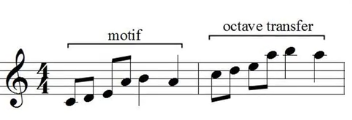
Octave Transfer
– similar to the Technique of Transposition where the Motif can be Transposed by a Higher or Lower Interval, in Octave Transfer the Transposition appears by Octaves only
– Usage in Single Motif Development
– Transposition for Individual Notes can be at any Octave or the same, so there are 3 Possibilities
a) Single Pitch may be Transposed by an Octave
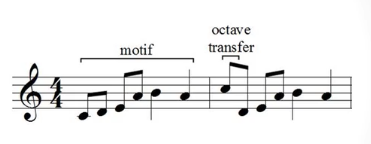
b) Several Pitches may be Transposed by an Octave
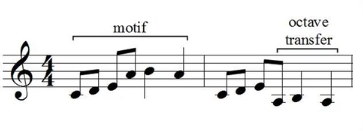
c) Entire Motif may be Transposed by an Octave
Repetition
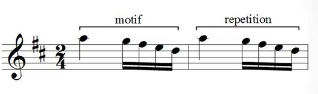
– Identical Repetition of the Motif
– i.e. using Exact Repetitions of the Principal Theme by using Fragments of the Original Melody
– Exact Repetitions Involves a Literal Repeating of Selected Fragments of a Melodic Phrase as a Way to Create Variations
– Example take an Ascending Part and Repeat Once, let it Flow and then Repeat an Descending Part Once
– Usage in Single Motif Development
Example
Retrograde
– Retrograde is the Motif (or Phrase) Restated in Reverse
– simply the Original Backwards, i.e. same Intervals in Reversed Order
– means C-E-F-G becomes G-F-E-C
– Usage for Single Motifs or Multiple Motifs / Phrases Development
Example
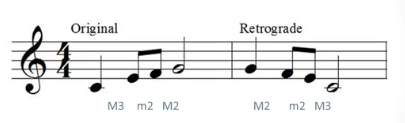
– Playing Phrases in “Retrograde” is more of a Mathematical Approach
– Retrograde Involves Playing Phrases Backwards and Inverting either the Intervals and/or Rhythm
– you Reverse both, the Intervals and/or Rhythm Exactly the same
– basically the Whole Thing is Played Backwards, where the “Whole Thing” can be either the Complete Melody or only Parts of the Principal Theme
– Simple Example would be a Melody A-B-C, in Retrograde this is simply C-B-A
– the Whole Thing Backwards
– means Starting with the Note at the End of a (Retrograde) Part and Descending from there
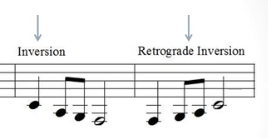
Retrograde Inversion
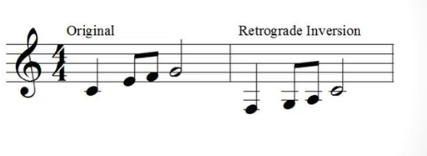
– Remember “Retrograde” Only is the same Motif (or Phrase) in “Backwards Order” (C-E-F-G becomes G-F-E-C)
– and “Inversion” Only is “Upside Down” (C-E-F-G becomes C-A-G-F)
– so “Retrograde Inversion” is “Upside Down” & “Backwards”
– means C-E-F-G becomes F-G-A-C
– Usage for Single Motifs or Multiple Motifs / Phrases Development
Example
Sequences
General
– Sequences Combine the 2 Techniques Repetition and Transposition
– Sequence is the Repetition of a Motif 3 or more Times (often in the Interval at Seconds)
– with each Repetition being Transposed by the same Interval Higher in Pitch (or by the same Interval Lower in Pitch)
– Sequences can either be in Ascending or in Descending Mode (but Not both in the same Sequence)
– Sequences can be at any Interval, although 2nds are often used
– also here we can have a “Diatonic Sequence” (Restated Sequences Remain in the Key), or a “Chromatic Sequence” (Non-Diatonic)
– many People have Problems to Wrap this Technique around their Head, to Master it follow these Short Guide (Rules):
1) Flip the Original Upside Down
2) Play it Backwards
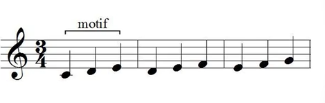
Ascending Sequence in 2nds
– C-D-E is Original, then at the Second from C Major D = D-E-F is the First Sequence and at the Second from D = E-F-G is the Second Sequence)
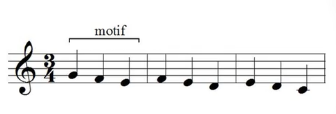
Descending Sequence in 2nds
Ascending each Sequence by a 3rd (C-Eb-G)
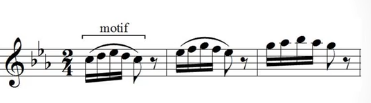
Diatonic Sequence
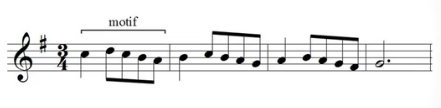
Chromatic Sequence
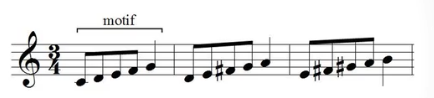
– i.e. a Sequential Repetition by Using a Part of Melody and Repeat it Up or Downwards
– Sequential Repetitions Involves Repeating Motifs on different Degrees of the Scale
– often (but Not always) Ascending or Descending Diatonically
– for Example a Melody in Am Starts with A, B, C, and then Repeat the same Melody Once but Starting the Interval from C which gives C, D, E (then let it Flow and Repeat other Parts of the Motif)
Transposed Inversion
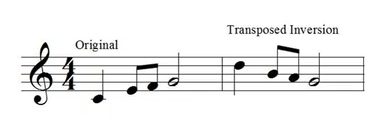
– Inversion Does Not have to Start at the same Note as the Original, it can Start at any Pitch
– Usage in Single Motifs or Multiple Motifs / Phrases Development
Example
– Transposed Inversion Starting on D, then Upside Down (means C-E-F-G becomes D-B-A-G)
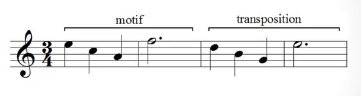
Transposition
– is Connected to Repetition, but the Motif is repeated by a Higher or by a Lower Pitch
– the Relative Position between Notes is the same
– if the Transposition is Written with Key Scale Notes only, it is a “Diatonic Transposition”, if Not it is a “Chromatic Transposition”
– Usage in Single Motif Development
Example
Truncation
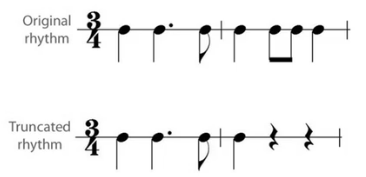
– Truncation is when any Part of the End of a Motif or Phrase is Left Off (Truncated)
– this Works Best with Whole Phrases since Motifs are already fairly Short to Begin with
– Usage in Rhythmic, Single Motifs or Multiple Motifs / Phrases Development
Example
– Last 3 Notes has been Left Off, Creating a Variation of the Original Melodic Material
– we could have Cut Off as Little or as Much as we Wanted it, which keeps the Truncation True as well
Final Motif Development Example (Single Pitches)
– You need Variations of a Basis Motif Sequence to Make a Conversation between Pitches
– All of these Techniques can be Applied to Harmony as well, i.e. Set the Motif to a Series of Chords
– as you “Re-Order” just the same Content, the Colours Stay the same which Helps to Not Lose Yourself (but Happy Accidents are Welcome)
– This is Our Motif which Serves as the Basis Sequence
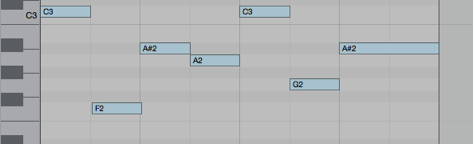
1) You can Copy the Sequence Over and Over to Make a “Exact Repetition”
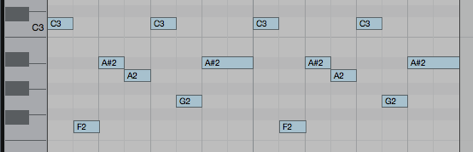
2) You can Copy the Same Basis Sequence to another Instrument, this is “Similar Motion”
– in this Case the Effect of 2 Voices is Lost and the Voices Sound Like 1 Voice
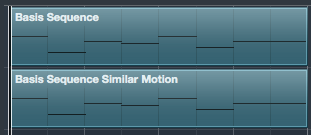
3) You can Transpose the Sequence, i.e. the Sequence Starts on a Higher or Lower Pitch (12 Possible Pitches)
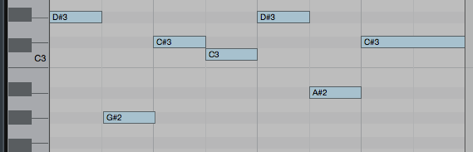
4) You can Invert the Sequence, i.e. the Sequence is Flipped Over which is Called an “Inversion”
– it is an “Exact Inversion” as it Does Not Follow the Key in which the Music is In
– Simply you Count How Many Pitches are between the Motif and Move in the Opposite Direction
– i.e. if a Note Goes Up by 7 Pitches you Write One that Goes Down by 7 Pitches
– i.e. if a Note Goes Down by 3 Pitches you Write One that Goes Down by 3 Pitches
Original
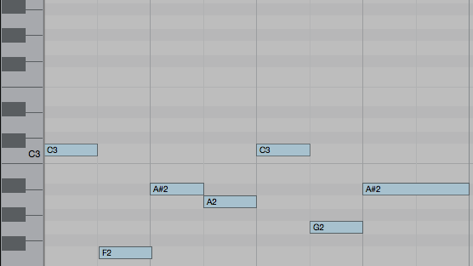
Exact Inversion
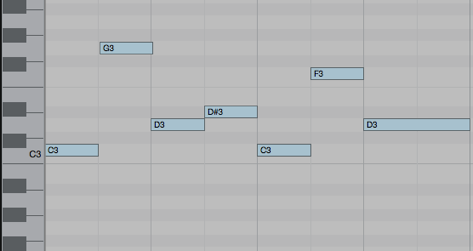
5) You can Create “Contrary Motion” by Playing the Inverted Sequence along the Basis Sequence
– in this Case you Hear Distinct 2 Voices, even if they are in the same Rhythmic Pattern
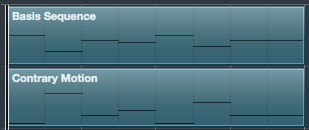
6) You can Make a “Tonal Inversion” where the Difference to the “Exact Inversion” is only that you Place the Flipped Notes to Match the Key in which the Music is in (usually the Next Nearest Position)
Original
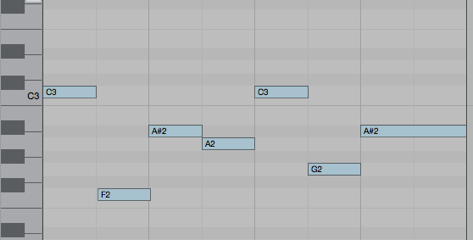
Tonal Inversion
– Taking Our Basis Sequence in F, you need to Correct the D# to either D or E to Match F Major (vs D# on a “Exact Inversion”)
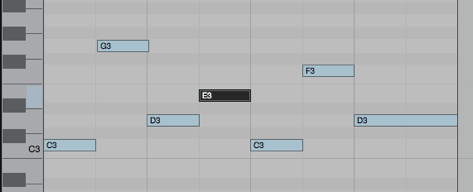
7) Further you can you the “Slice to Audio” Feature many DAW Provide and Trigger the Slices then via Midi Notes
– allows to Re-Order a Basis Sequence to Create More Interest, even if it is the same Content
– Not necessarily Re-Order in Pitch
8) You can Copy the Sequence and Play it Backwards, this is a “Retrograde”
– Simply Turn Rhythm and Pitches Backwards, i.e. 1st Note is then the Last etc. (in Cubase “Mirror”)
Original
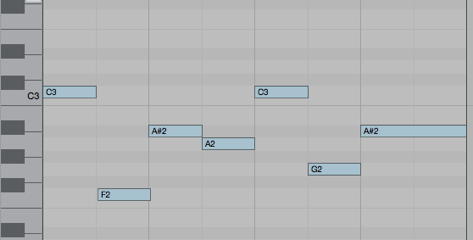
Retrograde
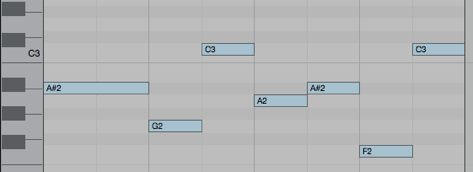
9) You can Change the Rhythm of the Basis Motif Sequence
– Half / Double Speed of Motif
– Create Finer Rhythmic Transformations
– Repeat Notes within the Motif
– Shift the Rhythm to Different Beats
Leave a Reply