General
– Inversions are the Exact same Notes but Move Over in Position
– Inversions allow you to Move Smoother between Different Chords
– Adding Inversions to a Tonic Chord is a Good Way to Create the Illusion of Movement, Even though the Basic Harmony is Static
– also a Great Way of Generating Interesting Bass Movement, when Leading to New Harmonies
– it is Crucial to Understand what is Happening Harmonically as it will Open Up a New World of Sonic Possibilities
– any Player of a Instrument, be it a Violinist, Harpist, Guitar, Horn Should Get Inversions in their Mind etc.)
Inversions in C
Root Position (or 1st Position)
C – G – E
1st Inversion (or 2nd Position)
E – G – C
– 3rd in the Bottom
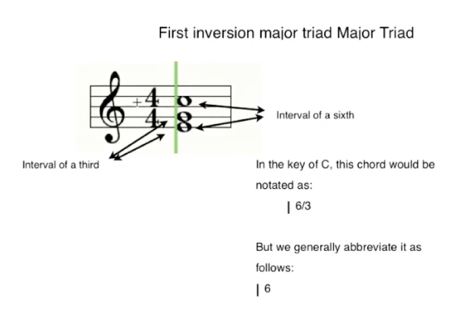
– it is Notated with a Roman Numeral Followed by the Arabic Numeral 6 in Superscript, which is an Abbreviation of 6/3 and Denotes the 1st Inversion Voicing to be Used
– i.e. “C-E-G Chord in 1st Inversion”is Starting from E and has the Distance of a 6th to Next C (E – C)
2nd Inversion (or 3rd Position)
– G – C – E
– 5th in the Bottom
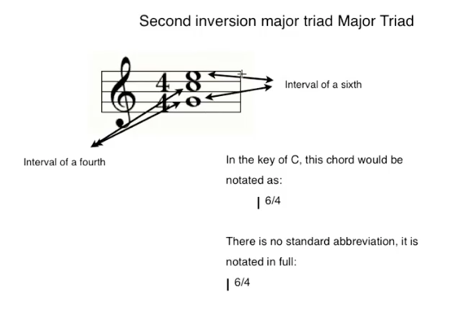
– it is Notated with a Roman Numeral Followed by 6/4 in Superscript, which Indicates the Intervals between the Notes as Being in2nd Inversion
– i.e. “C-E-G Chord in 2nd Inversion” is Starting from G and has the Distance of a 4th to Next C (G – C) (and Again, the Distance from G – E is a 6th)
Practice Chord Inversion
– Play Root, 1st Inv and 2nd, then Play Backwards Same Order
– Do this in Every Key
– If you are Comfortable with Singles Notes, Play them as Block Chords
– If you are Comfortable with Block Chords, Play them Arpeggiated
– Finally Do the same with Minor Chords
Major Inversions (Example on C)
1) Root = C – E- G
2) 1st Inv = E – G – C
3) 2nd Inv = G – C – E
4) 2nd Inv Backwards = G – C – E
5) 1st Inv Backwards = E – G – C
6) Root Backwards = C – E- G
Minor Inversions (Example on C)
1) Root = C – Eb- G
2) 1st Inv = Eb – G – C
3) 2nd Inv = G – C – Eb
4) 2nd Inv Backwards = G – C – Eb
5) 1st Inv Backwards = Eb – G – C
6) Root Backwards = C – Eb- G
Leave a Reply