
General
– It is a Good Idea to Sing Up a Scale, Even in your Head and to Give a Number to Each note
– this Helps to Internalize Intervals and Chords (as you Practise Tapping Out a Rhythm)
– also “Bind” Simple Intervals with Known Songs Melodies (e.g. Take On Me Refrain (Aha) Starts with a Maj 7th Interval (C to B) etc.)
– Triads (Right Hand) Over Tritones (Left Hand) are Interesting, e.g. Over a C Tritone Play Am, Fm, D7b5, Ab, A, F#, Eb, Db, Eb + Db Combined, Ebm, Dm, G°, F#m, Dm, Fm, Db+, Dbm, E7sus4, Eb7sus4, A7sus4
– you can Create any Diminished Chord from a Major Chord through Lowering the 3rd (Bottom Interval ) and the 5th (Outer Interval) by a Semitone
4th & 5th
– the 4th and 5th Sort of Produce a Similar Sound together with a Root Note
– Both Sit Very well, are Very Powerful and Both are Stable
– often Fanfares Chime in to Produce a Powerful 4th and 5th
– the 4th sits at 4 Position and 5th sits at 5th Position in any Key
– Inverted, the 4th sits at the 5th Position and the 5th at the 4th Position (looking at it Downwards the Keyboard)
– any Exercise with just 4th + 5th Intervals will Open a Huge Sonically World
Basic Exercise with 4th & 5th
– Do this in every Key
– Train it with a Piano and then use a Sonically Bigger Patch to Feel the Power
– basically you Play a 4th and 5th from the Root Note, Move to the 4th Step and Play a 4th and 5th, then Move to the 5th Step and Play a 4th and 5th before Completing a Octave Higher
1) Root
2) 4th (from Root)
2) 5th (from Root)
3) 4th (from 4th)
4) 5th (from 4th)
5) 4th (from 5th)
6) 5th (from 5th)
7) Complete with Root and 4th and then Root and 5th (Octave Higher)
Exercise with 4th & 5th (Example on C)
1) Root C
2) 4th (from Root) C+F
2) 5th (from Root) C+G
3) 4th (from 4th) F+Bb
4) 5th (from 4th) F+C
5) 4th (from 5th) G+C
6) 5th (from 5th) G+D
7) Complete with Root and 4th and then Root and 5th (Octave Higher) C+F, C+G
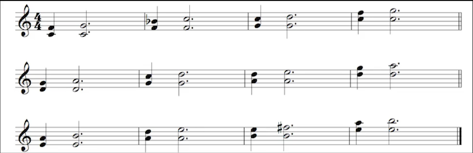
Advanced Exercise with 4th & 5th (Example on C)
– basically Go Up in 4ths Two Times, then Repeat Last Interval Once and Continue
– try it in Triplets
– Do this in every Key
– if you are Comfortable with it, put a Bass Note (Root) under that Motion
1) C to F
2) F to Bb
3) Repeat F to Bb (i.e. Go Down to F Again)
4) Bb to Eb
5) Eb to Ab
6) Repeat Eb to Ab (i.e. Go Down to Eb again)
7) Ab to Db
8) Finalise with a 4th Chord from Root C, which is F – Bb – Eb
Major & Minor Chords
– so to Perform a Chord we finally need a Note in the Middle of a 5th
– i.e. Make a Commitment for that Middle Note by Either Placing a Minor 3rd or Major 3rd Over C
– Looking at this from the 5th, a Minor 3rd Reversed is a Major Chord or a Major 3rd Reversed is a Minor Chord
Inversion
– any Major or Minor Chord can be Played from different Positions
– these are the Exact Same Notes but Move Over in Position
– it is Crucial to Understand what is Happening Harmonically as it will Open Up a New World of Sonic Possibilities
– any Player of a Instrument, be it a Violinist, Harpist, Guitar, Horn Should Get Inversions in their Mind etc.)
Root = C – E- G
1st Inv = E – G – C
2nd Inv= G – C – E
Exercise Chord Inversion
– Play Root, 1st Inv and 2nd, then Play Backwards same Order
– Do this in every Key
– If you are Comfortable with Singles Notes, play them as Block Chords
– If you are Comfortable with Block Chords, play them Arpeggiated
– finally Do the same with Minor Chords
Major Inversions (Example on C)
1) Root = C – E- G
2) 1st Inv = E – G – C
3) 2nd Inv = G – C – E
4) 2nd Inv Backwards = G – C – E
5) 1st Inv Backwards = E – G – C
6) Root Backwards = C – E- G
Minor Inversions (Example on C)
1) Root = C – Eb- G
2) 1st Inv = Eb – G – C
3) 2nd Inv = G – C – Eb
4) 2nd Inv Backwards = G – C – Eb
5) 1st Inv Backwards = Eb – G – C
6) Root Backwards = C – Eb- G
Relative Major & Minor Keys
– every Major has a Relative Minor
– a Relative Key Shares the Idea of the same Notes
– in the Key of C, A Minor is the Relative Minor (Natural Minor) and Shares the Idea having No Sharps or Flats as C Major
– you Find a Relative Minor by Going Down a Minor 3rd (Whole Step + Half Step Downwards)
– you Find a Relative Major by Going a Up a Minor 3rd (Whole Step + Half Step Upwards)
– a better Way to Find a Relative Minor, is by going Up a Whole Step from the 5th of the current Key (means to Play that Whole Step Up instead the 5th)
– so in C this would be C – E – A instead C – E – G, which only needs One Finger to be Moved to get to the Relative Minor at a 2nd Inv
Simple Exercise Relative Keys (Start on C)
– this Exercise Focuses on only Moving One Note (One Finger) at a Time to get the Relative Keys in a “Cycled Fashion”
– we Start with No Sharps or Flats ( C Major / A Minor), then Continue adding Flats and Sharps (F Major / D Minor), before Closing with a V to I Chord
– basically you are Playing 1 – 6 – 4 – 2 – 5 in every Position
– Practice that in every Key and get Comfortable with Close Voice Leading
– “Close Voicings” serve very well for Music that stays almost still, because in Fact only One Note Moves but Open sonically a New World
1) C – E – G ( C Major, No Sharps and Flats)
– Start Up Chord
-1 Chord
– prepare to Move to A Minor by One Finger with the Closest Note to A, which is G
2) C – E – A (A Minor, No Sharps and Flats)
– Relative Minor of C
– 6 Chord
– we Replaced G as the closest Note from A to get A Minor
– prepare to Move to F Major by One Finger with the Closest Note to F, which is E
3) C – F – A (F Major, One Flat Note Gb)
– 4 Chord
– we Replaced G as the closest Note from A to get A Minor
– prepare to Move to D Minor by One Finger with the Closest Note to D, which is C
4) D – F – A (D Minor)
– Relative Minor of F
– 2 Chord
– we Replaced C as the closest Note from D to get D Minor
5) Close this Exercise by Going first to the 5 Chord (V) of C Major which is a G Major, and then Back to the 1 (I) Chord C Major
– the closest Way from D Minor to a G Major Chord is by Moving F to G and A to B
D – G – B (1st Inv)
– 5 Chord
– the closest Way from G Major to a C Major Chord is by Moving D to E and B to C
E – G – C (1st Inv)
– 1 Chord again
6) If you are Comfortable, Start over from the Current 1st Inversion C Major Chord
– so you End Up with C Major at 2nd Inversion
– if you Continue Once more, you are Back at C Major Root Position where you Started at
– by the Way, these Chords and Movements Cover the Entire Music Scene of the 60ies
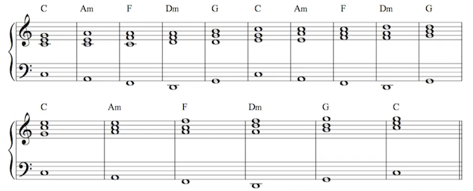
Same Simple Exercise Relative Keys (but Start on F)
1) F – A – C ( F Major, 1 Flat)
– Start Up Chord
– 1 Chord
– prepare to Move to D Minor by One Finger with the Closest Note to D, which is C
2) F – A – D (D Minor, 1 Flat)
– Relative Minor of F
– 6 Chord
– we Replaced C as the closest Note from D to get D Minor
– prepare to Move to Bb Major by One Finger with the Closest Note to Bb, which is A
3) F – Bb – D (Bb Major, Two Flat Note Gb, Bb)
– 4 Chord
– we Replaced A as the closest Note from Bb to get Bb Minor
– prepare to Move to G Minor by One Finger with the Closest Note to G, which is F
4) G – Bb – D (G Minor)
– Relative Minor of Bb
– 2 Chord
– we Replaced F as the closest Note from G to get G Minor
5) Close this Exercise by Going first to the 5 Chord (V) of F Major which is a C Major, and then Back to the 1 (I) Chord F Major
– the closest Way from G Minor to a C Major Chord is by Moving Bb to C and D to E
G – C – E (1st Inv)
– 5 Chord
– the closest Way from C Major to a F Major Chord is by Moving G to A and E to F
A – C – F (1st Inv)
– 1 Chord again
6) If you are Comfortable, Start over from the Current 1st Inversion F Major Chord
– so you End Up with F Major at 2nd Inversion
– if you Continue Once more, you are Back at F Major Root Position where you Started at
– by the Way, these Chords and Movements Cover the Entire Music Scene of the 60ies
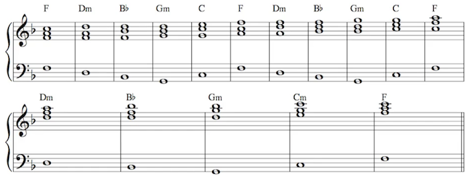
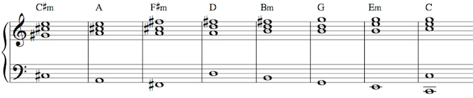
Advanced Exercise Relative Keys (Start on C)
– the same Technique as Basic Exercise, but we Expand to get to All (24) Keys in All Major and Minor Qualities and we use a Bass Note as a Guide on the Left Hand
– we basically Move from No Flat Keys to All and from All Sharps Back to No Sharps
– easy by Placing a Bass Note a m3rd Down & then a M3rd Down etc. (Bass from C to A (m3rd) to F (M3rd) to D (m3rd) to Bb (M3rd) to G (m3rd) to Eb (M3rd) etc.
– in the Right Hand you Move only One Finger to the New Chord, this Movement is Defined by the every Next Bass Note (same Pattern)
– this Exercise should be Done by Starting with the Right Hand from a Root Position, then from a 1st Inv Position and finally from a 2nd Inv Position (while the Left Hand Bass Pattern stays the same)
1) C – E – G ( C Major, No Sharps and Flats)
– Start Up Chord Right Hand
– Bass Note C Left Hand
– prepare the Bass Note to be Moved to A (m3rd Down from C) to get to A Minor
2) C – E – A (A Minor, No Sharps and Flats)
– Relative Minor from C Chord Right Hand
– Bass Note A Left Hand
– prepare the Bass Note to be Moved to F (M3rd Down from A) to get to F Major
3) C – F – A (F Major, One Flat Note Gb)
– F Major Chord Right Hand
– Bass Note F Left Hand
– prepare the Bass Note to be Moved to D (m3rd Down from F) to get to D Minor
etc.
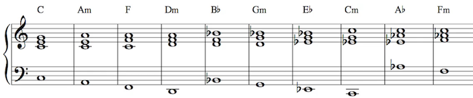

Motifs with Close Voicings
– a really useful Technique is to Create a Motif in the Upper Structure and then to Find different Bass Notes or Chords that Work along with it
– this Works well with Open Motifs (means just a Few Notes in the Motif), because they can be a Part of so many Chords
– Open Motifs also Involve to Leave Out the 3rd, Avoid to Classify the Motif itself to be Minor or Major
– all these Notes Played together Open up a whole New World, depending on the Chords from Left Hand
– it is Up to the Composer How Far away or How Inside from the Motif, i.e. Changing Lower Structure just with Scales Notes or Expand with Non-Scale Notes
– but the Focus is on Finding Notes in the Lower Structure to Introduce these “Special Chords” which can give you every possible Feeling you are Looking for
Example 1 (Change Chords to Motif)
– for Example a Open Motif such as “D A D E Arpeggiated” on the Right Hand with dedicated 3 Note Chord Blocks on the Left Hand such as D, B, G or even Bb
– for Example the Bb Flat Chord along D A D E Motif Introduces a Tritone with the Bb from the Chord and the Interval to the E Note in the Motif which Sounds totally different again
Example 2 (Change Bass Note only to Motif)
– for Example a Open Motif such as “A E A A(8), G D E” Arpeggiated” on the Right Hand
– means Root, 4th, 5th, 7th, Octave in the Motif
– over that you can Play a A (Root Note) which is very Consonant Sounding
– or a you can Play a Bb Bass Note which is very Dissonant Sounding, because Bb Turns the A into a 7th of the Bb, it also Turns E into a Tritone from Bb
– or you can Play a F Bass Note which Introduces a New Chord D Minor (we already have D and A in the Motif and with F = D Minor)
Chords Over a Pedal Tone
– the Pedal Tone is the Usage of 2 Notes from the Lower Register which Define the Root Note, to where we Play Chords in the Higher Register
– for Example Press C1 + C2 as the Pedal Tone and then Search Chords that Work over that C Pedal Tone
– searching for Chords that Work Over a Pedal Tone gives a lot of Possibilities
– by the Usage of Inversions you can Smoothly Alter between your Favourite Chords Over a Pedal Tone
– you can Expand by using also Non-Diatonic Chords that Sound very well Over a Pedal Tone (although they Not necessarily Fit into a Scale Set)
– the Goal is to really get Comfortable what Inversions, be it Diatonic or Non-Diatonic Chords, work Over Pedal Tones and even better over Whole Melody Lines as the Next Step
Minor Chords Over a Pedal Tone
– searching for Chords in a Natural Minor Scale that Work Over a Pedal Tone gives a lot of Possibilities
– of course the Root Chord itself Works all Times, but we also the Following Chords:
Example 1
– we Take D as the Pedal Tone and we Add the 7 Chord of D Minor which is C Major
Example 2
– we Take D as the Pedal Tone and we Add the 6 Chord of D Minor which is Bb Major
Example 3
– we Take D as the Pedal Tone and we Add the 5 Chord of D Minor which is A Minor
Example 4
– we Take D as the Pedal Tone and we Add the 4 Chord of D Minor which is G Major
Example 5
– we Take D as the Pedal Tone and we Add the 3 Chord of D Minor which is F Major
Example 6
– we Take D as the Pedal Tone and we Add the 2 Chord of D Minor which is E Dim
– this is the only Chord that is a little Questionable, e.g. has a Total different Sound
Major Chords Over a Pedal Tone
– searching for Chords in a Major Scale that Work Over a Pedal Tone gives a lot of Possibilities
– of course the Root Chord itself Works all Times, but we also the Following Chords:
Example 1
– we Take C as the Pedal Tone and we Add the 4 Chord of C Major which is F Major
Example 2
– we Take C as the Pedal Tone and we Add the 5 Chord of C Major which is G Major
Example 3
– we Take C as the Pedal Tone and we Add the 2 Chord of C Major which is D Minor
Example 4
– we Take C as the Pedal Tone and we Add the 3 Chord of C Major which is E Minor
Example 5
– we Take C as the Pedal Tone and we Add the 6 Chord of C Major which is A Minor
Example 6
– we Take C as the Pedal Tone and we Add the 7 Chord of C Major which is B Dim
– this is the only Chord that is a little Questionable, e.g. has a Total different Sound
Non-Diatonic Chords Over a Pedal Tone
– Expand the Possibilities by Searching Chords that Sound very well Over a Pedal Tone (although they Not necessarily Fit into a Scale Set)
– means to Start Use the Scale Note “Slots”, but Triggering Non-Diatonic Chords where they Fit to Open New Sonically Possibilities
– For Example in a E Minor Scale, the Original Scale Notes/Chords would be Em, F#Dim, G, Am, Bm, C, D, Em)
– Song Specifically, this means you have Written Melody and Chords in E Mixolydian Scale so Far, now you simply Change a Few Dedicated “Slots” to Non-Diatonic Chords (away from Original Mixolydian Scale Chords)
Example Non-Diatonic Chords over E Minor
– in this Case we Set All Chords to be Major
– so we Leave some Scale “Slots” Unaffected and Change only Few to Turn into Major
– but you can Generate a lot of other Non-Diatonic Chords
Example 1
– we Take E as the Pedal Tone and we Change the 1 Chord of E Minor to E Major
Example 2
– we Take E as the Pedal Tone and we Change the 2 Chord of F#Dim to F# Major
Example 3
– we Take E as the Pedal Tone and we Leave the 3 Chord of G Major at G Major
Example 4
– we Take E as the Pedal Tone and we Change the 4 Chord of A Minor to A Major
Example 5
– we Take E as the Pedal Tone and we Change the 5 Chord of B Minor to B Major
Example 6
– we Take E as the Pedal Tone and we Leave the 6 Chord of C Major at C Major
Example 7
– we Take E as the Pedal Tone and we Change the 7 Chord of D Minor to D Major
4th Chords Detailed
– Layering 4th Chords is a very Powerful Sound
– means to Build Diatonic 4th Chords within a Scale, Play them from different Positions and also Invert them
– each of the 3 possible Inversions of 4th Chords give you a very Personal Character
– the 4th Chord Layering Technique is usually Build Up from Root, 4th, 5th and 7th Scale Step
Example Build Up 4th Chords from Root, 4th, 5th in C Natural Minor
– C Minor Consists of C, D, Eb, F,G, Ab, Bb, C
– we have 4 Individual (Diatonic) 4th Chords we can Build over C at Root Position, which are C to F, F to Bb, Bb to Eb and Eb to Ab)
Build Up 4th Chords from Root C (C to F to Bb)
– so we can Play 4th Chord Notes C, F, Bb together starting from Root Position of C
– Inverted Once F, Bb, C already Sounds very different as it automatically Creates a F Sus 4 Chord
– Inverted Twice Bb, C, F again Sounds very different as it automatically Creates a Bb Sus 2 Chord
Build Up 4th Chords from Scale 4th Step F (F to Bb to Eb)
– so we can Play 4th Chord Notes F, Bb, Eb together starting from 4th Position of C which is F
– Inverted Once Bb, Eb, F already Sounds very different as it automatically Creates a Bb Sus 4 Chord
– Inverted Twice Bb, C, F again Sounds very different as it automatically Creates a Eb Sus 2 Chord
Build Up 4th Chords from 5th Scale Step G (G to C to F)
– so we can Play 4th Chord Notes G, C, F together starting from 5th Position of C which is G
– Inverted Once C, F, G already Sounds very different as it automatically Creates a C Sus 4 Chord
– Inverted Twice F, G, C again Sounds very different as it automatically Creates a F Sus 2 Chord
Build Up 4th Chords from 7th Scale Step Bb (Bb to Eb to Ab)
– so we can Play 4th Chord Notes Bb, Eb, Ab together starting from 7th Position of C which is Bb
– Inverted Once Eb, Ab, Bb already Sounds very different as it automatically Creates a Eb Sus 4 Chord
– Inverted Twice Ab, Bb, Eb again Sounds very different as it automatically Creates a Ab Sus 2 Chord
Exercise 4th Chords
- Get 4th Chords easier into your Mind or even into your Fingers
Basic
– One Key only Training (C Minor)
1) Press C to F to Bb (as Single Notes Upwards)
2) Press F to Bb to Eb (as Single Notes Upwards)
3) Press Bb to Eb to Ab (as Single Notes Upwards)
4) Then the same Backwards to C again
Advanced
– Chromatic through Keys via Root and Last 4th on 7th Degree
– Movement is Arpeggiated 1x Forward and 1x Backward (means 1x to New Key Upwards and 1x to New Key Downwards)
– Left Hand just Changes Chromatically to New Bass Root when Last 4th Chord
1) Arpeggiated Upwards C to F to Bb to Eb to Ab (Left Hand Plays C)
2) Change to New Key by Go Up a Half Step from Last Diatonic 4th Chord in C (which is Ab) to A
3) So we Now Play 4th Chords Arpeggiated Downwards to C# from A, (A to E to B to F# to C#) where A is by the Way a 4th Chord Build On 7th Degree of C# (Left Hand Plays C#)
4) Once you Finished Arpeggiating Downwards to C#, go Up a Half Step to D (Left Hand Plays D) and Start Over (Arpeggiate Upwards to 7th Degree of D and Raise there a Half Step Up to Eb)
5) This is One Full Circle and you should Continue to Practice through all Keys
Picture Shows Advanced Notation in One Full Circle
Measure 1 = C to F to Bb, Measure 2 = F to Bb to Eb, Measure 3 = Bb to Eb to Ab (Upwards Arpeggiated & Left Hand Plays C)
—> between Measure 3 and 4 a Half Step Up from Ab to A and Build 4th Chords Downwards from here
Measure 4 = A to E to B, Measure 5 = E to B to F#, Measure 6 = B to F# to C# (Downwards Arpeggiated & Left Hand Plays C#)

Chord & Altered Bass
– the Idea is to Take Basic Chords and Put Altered Bass Note under it
– Not necessarily Inversion Notes, but other Diatonic Notes
– of Course the I, IV, V Chords can be Interchanged very easy
– but also other Altered Bass Notes than the Standard I, IV or V still Maintain that Harmonic Change in Sound
– this is a very Common practical Way to Lead Music into Un-Expected Ways, by simply Change Bass Notes
Example – Altered I, IV, V Bass Notes over I, IV, V Chords in C Major
– put “F” as the Bass Note under a C Major Chord
– put “C” as the Bass Note under a G Major Chord
– put “G” as the Bass Note under a F Major Chord
Simple Exercise 1 – Altered I, IV, V Bass Notes over I, IV, V Chords in C Major
– basically you Play the following Pattern in Closed Voicing with Right Hand and the Altered Bass Note with the Left Hand
– you Start with the 5 Chord over the 1 (for Example in F Major Start with C Chord over F)
– the 2nd Chord s always at Root Position (for Example in F it´s a F over F Major Root Position)
– try this in All different Keys
1) G Chord over C (2nd Inv)
2) C Chord (Root)
3) F Chord over C (1st Inv)
4) C Chord over F (Root)
5) F Chord (1st Inv)
6) G Chord over F (1st Inv)
7) F Chord over G (1st Inv)
8) G Chord (1st Inv)
9) C Chord over G (2nd Inv)
10) G Chord over F (1st Inv)
11) F Chord (1st Inv)
12) C Chord over F (Root)
13) G Chord over C (2nd Inv)

Simple Exercise 2 – Altered I, IV, V Bass Notes over I, IV, V Chords in F Major
1) C Chord over F (2nd Inv)
2) F Chord (Root)
3) Bb Chord over F (1st Inv)
4) F Chord over Bb (Root)
5) Bb Chord (1st Inv)
6) C Chord over Bb (1st Inv)
7) Bb Chord over C (1st Inv)
8) C Chord (1st Inv)
9) F Chord over C (2nd Inv)
10) Bb Chord over C (Root)
11) Bb Chord (1st Inv)
12) F Chord over Bb (Root)
13) C Chord over F (2nd Inv)

Options for Altered Bass
– Try other Altered Bass Notes than the Standard I, IV or V of a Scale over other Diatonic Chord
– for Example in C Major the 5 Chord (G Chord) over 6th Step Bass (A)
– Once you get Comfortable, you can Mix Up “Simple Altered Patterns” with “Advanced Altered Patterns”
Example – Altered Bass Notes over Diatonic Chords in C Major
– put “D” as the Bass Note under a C Major Chord
– put “A” as the Bass Note under a G Major Chord
– put “D” as the Bass Note under a F Major Chord
– put “E” as the Bass Note under a A Minor Chord
Advanced Harmony / Tension Notes
– Adding Tensions Notes to Chords
– Building #9 Chord (with Dominant b7 and #9) or Dominant 13 Chord (Dominant b7 and 13)
Examples of #9 Chord
– in these Examples we Leave away the 5th as it gives another Sound, but Add a b7 (which is the Dominant) and Add a #9 (which is the m3rd)
– also called the Seven Sharp 9 Chord
Example in C Major
1) Play C in the Bass and its 3rd E
2) Add Tension Note 1 = Bb (which is the Dominant b7 whereas the Regular 7 would be B)
3) Add Tension Note 2 = Eb (which is the #9 (or m3rd) whereas the Regular 9 would be D)
4) So we get C, E, Bb, Eb as an Extension Chord
Example in G Major
1) Play G in the Bass and its 3rd B an Octave Higher
2) Add Tension Note 1 = F (which is the Dominant b7 whereas the Regular 7 would be F#)
3) Add Tension Note 2 = Bb (which is the #9 (or m3rd) whereas the Regular 9 would be A)
4) So we get G, B, F, Bb as an Extension Chord
Example in F Major
1) Play F in the Bass and its 3rd A an Octave Higher
2) Add Tension Note 1 = Eb (which is the Dominant b7 whereas the Regular 7 would be E)
3) Add Tension Note 2 = Ab (which is the #9 (or m3rd) whereas the Regular 9 would be G)
4) So we get F, A, Eb, Ab
Examples of Dominant 13 Chord
– again, we Leave away the 5th, but Add a b7 (which is the Dominant) and Add the 13 (which is the 6th)
– called the Dominant 13 Chord
Example in C Major
1) Play C in the Bass
2) Add Tension Note 1 = Bb (which is the b7 whereas the Regular 7 would be B)
3) Add the 3rd (E)
3) Add Tension Note 2 = A (which is the Regular 13)
4) So we get C, Bb, E, A
Example in F Major
1) Play F in the Bass
2) Add Tension Note 1 = Eb (which is the b7 whereas the Regular 7 would be E)
3) Add the 3rd (A)
3) Add Tension Note 2 = D (which is the Regular 13 or also simply the 6th)
4) So we get F, Eb, A, D
Example in G Major
1) Play G in the Bass
2) Add Tension Note 1 = F (which is the b7 whereas the Regular 7 would be F#)
3) Add the 3rd (B)
3) Add Tension Note 2 = E (which is the Regular 13 or also simply the 6th)
4) So we get G, F, B, E
Exercise Mix Up “#9 (b7)” with “Dominant 13 Chord” in C Major
– Once you get Comfortable, you can Mix Up “#9 Chord (b7)” with “Dominant 13 Chord”
– basically the Left Hand Bass Alters between Going Up 4th then Down a 5th etc.
– but the Right Hand Alters between a #9 Chord and 13 Chord in a Chromatic Half Step Movement Downwards (Chromatic Half Step is from the Lowest Note of either current 9 Chord or 13 Chord)
1) Left Hand Bass constantly Moves by 4th up / 5th Down
– means Starting on C (Up a 4th) to F (Down a 5th) to Bb (Up a 4th) to Eb (Down a 5th) to Ab etc.
2) Right Hand Starts with 9 Chord over C Bass Note
– means C in the Bass + the C #9 Chord E, Bb, Eb
3) Now the Right Hand Moves Down Chromatically Half Step (Thumb from E to Eb) and Plays a 13 Chord
– while Left Hand moves Up a 4th to the F in the Bass
– means F in the Bass + the F Dominant 13 Chord Eb, A, D
4) Again the Right Hand Moves Down Chromatically Half Step to (Thumb from Eb to D) and Plays a 13 Chord
– while Left Hand moves Down a 5th to the Bb in the Bass
– means Bb in the Bass + the Bb #9 Chord D, Ab, Db
etc.
Leave a Reply