
- 2 Main Aspects of Sound that can be Measured using Numbers are Frequency (How often a Sound Wave Fluctuates) and Amplitude
– Amplitude = Measures How Far a Sound Wave Fluctuates
– If it is a Small Fluctuation, the Result is a Quiet Sound (Waves with Lower Amplitude)
– If it is a Large Fluctuation the Result is a Loud Sound (Waves with Higher Amplitude)
– another Way to Think of Amplitude is How Big a Difference in Air Pressure a Sound Makes
– a Barometer Measures Air Pressure, that is How Crowded the Air Molecules are on Average within a given Space which is usually Measured in “Pascals”
– Air Pressure Depends on Physical Elevation Above or Below Sea Level, such as Weather and other Things
– for Sound, a Specific Number Does Not Matter that much, what Matters is How Much it Changes, e.g. if the Air Pressure Near your Ear stays Constant at the Average that the Barometer Says, then you will Hear Silence
– but if the Air Pressure at you Ear Fluctuates Above or Below at the Average by Say 1:25000th of a Pascal, then you Might just Barely Hear a Sound like the Tiniest Whisper in the Next Room
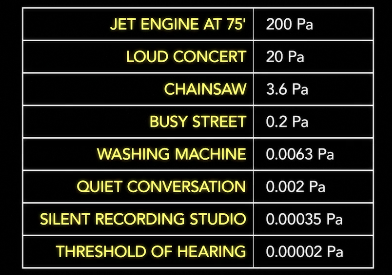
– if the Air Pressure Fluctuates by 200 Pascals, then the Sound is Painfully Loud (1:25000 vs the 200 is a Difference in Air Pressure of 5´000´000 Times which is Quiet a Difference)
– so to Make such a Big Range more Manageable and to Make it better to Reflect the Way Our Ears Hear, we use a Logarithmic Scale to Define it
– with a Logarithmic Scale, as you Multiply the Change in Air Pressure, you only Add Numbers to the Loudness Scale
– to Measure Loudness we use Decibels dB (though Decibels per se is Not a Unit at All), so it is Rather a Ratio of Comparison
– but “dB” is Logarithmic and Serves Perfectly for Covering the Huge Range of Amplitudes we can Hear
– plus we can Use the “dB” as if it were a Unit of Measurement, by Defining a Reference Point and for Acoustic Sound Pressure we Mark this Reference Point with “SPL” Sound Pressure Level
– e.g. if we Set Zero dB to be the Quietest Volume Most People can Hear (Threshold Of Hearing) and then we Keep Adding Decibels, we Arrive at the Painfully Loud 200 Pascals Fluctuation from the Jet Engine at a Much More Manageable Number around 140dB SPL (because the Logarithmic Scale Turns the Addition of Decibels into Multiplication of Pascals)
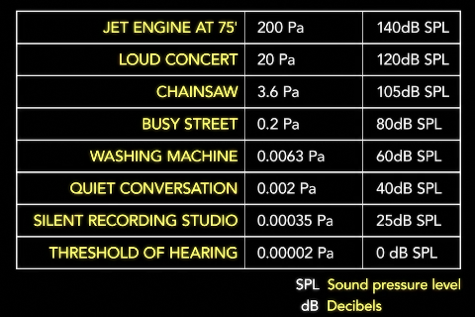
– so using Decibels has the Advantage or More Useful Numbers Across the Board
– it is Useful to Know that in Recording and Mixing, a Boost of Amplitude by 6dB Doubles the Amplitude of that Signal and Reducing it by 6dB Halves the Amplitude of that Signal
Leave a Reply