General
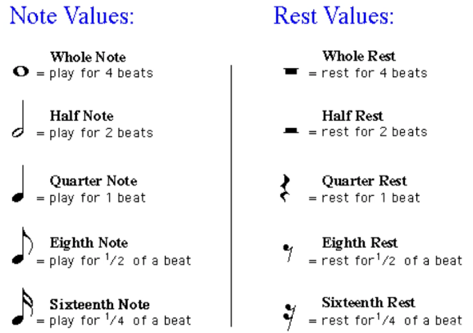
– a Rest is a Rhythmic Amount that has No Pitch
– Indicate a Measured Amount of Time in which Nothing is Played
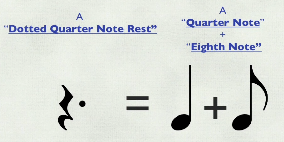
– in Principle, a Dot After a Rest Adds Half of the Rest´s Value to itself (works the same as with “Normal” Notes)
– there is a Dedicated “Rest” Symbol for Every Rhythm, which Simply means “Do Nothing” for that Amount of Time (Quiet)
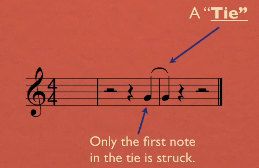
– Notice that if we Want Not Complete Silence, but Playing the First Note Sustained Over a “Group of Rests”, we Use the “Tie” Symbol (Notes then Sustain Over Rests)
Examples of Rests
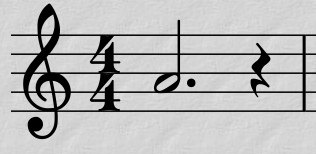
– e.g. here (in 4/4) we have a Half Note with a Dot = 3 Beats (2+1), and to Complete the Measure we Need to Add a 1 Beat Quarter Note Rest
– i.e. 2 + 1 + 1 = 4
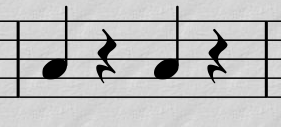
– or here we have 1 Quarter Note – Rest Quarter – 1 Quarter Note – Rest Quarter
– i.e. 1 + 1 + 1 + 1 = 4
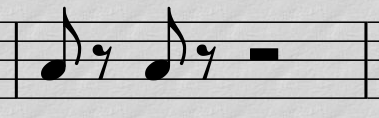
– or here we have 1 Eight Note (1/2 Beat) – Rest Eight (1/2 Beat) – 1 Eight Note (1/2 Beat) – Rest Eight (1/2 Beat) – Rest Half (2 Beats)
– i.e. 1/2 + 1/2 + 1/2 + 1/2 + 2 = 4
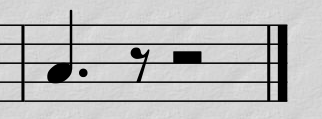
– or here we have 1 Dotted Quarter Note (= 1 Beat + 1/2 Note) – Rest Eight (Together with the 1 Beat + 1/2 Note = 2 Beats) – Rest Half (2 Beats)
– i.e. 1 + 1/2 Note + 1/2 Note + 2 = 4
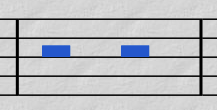
– Again, Since the Measure can Not be Empty, there is a “Whole Rest” (4 Beats) by Default, Hanging on the Line
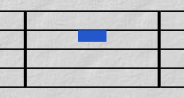
(whereas the “Half Rest” is Sitting on the Line)
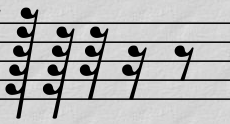
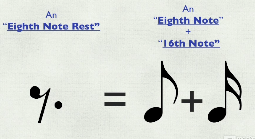
– the Faster Rests are Variations of the Eight Rest (here from Right to Left 8th to 128)
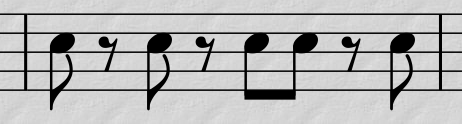
Example Counting with Rests
– e.g. “1 (Eight Note) – and (Eight Rest) – 2 (Eight Note) – 3 (Quarter Note) – and (Quarter Note) – 4 (Eight Rest) – and (Eight Note)”
– Notice there the Rest Falls on 4 (i.e. No Beat on 4), but an “And” of 4
Dotted Rests
Leave a Reply