General
– Is the Most used Synthesizer Model, whether it is Analog Based or Virtual Based
– Subtractive Synth means, a Sound is Derived from a Sound Source (from Waveforms) and then you are Subtracting Things from it (via Filters, Envelope, Modulators)
– Workflow starts from a Keyboard Trigger (Midi Keyboard) –> Sub Oscillator (Sin, Tri, Saw, Sqr) –> Filter Section (Cutoff, Res etc.) –> Amp Env (ADSR) –>Output Stage
Sawtooth (Subtractive)
– Contains All Harmonics, Even & Odd to an Infinite Level
– so in Subtractive Mode you Shape & Cut Harmonics of Such as Shape with Filters, EQ etc.
– the Harmonics are Spread All the Way Up to the Limit of the System, which in the Case of a Virtual Analog Synth will be Half of the Sampling Rate
– After Half of the Sample Rate, “Aliasing” occurs (i.e. they Extend to the Nyquist Limit)
– Saw Wave is Suitable for a Variety of things such as Pads, Strings or Basses etc.

Square (Subtractive)
– Sometimes Called “Rectangle”
– Contains All Odd Harmonics to an Infinite Level
– also Subtractive Options to Cut & Shape Harmonics with Filters, EQ etc. (as the Saw Wave)
– the Harmonics are Spread All the Way Up to the Nyquist Limit (as the Saw Wave)
– gives the Characteristic Hollow Sound
– Square Wave is Suitable for “Cheesy” Sounds such as Chip Sounds, Computer Sounds etc.

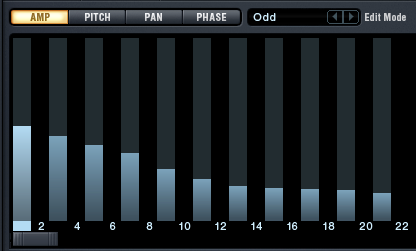
– in Order to Turn a Single Sine Wave to a Square Wave, you basically Skip all Even Harmonics and Pull In Only the Odd Harmonics along the Fundamental (1,3,5,7 etc. instead of 1,2,4,6 etc.)
Triangle (Subtractive)
– Contains Only “Odd Harmonics” (as the Square Wave), but with a Much Quicker Release (Drop Down in Level) of the Odd Harmonics than in Square Wave
– so the Triangle Does Not Sound as Bright
– Triangle Wave is Suitable for Reed or Flute Instruments

Pulse (Subtractive)
– Re-Introduces the Even Harmonics, Depending on the Pulse-Width Settings
– the Base of Many Classic Analog Type Sounds
Leave a Reply