General
– any Frequency Higher than the Fundamental
– Every Sound / Noise we Hear, Consists of a Series of Overtones
– or you can Say that Every Sound is a Mix of Different Overlapping Harmonic and Inharmonic Cycles that are Based on a Fundamental
– that Mix of Harmonic and Inharmonic Cycles is Together Called “Partials”
– and the Structure of Partials Characterises a Particular Sound by Building a Very Specific “Overtone Series” (Each Partial has a Different Frequency with a Different Phase at a Different Amplitude)
– so a Sounds Overtones can be of Inharmonic Partials and / or Harmonic Partials, while the Term “Harmonic” in this Case Means in Relation to the “Perfect Harmonic Series”
– so Harmonic “Even” Partials (= 1,2,4,6 etc.) are a Multiple of the Fundamental, thus Always Support the Fundamental
– means they are a Multiple of the Fundamental by a “Whole Number”, which is Times 1,2,3 4 etc. of any Fundamental Frequency (e.g. from Hertz 64, 128, 192, 256, 320, 384, 448, 512 Up to 1024)
– whereas “Odd“ Overtones (= 1,3,5,7 etc.) are Non Doubles of the Fundamental are Non-Harmonic and Add Something New (= “Noise”)
Partials in Relation to Hz
– this Picture Shows Only the First 16 Available Overtones
– you can Look at the Partial Numbers as Musical Ratios
– Partial 1 is the Fundamental and has a Ratio of 1:1
– Partial 2 has a Ratio of 2:1 and is Octave 1 of the Fundamental
– Partial 3 has a Ratio of 3:2 and is a 5th Above Fundamental
– Partial 4 has a Ratio of 4:1 and is Octave 2 of the Fundamental
– when Building the Overtone Series you can See How the “Logarithmic Scale” Evolves
– i.e. Every Next Overtone is Closer to the Previous One on a Piano Since Music is Measured in “Ratios” (Intervals Get Closer the Higher as you Go)
– this also Explains Why a Very Narrow Set of Tones Sound Better in a Higher Frequencies than in Lower Frequencies (Low Interval Scholar)
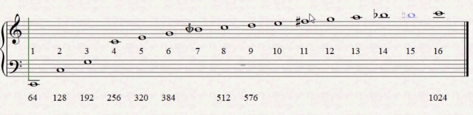
1) the Fundamental Gets the Number 1, here at 64Hz
2) so the 1st Partial is Called “2”
– is a Double of the Fundamental and Builds the Octave 1
– Half the Length of a String = 2:1 when you Measure Air, but Double the Frequency
– so 64Hz x 2 = 128Hz
3) Know Simply Double the 1st Partial “2” to Build the Partial “4”
– will be Logically 2 x 128Hz = 256Hz
– also Builds the Octave 2
4) Double Again to Create Partial 8 and Partial 16 to Generate Repetitions of Already Existing Tone Qualities which are All Octaves so Far
– i.e. 2 x 256Hz = 512 (Partial 8) and 2 x 512 = 1024Hz (Partial 16)
– So you can Say Partial 4 is Either 2 Times the Partial 2 or 4 Times the Partial 1
5) To Examine the 3rd Partial, you can Look at the a Ratio of 3:2, which is Commonly Known as the Pure 5th
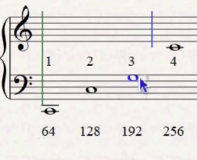
6) Now you can Simply Search the Octaves of Partial 3 by Going to Partial 6 (Ratio 2:1) and Partial 12 (Ratio 4:1)
7) To Examine the 5th Partial, you can Look at the a Ratio of 5:4, which is Commonly Known as the Pure 3rd, i.e. the Major 3rd
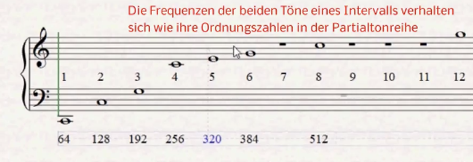
– you can also Look at the 6th Partial as 6:5 which is the Minor 3rd
Additive Building Overtones via Partials
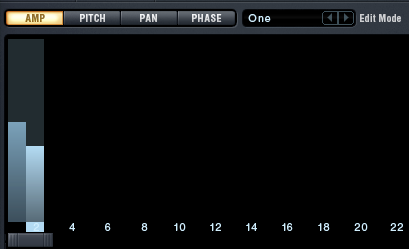
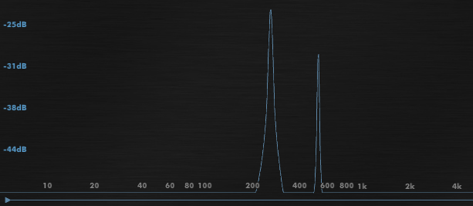
– as soon as you Stack another Sine Wave to an Existing Fundamental Sine Wave, you have basically Created an Overtone at Double the Given Frequency
Subtractive Usage Shape Partials
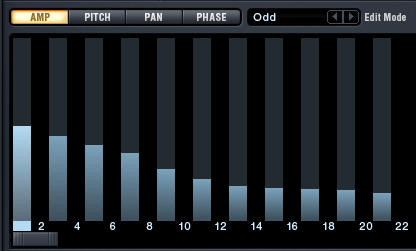
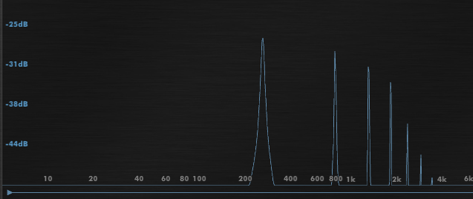
– in Order to Turn a Single Sine Wave to a Square Wave, you basically Skip all Even Harmonics and Pull In Only the Odd Harmonics along the Fundamental
– i.e. 1,3,5,7 etc. instead of 1,2,4,6 etc.
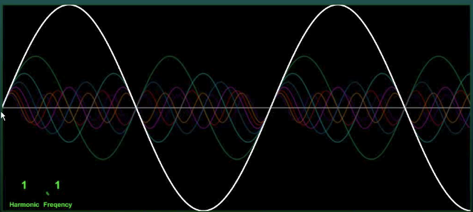
Harmonic Cycle
– Harmonic Overtones Keep a Cycle Repetitive, means they Start and Finish at the same Phase, Over the Fundamental Frequency
White = Fundamental
Green1: Has 2 Cycles per 1 White Cycle of the Fundamental Frequency
Green2 = Has 3 Cycles per 1 White Cycle of the Fundamental Frequency
Green3 = Has 4 Cycles per 1 White Cycle of the Fundamental Frequency
Blue = Has 4 Cycles per 1 White Cycle of the Fundamental Frequency
Red = Has 5 Cycles per 1 White Cycle of the Fundamental Frequency
etc.
Harmonic Sequence Series Table
– First 32 Partials of the Harmonic Sequence Series
– List Starts from Fundamental A3 = 220Hz and Shows the Following Values:
Harmonic Count (e.g. Harmonic 1 etc.)
Interval with Fundamental (e.g. A3)
Interval with Fundamental in Cents (e.g. 1200)
Hertz / Ratio (e.g. 440)
Interval with Previous Harmonic in Cents (e.g. 1200 (Octave 1)
Amplitude of Current Overtone in dB (e.g. -6.02 (1/2))
– the Bold Value Shows when a New Overtone is Added Until the 12 Keys are Complete (i.e. Needs 27 Overtones to Complete All 12 Different Notes)
| Harmonic Count | Interval with Fundamental Note | Interval with Fundamental Cents | Hertz / Ratio | Interval with Previous Harmonic in Cents | Amplitude of Current Overtone in dB | |
| Harmonic 1 | A3 | 0 | 220 | 1 .#INF cents | 0 (1/1) | Perfect Unison |
| Harmonic 2 | A4 | 1200 | 440 | 1200 (Octave 1) | -6.02 (1/2) | Perfect Octave |
| Harmonic 3 | E4 | 1901.95 | 660 | 701.955 (5th) | -12.04 (1/3) | Perfect 5th |
| Harmonic 4 | A5 | 2400 | 880 | 498.045 (4th) | 8.06 (1/4) | 2 Octaves |
| Harmonic 5 | C#5 | 2786.31 | 1100 | 386.314 (M3rd) | 24.08 (1/5) | Major 3rd |
| Harmonic 6 | E5 | 3101.95 | 1320 | 315.641 (m3rd) | -30.1 (1/6) | 2 Octaves + Perfect 5th |
| Harmonic 7 | G5 | 3368.83 | 1540 | 266.871 (m3rd) | -36.12 (1/7) | 2 Octaves + Minor 7th |
| Harmonic 8 | A6 | 3600 | 1760 | 231.174 (M2nd) | -42.14 (1/8) | 3 Octaves |
| Harmonic 9 | B6 | 3809.91 | 1980 | 203.91 (M2nd) | -48.16 (1/9) | 3 Octaves + Major 2nd |
| Harmonic 10 | C#6 | 3986.31 | 2200 | 182.404 (M2nd) | -54.16 (1/10) | 3 Octaves + Major 3rd |
| Harmonic 11 | Eb6 | 4151.32 | 2420 | 165.004 (M2nd) | -60.2 (1/11) | 3 Octaves + Tritone |
| Harmonic 12 | E6 | 4301.95 | 2640 | 150.637 (m2nd) | -66.22 (1/12) | 3 Octaves + Perfect 5th |
| Harmonic 13 | F6 | 4440.53 | 2860 | 138.573 (m2nd) | -72.24 (1/13) | 3 Octaves + Minor 6th |
| Harmonic 14 | G6 | 4568.83 | 3080 | 128.298 (m2nd) | -78.26 (1/14) | 3 Octaves + Minor 7th |
| Harmonic 15 | G#6 | 4688.27 | 3300 | 119.443 (m2nd) | -84.28 (1/15) | 3 Octaves + Major 7th |
| Harmonic 16 | A7 | 4800 | 3520 | 111.731 (m2nd) | -90.3 (1/16) | 4 Octaves |
| Harmonic 17 | Bb7 | 4904.95 | 3740 | 104.95 (m2nd) | 4 Octaves + Minor 2nd | |
| Harmonic 18 | B7 | 5003.91 | 3960 | 98.95 (M2nd) | 4 Octaves + Major 2nd | |
| Harmonic 19 | C7 | 5097.51 | 4180 | 93.60 (m3rd) | 4 Octaves + Minor 3rd | |
| Harmonic 20 | C#7 | 5186.31 | 4400 | 88.80 (M3rd) | 4 Octaves + Major 3rd | |
| Harmonic 21 | D7 | 5270.78 | 4620 | 84.46 (4th) | 4 Octaves + Perfect 4th | |
| Harmonic 22 | Eb7 | 5351.31 | 4840 | 80.53 (4th) | 4 Octaves + Tritone | |
| Harmonic 23 | D#7 | 5428.27 | 5060 | 76.95 (Tritone) | 4 Octaves + Tritone | |
| Harmonic 24 | E7 | 5501.95 | 5280 | 73.68 (4th) | 4 Octaves + Perfect 5th | |
| Harmonic 25 | F7 | 5572.62 | 5500 | 70.67 (M3rd) | 4 Octaves + Minor 6th | |
| Harmonic 26 | F7 | 5640.52 | 5720 | 67.90 (M3rd) | 4 Octaves + Minor 6th | |
| Harmonic 27 | F#7 | 5705.86 | 5940 | 65.33 (m3rd) | 4 Octaves + Major 6th | |
| Harmonic 28 | G7 | 5768.82 | 6160 | 62.96 (M2nd) | 4 Octaves + Minor 7th | |
| Harmonic 29 | G7 | 5829.57 | 6380 | 60.75 (M2nd) | 4 Octaves + Minor 7th | |
| Harmonic 30 | G#7 | 5888.26 | 6600 | 58.69 (m2nd) | 4 Octaves + Major 7th | |
| Harmonic 31 | G#7 | 5945.03 | 6820 | 56.76 (m2nd) | Harmonic 31 G#7 | |
| Harmonic 32 | A8 | 6000 | 7040 | 54.96 (Octave) | 5 Octaves |
Leave a Reply