
General
– We use Notation in a Time Signature for Example if we Do something in 3/4 Time (3 Quarter Notes per Bar), Each Measure has 3 Beats = Top Number (# of Beats per Measure) & Each Beat is 1 Quarter Long = the Bottom Number (Length of each Beat)
– The Top can be any Number while the Bottom Number has to be a Power of 2 (means Bottom stays Dividable by 2)
– p and q look for common Subdivisions as within mathematical Fractions, so “p” (Top Number) against “q” (Bottom Number) LCM “p:q” , means in a 3:5 Signature you need 15 Divisions so they meet each other again (at 1 and then at 15)
Examples
– Whole Note = 4 Beats
– Half Note = 2 Beats
– Quarter Note = 1 Beat
– Eight Note = 1/2 Beat
– 16th Note = 1/4 Beat

– If we wanna a Note that isn´t a Fraction with the Power of 2 in it, we can use other Notation as Triplets or Quintuplets (also a Beat, but no longer divided into 2, 4th, 8ths or 16ths etc.)
– a Dot after a Note is to use Half of the Length of the Note, means if we had a 2 Beat Line we would add the Half of that 2 Beat Line = 1 Beat additionally to the 2 Beats = 3 Beats (same works with Rests)

Notation Extras
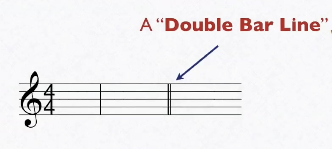
– a Double Bar Line separates Two Sections of a Piece (Verse || Chorus)
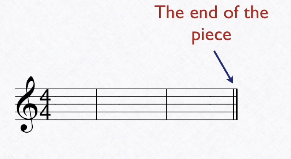
– Thicker Bar Line after a Thin Bar Line indicates End of the Piece
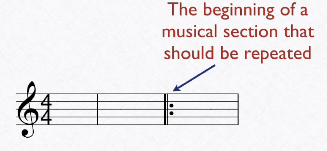
– Thick / Thin / and 2 Dots indicate the Beginning of a Section that should be repeated
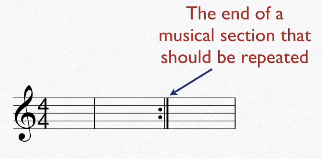
– 2 Dots /Thin / and Thick indicate the End of a Musical Section that should be repeated
Leave a Reply