General
– is a Temporary Change to a New Tonal Center / Key (Not Definitive as Transposition)
– Take the Content and Move it to Another Key for a Significant Amount of Time, Before Going Back to the Initial Key
– Every Modulation by a Certain Scale Degree gives a Certain Type of Feeling which is something to Consider for the Ideal Response
– this can be Effective if you need to Extend a Song by a Couple of Minutes, but you Want to Preserve the Overall Integrity
– i.e. Modulation is Changing from One Key to a Different Key within a Single Movement of a Piece to Bring Variety to Keep a Piece from Becoming Boring or Repetitive
– a Common way for Modulation is Moving between Relative Minor/Major (No Need to Introduce a New Staff)
– in Reality you can Modulate to Every Key you want to, Often Done via the 5 Dominant Chord of the New Key (for Example C to E via B7 (B is the Dominant of E)
– Pop Often uses Modulations Up a Half-Step or a Whole-Step at the End or Ride-Out of a Song
– usually you stay for a Decent Amount of Time in the New Tonal Centre to Give the Listeners Ear a Chance to feel it
– there are many Ways to Modulate but all of them Involve the Establishment of a New Tonic Chord (a New “I” Chord)
– Modulation Chords Last Longer than Borrowed Chords so a New Key Center is Tonicised
– Modulation often Marks a New Section of a Song & is Followed by a Series of Chords that Confirm it as the New Tonal Center
Modulation in a Progression
– Remember “Modulation” is the Shift to a New Tonal Center in a Chord Progression (Not just a “Transit” as with Secondary Dominants)
– Lasts for a Significant Period of Time
– Often Occur at the Start of a New Section & then last throughout that Section (Traditionally a Bridge, Chorus or Outro for Example)
– furthermore the New Section usually has Chords which support & confirm this Section as a New Tonal Center
– Write down Scales / Keys / Tonal Centers you want to use & compare its Notes to decide where / how to Modulate (or which Chords can serve as Pivot Chords etc.)
– Use “Common Tone Modulation” or “Common Chord Modulation” where we connect different Tonal Centers with a single Pivot Note or a Pivot Chord (a Note or Chord that occurs in both crossing Tonal Centers
– Focus / Add Melody Notes that occur in both Tonal Centers for a more “Smooth” Modulation
Two Types of Modulation
Smooth:
– Shift to a Closely Related Tonal Center
– more Natural Change cause New Tonal Center shares more Notes with the Last Tonal Center)
– a “Pivot Chord” is very effective because a Pivot Chord is Shared by both Tonal Centers (Common Chord Modulation)
– this counts also for a “Pivot Note” – a Pivot Note must also be Shared by both Tonal Centers (Common Tone Modulation)
Abrupt:
– Use for a Feeling of Surprise
– Change of Direction
– It can be “Jarring” (Feeling of being Transposed to a other Place Musically or Emotionally)
– Often found during an Outro Chorus or Up a Half-Step / Whole-Step
– Abrupt Modulation can be Effective for Solo Sections
– can also be achieved by Modulating to the Parallel Minor when Transitioning from a Major Key or Vice Versa
Smooth Modulation Examples
Example 1 Smooth “Pivot Chord” Modulation
– Here a Pivot Chord is used to Modulate via the Shared F Chord from C Major to F Major
– also the last F Chord is basically the IV of C Major and the I Chord of F Major of course
– this is called a “Common Chord Modulation”

Example 2 Smooth “Pivot Chord” Modulation
– Here a Pivot Chord is used to Modulate via the Shared G Chord from C Major to G Major
– the 5th of C Major is G and we use the I Chord of G Major & then confirm the New Tonal Center “G” with G Major Diatonic Chords

Example 3 Smooth Modulation to a Relative Minor

Abrupt Modulation Examples
1 Abrupt “Whole-Step” Modulation
– Here we modulate from C Major to D Major for a “Lifted” Feeling (D being the 5th of the last G Chord)
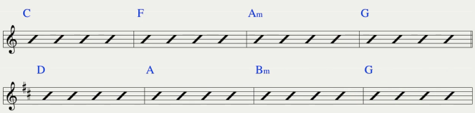
2 “Smooth-Out” a Abrupt Modulation via Dominants
– Try to “Precede” from C to the New Key D with the New Keys V or V7 Chord
– Here we Insert A before D (as the 5th Chord of the Next Tonal Center D) to prepare the Listener already in the “Previous Section” for a smoother Key Change

– same Example as above with a Dominant A7 (A7 as the V7 Chord of new Tonal Center D)

3 Example with a Dominant B7 (B7 as the V7 Chord of new Tonal Center E)

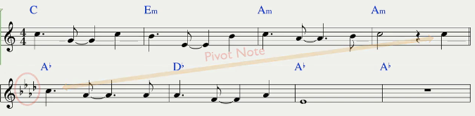
4 Example Abrupt “Pivot Note” Modulation (Common Tone Modulation)
– Here the Pivot Note C is used to Modulate from Am a Half-Step down to Ab (because C is a Common Tone within A Minor & Ab Major)
5 Example Abrupt “Parallel Minor” Modulation
– simply by modulating to the Parallel Minor when transitioning from a Major Key or Viceversa
– Here we go from C Major to C Minor

Other Modulation Techniques
Basic Workflow
1) Compose / Outline a Basic 8 Bar Principal Theme with Chords and Melody in a Desired Key (here Am)
2) Modulate the Content Up a 4th from the Point to Extend On with Proper Modulation by Circle of 4th/5th, Inversion e.g. Nearest Notes
3) Means the Content Stays exactly the same but Yet Playing in Key (can be Diatonic Degree or Not where Knowing the Effect of certain Modulation Intervals is Experience)
Pivot Chords Modulation
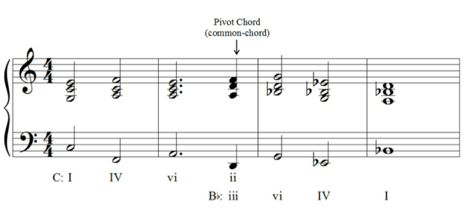
– “Pivot Chords” are Chords that are Common to 2 Different Keys
– used to Modulate from the Key you are Starting in and the Key you are Modulating to
– to Find Chords that 2 Keys Share in Common simply Line Up all of the Chords of the 2 Keys
– for Example C Major and Bb Major, D Minor & F Major are the Only Chords that are Common to Both Keys and are therefore Called “Common Chords” and Serve as Pivot Chords to Modulate from C to Bb

– there are 3 Steps for Successful Modulation by Pivot Chords
1) A Tonic Must already be Firmly Established
2) A Pivot Chord is used and the Tonal Center begins to Change
3) A New Tonic is Firmly Established and made Clear to the Listener
Example of a Pivot Chord Usage
Altered Chords Modulation
– we Discussed earlier that a Secondary Dominant Altered Chord can be used as a Tonic for a Brief Period of Time and if we Not Return to the Tonic Chord, we Modulated successfully to another Key
– this Example Modulates from G Major to D Major changing the “ii” Chord an Measure 4 (2nd Half) from A Minor to A Major Turning One Note to C Sharp
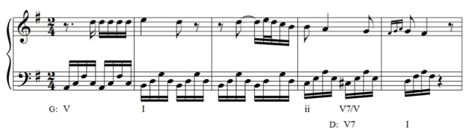
– it is No Pivot Chord because technically there is A7 is Not Shared between Keys G Major and D Major, but only belongs to the Key of D Major
– i.e. this Substitution creates a A7 which is only “Loosely” Related to G Major by being a Secondary Dominant “V7 of V” (but Not V7 as it is in Relation to Destination Key D Major)
Pivot Tone Modulation
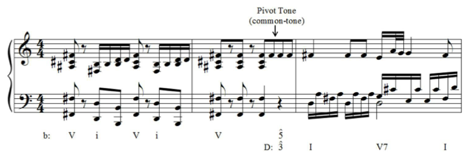
– also Called “Common-Tone” Modulation
– Pivot Tone Modulation uses a Single Tone that is Common to both, the Starting Key and and the Destination Key (whereas Pivot Chord Modulation uses a Chord that is Common to both in Order To Modulate)
– this Example begins in the Key of B Minor and Modulates into the Key of D Major based on the F Sharp Tone, which is the 5th in B Minor and 3rd in D Major
Sequential Modulation
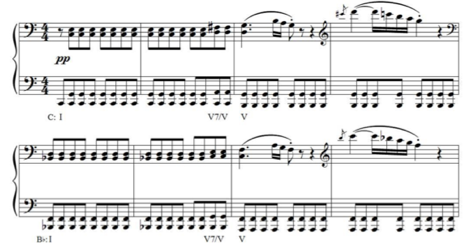
– Sequential Modulation uses the Chromatic Scale (instead Diatonic) and is fairly Common
– for Example begins in the Key of C Major and Modulates to Bb Major and the Second Line is the same as in the 1st 4 Measures but a Whole Step Lower in Pitch which is the Character of Sequential Modulation
Direct Modulation
– also Called “Abrupt Modulation” because there is No Setup for it
– it Typically occurs between 2 Phrases and is also called “Phrase Modulation” (but also occurs between Sections of a Song)
– this Example begins in C Major and Modulates into G Major via a Authentic Cadence V-VII-I Ending on Phrase 1 (but without Warning into G Major in 2nd Phrase)

Leave a Reply