
– 2 Main Aspects of Sound that can be Measured using Numbers are Frequency (How often a Sound Wave Fluctuates) and Amplitude (How Far a Sound Wave Fluctuates)
– Frequency = How often a Sound Wave Fluctuates
– the Simplest Possible Sound is a Sine Wave and has only 1 Frequency at a Time
– we Perceive that Frequency as a Pitch on a Spectrum from Low to High
– while Pitch has more a Musical Meaning, Frequency Refers to the Rate at which a Sound Wave Fluctuates (Different from the Speed of Sound)
– Imagine a Beach with Waves, we could Measure the Speed of the Waves which is How Fast they Move Towards the Beach, or we could Measure the Frequency of the Waves which is How Often a Wave Arrives
– i.e. if a Wave Hits the Shore Every Second, the Frequency is 1 Wave per Second
– we can Compare the Frequency of Ocean Waves to the Frequency of Sound Waves, we simply Measure the Pattern of High and Low Air Pressure Fluctuations in Cycles per Second which is a Unit Known as Hertz (Hz)
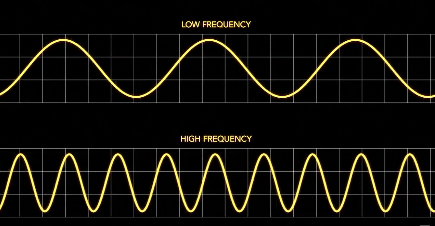
– Higher Frequencies Change Pressure Up & Down More often and Lower Frequencies Change Pressure Up & Down Less Often, which Gives us also a Shape
– Shapes of Sound can be Measured and Visually Represented with an Oscilloscope which Shows Time Horizontally and Waves Fluctuations Up & Down Vertically
– so a Shape (Tone) of 100Hz gives us 100 Cycles Per Second, 5000Hz = 5000 Cycles Per Second etc.
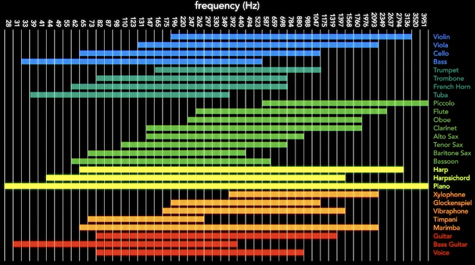
– In Contrast to the Sine Wave which has only 1 Fundamental Frequency, Real World Instruments have a Fundamental Frequency that Determines the Musical “Pitch” Plus other Harmonic Frequencies that Determine the “Timbre”
– the Timbre is what Makes One Voice or Instrument Sound Different from another (Below List Shows which Instruments can Produce what Frequencies)
– it is Important to Understand, No Matter what the Frequency of a Wave is, the Sound itself Moves at the Same Speed = “the Speed of Sound”
– what the “the Speed of Sound”, Depends On what the Sound is Moving through
– i.e. in Air, at Average Temperature and Humidity it is just Over 340 Meters per Second (which is Pretty Fast)
– but in other Materials it can be even Faster, e.g. 4 Times Faster in Water (ca. 1400 Meters per Second), or 15 Times Faster in Solid Eire (ca. 5000 Meters per Second)
Leave a Reply