General
– also called “Changes” in Jazz
– often a Song starts in the Tonic (Root) and the way that the Chords refer back to it or play against to it – is what the listener takes on a Journey
– Chord Progressions move from States of Tension to States of Resolution (Turnaround in Jazz)
– help us give Structure & Definition to a Songs Rhythm and Form
– Chords tend to change on Downbeats and Quarter Notes
– Harmonic Rhythm = “Frequency” or “Rate” at with which Chords change in a Progression
– Cadence is a Resolution that Occurs at the End of a Section or a Song (kind a “Final”)
– Progressions or Chords are not Copyrightable
– Progressions are Referred from the Tonic (I)
– can be Diatonic Progressions or Chromatic Progressions for more Colour
– a Progression requires in Minimum 2 Chords (in Dance Music or Minimal with more Drum Focused Rhythms)
– Simpler Chord Progressions use in Minimum 3 Chords
– As we know same Chord Progressions as I, IV, V are heavily used but the other Song Elements as Lyrics, Melodies and Rhythm make the Song unique (also Timbre, Root Key, Pitch etc. are Reasons why No Song sounds 1:1 the same)
– the Journey is Made effective when we are able to get a Sense of “Where We Are” in Relation to the Tonic
– 1st Inversion is simply play the 5th from Root Chord below
– Learn 1, 4 & 5 Chords in all 12 Keys
– Chord Progressions often Bounce between Chord Qualities (Minor to Major) where the more used Quality decide if the Song is either Minor or Major
Classification of Diatonic Major Scale Degrees
(I) Tonic = Chord on the 1st Degree
(ii) Supertonic = Chord on the 2nd Degree
(iii) Mediant = Chord on the 3rd degree
(IV) Subdominant = Chord on the 4th degree
(V) Dominant = Chord on the 5th degree
(vi) Submediant = Chord on the 6th degree
(vii°) Subtonic (Leading Tone) = Chord on the 7th degree
Simple Examples
– the I – IV -V Progression works so well because the Keys are very related to each other (see the Circle how the F Chord is 1st in 4th Direction and G is the 1st in 5th Direction (this applies also to Minor Chords being i – iv -v)
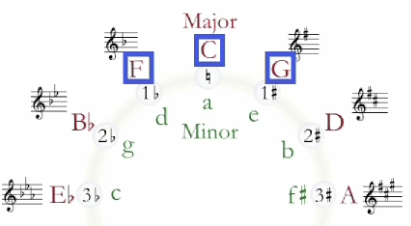
– in a IV – V -I Progression the IV often gets substituted by a Minor 2nd Chord (ii) – results in a ii – V – I Progression (also see Circle of 4th where Dm is the relative Minor of F and therefore can be easily substituted for it)
– the ii (Dm) – V7 (GDom7) – I (C) is the most common Progression in Jazz
– Resolution (Turnaround in Jazz) = the Movement from a State of Dissonance/Suspension (GDom7) to a place of Consonance (C Maj)
– iii (Em) – VI7 (ADom7) – ii (Dm) – V7 (GDom7) moves in 4th and is a common Progression in Jazz
Diatonic Chord Progressions
– Diatonic Progressions are the Foundation (keep it simple as in Pop / Rock 90% are Diatonic Progressions)
– Notes & Chords derive from the Parent Scale
– for Example in C Minor Scale we can build with = Cm Do D# F Gm Gbm Bb
– a Diatonic Progression in G Minor could be Gm (i) – Cm (vi) – Dm (v) – Gm (i) – Gm (i) – Eb (VI) – Dm (v) – Gm (i)
– 1, 4, & 5 Primary Chords can easily rotate in Random Positions (the Progression should at Minimum Start or End in Tonic for a “Home Feel”)
4 Note Chord Progressions
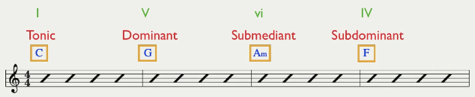
– Beside the Primary Chords, the 4 Note Chord Progression introduces the vi (6th) Degree for a much broader Journey
- for Example this easy Order or any other Position (remember to Start or at least Finish in Tonal Centre (Root)
Better Chord Progressions
1) A Balanced Journey through Tension & Release while supporting the Melody Notes
2) A Noticeable Connection to the “Ballpark” of the Tonal Centre
3) Support Lyric, Story & Emotion of the Song
Looking for Notes / Chords to Build Chord Progressions
1)Diatonic Scale Degrees (build Chords from only the Notes within a Scale)
2) Circle of 4th & 5ths Roundtrip / Back Cycling (5th to 5th / 4th to 4th which is a 5th Inverted)
3) Use Parallel Scale Chords / Borrowed Chords (opposite possible Chords starting from the Same Key on (lets say G) Deriving from a either Major, Minor or any Scale as Dorian, Aeolian etc.)
4) Use Relative Scale Chords
5) Secondary Dominants (use the 5th Degree of any Note within Diatonic Scale, e.g. in a C Major Scale Insert the D7 Chord before G (D is the V Chord of G) & then continue with Standard G Chord
6) Added Tones (use 2nd, 4th or 6th of the Diatonic Scale and add these Notes to a Triad where it supports well a Melody or to add more Character to a Standard Triad with a fourth Note in a Chord)
7) Sus Chords (leave away the 3rd but add the 2nd or 4th of the Diatonic Scale)
8) Passing Chords (a 1 Bar or Half a Bar Connecting Chord, that uses the same Colour (Major/Minor) either Chromatic or Diatonic & typically falls on a Weak Beat (2 or 4)
9) Slash Chords (Inversions) to “Bridge” Notes in Directional Movement in Ascending or Descending Mode
10) Modulation to Shift (definitely) to a New Tonal Centre in a Chord Progression (either via Abrupt or Smooth Mode)
11) Harmonic Rhythm to vary Impression of given Chords (Starting your Progression in a predictable Way and then Going to somewhere unexpected by changing The Rate at which Chords occur in a Progression Rhythmically (Quarters, Bars, 1/2 etc.))
12) Fake-out Surprise – means Starting your Progression again in a predictable Way but use a Dominant 7th Chord of a Scale to then move to somewhere other than the Tonic to create Surprise
13) Transposition – take the Roman Numeral System to represent Chords & easily “Adapt” the Numerals (Scale Degrees) to perform the same in any other Key
Leave a Reply