General
– was the First Synthesis Technique of All (before Moog etc.)
– Forms of Usage even Date Back to 1800 with the “Tella Harmonium” (Later Pipe Organs where every Pipe is basically a Sine Wave)
– Sine Wave is the Actual Building Block of All Sound and Additive Synthesis is Nothing else than Building on Multiple Sine Waves
– the Fourier (Inventor of FFT Analysis) Theory States that a Complex Wave is Made Up on Sine Waves or also Called “Sinusoidal Components”
– a Pure Sine Wave (without any Partials) Consists of Only 1 Fundamental Peak

– this Fundamental is a Integer Number which you can Multiply by 2
– e.g. a Fundamental o”f C3″ at 263Hz is 2 Times the Frequency = 526Hz (Octave of Fundamental), 3 Times the Frequency = 789Hz (5th of Fundamental) etc.
– the Idea is to Model “Waveforms” with all different Partial Structures per Sine Wave, then Morph between Blocks of Partials with a Position Slider, even Stack them or Model a Dedicated Frequency Shape over Time according to another Sound (by Positioning Partials over Time)
– any Sound in the World can be Broken into a Series of “Sine Waves”, so the Goal is to “Re-Build” Sounds in Additive Synthesis through Frequency and Amplitude
– 1 Sine Wave has No further Harmonics than its own 1 Pure Frequency, but the Combination of a Series of “Sine Waves” Builds the Harmonic Spectrum
– a FFT Analyser Show these Partials very exactly
– If the Harmonics are Not an Integer Multiple of the Fundamental they are Called “Partials”, i.e. the Spectrum is Defined as “Inharmonic” (as a Bell, Percussion or Noise)
– in the Real World Sound Travels and Looses Energy over Time, so Sound is Time Based and Decays over Time which is also True when Designing Sounds in a Additive Engine (i.e. Fade Out Overtones over Time or it will probably Sound Unrealistic and Annoying)
– Synths have actually different Engines i.e. how many Overtones you can actually use, some let you Input only 32 Partials, others 128, other Synths 512
– of course this Demands on the CPU and so some Synth will show you Actual Partial Usage (Loom, Razor etc.)
– Lower Notes Played will need much more Partials to Recreate a Sound
– also Notice that Partials Reach from the Fundamental (Bottom) to Top, so a High Note may already be the End of what we Hear at all (i.e. its Overtones are above 20kHz anyways)
– also Notice that the Relationship of Partials Change from Note to Note, so there might be a Detuning because Changing the Fundamental has an Impact on the Overtone Structure
– to Maintain the Relationship of Partials when Playing on different Keys, there is often a “Synced” Parameter in Synths
Partials as the Building Block (Breakpoint in Alchemy)
– “Additive Synthesis” Makes Use of that Fact, that any Sound can be Broken into a Series of Sine Waves (also Called “Partials”)
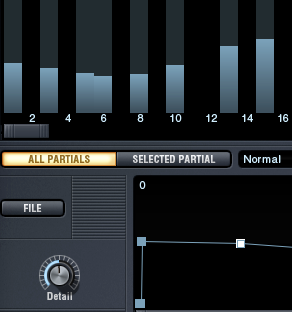
Block 1 has its own Series of Sine Waves (Partials / Harmonic Structure / Waveform)
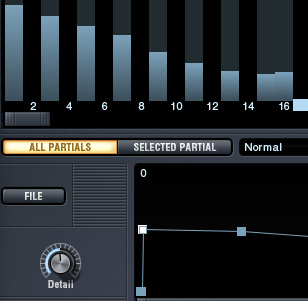
Block 2 has its own Series of Sine Waves (Partials / Harmonic Structure / Waveform)
Leave a Reply