General
– Cadence is a Resolution Occurring at the End of a Section or a Song (Kind a “Final”)
- i.e. the Way a Phrase or Sequence of Chords Comes to an End
- Typically a Harmonic Progression of 2 or 3 Chords that come to an More or Less Obvious Conclusion
– a Cadence is Like “Musical Punctuation” and is Defined as a Progression of 2 Chords that Expresses some Degree of Finality
– What Happens Harmonically at the Resting of a Phrase
– Usually a 2-Chord Progression that Happens at the End of a Phrase
– a Cadence can be at Any Point in a Piece of Music that Feels Like an Ending Point, Even if it is Only Temporary (or in the Middle)
– a Type of “Resolution”, e.g. Getting back to the I Chord
– in Jazz Called “the Turnaround”
– Compare it with Grammatical Punctuation like Periods, Commas, Question Marks etc.
– there are 4 Types of Cadences
Authentic Cadence
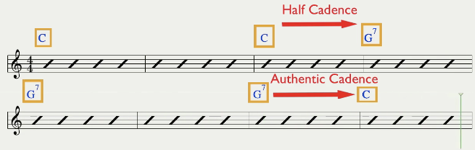
– the Resting of a Musical Phrase when the Chord Progression is V to I (Dominant to Tonic)
– V to I or V7 to I
– “Strong Cadence” with a Resolution from the V Chord to the I Chord
– Like “Period” in Grammatical Punctuation, it Stands for a Very Definitive Type of Ending
– the Leading Tone in the V Chord Gives the Strong Feel of Resolution by following to I Chord (in C Major this would be the B in G Major to the C in C Major)
– in a C Major Dominant 7 Chord, the F as the 7th also “Cries” to Cadence Strongly to E
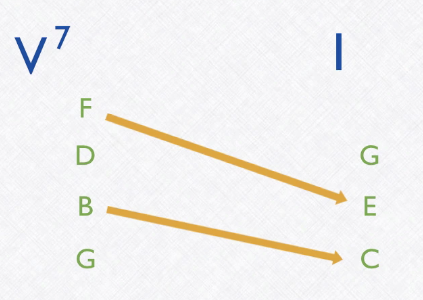
– Notice that in Classical Music Rules are More Strictly (Perfect & Imperfect)
Perfect
– Dominant and Tonic Must be in Root Position
– the Top Voice Ends on a Tonic Note

Imperfect
– Dominant and Tonic can be Inversions
– the Top Voice can End on a Any Note
– and you can also Use the 7 Dim Chord Instead of the V Chord Going to the I

Half Cadence
– the Resting of a Musical Phrase when the Chord Progression Ends on a V Chord (Ends on Dominant Chord)
– Sounds “Incomplete”, Usually in the Middle of a Longer Section of Music (Impression you are Not Quite at the End yet)
– I to V (sometimes ii, vi or IV is used in Place of I)
– Called a “Weak Cadence” & Ends on the V Chord
– Like a “Comma” in Grammatical Punctuations, it Stands for a Pause before a Authentic (or Ultimate) Resolving
Plagal Cadence
– the Resting of a Musical Phrase when the Chord Progression Ends on the Subdominant Going to the Tonic Chord (Subdominant to Tonic)
– IV to I
– Plagal Builds the Resolution from IV to the I Chord Called the “Amen” Cadence
– Derives from the Fact that it´s used a lot in Church Music as the Finish “Amen”
– Feels “Softer” and More Subtle that Authentic but has a Similar Function for Finality

Deceptive Cadence
– the Resting of a Musical Phrase when the Chord Progression Ends on Something Other than the I Chord
– e.g. in Major Often a Dominant Chord Going to the VI Chord (as the VI Chord is its Relative Chord and a Nice Substitute for the I Chord)
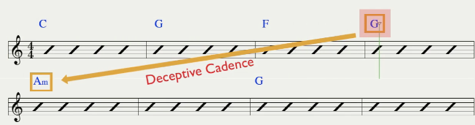
– V to a Chord other than I (most often it is V to vi)
– Traditionally V Chord Moves to the vi Chord and known as “Surprise Cadence” (cause V Does Not Resolve to I Chord)
– this Works Good because the C and Am (I and vi in Major C) have 2 Notes in Common with C & E
– Kind a “Question or Exclamation Mark” in Grammatical Punctuations, it stands for a Pause before a Authentic (or Ultimate) Resolving
Leave a Reply