
General
– Hemiola Arises from the Metric Ambiguity Posed by a Measure of 6 Beats, which can be Divided in 3 Groups of 2 or 2 Groups of 3 (3 to 2 Pattern)
– i.e. 2 Different Patterns (2:3 Pattern) with a 2 Beat Pattern vs a 3 Beat Pattern to Form 6 Beat Groups (a Ratio of 1 1/2)
– 6/8 is particular Interesting cause 6 = 2 x 3 (which is a Part of two Different Primes), you can think of 6 as 2 Groups of 3 or you can Think of it as 3 Groups of 2
– Africans use more of a 3:4 to Form 12 Beat Groups (more Complex as the Duration is Longer and more options are available as the Ratio is 0.75 instead)
6/8
– 6 can be 2 Groups of Triplets
– or 3 Groups of 2
– Listen to “Händel Wassermusik” Example of Hemiola Sequentially
3:2
– Example of a Hemiola Formula used Simultaneously instead Sequentially
– 3 (3 Quarter Notes Per Bar Part 1) against 2 (2 Beats per Bar Part 2)
– you may try Out other Mathematical Stuff based on that Hemiola (Brubeck’s “Time Out” has a lot of Interesting Patterns)
– Ligeti used the Time Signature 4:3 in the 3rd Movement of Piano Concerto with Repetitions on Beat 28 (he often used 3:4 Patterns towards African 12 Beat Groups)
– to get a Group of 12 (4×3 e.g. 3×4), he used the Following Scheme to Form Patterns:
4 Beat Patterns
1) 6 x 28 = 168 Quarter Notes
2) 4 x 28 = 112 Dotted Quarter Notes
3) 2 x 28 = 56 Dotted Whole Notes
3 Beat Patterns
1) 3 x 25 = 75 Whole Notes
2) 4 x 25 = 100 Dotted Quarter Notes

3:2 “Hemiola” in a 6/8 Signature (European)
1) The Right Hand plays 2 Beats
2) in Order to Divide the Measure of 6/8 into 2 Beats, each of these Beats must have the Value of a Dotted 1/4 Note or 3 x 1/8 Notes
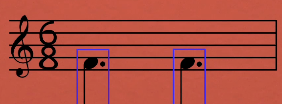
3) Now we need a Left Hand Pattern that divides the 6/8 Pattern evenly into 3 Beats
4) So we need 3 Quarter Notes, which is equivalent to 6 x 1/8 Notes
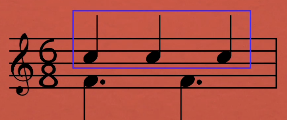
5) Note that the 3 Beat Pattern must move Faster than the 2 Beat Pattern in Order of them both to occupy the Length of a Measure
6) If well Done, You can Change your Focus from the 2 Beat Pattern to the 3 Beat Pattern and Back etc.
7) Listen to Right Hand on Right Speaker & Left Hand on Left Speaker
4:3 Pattern in a 3/4 Signature (African Hemiola Quality)
– i.e. 2 Different Patterns (2:3 Pattern) with a 2 Beat Pattern vs a 3 Beat Pattern to Form 6 Beat Groups (a Ratio of 1 1/2)
1) Here the Primary Beat Pattern needs 3 Beats
2) So the Right Hand needs 3 x 1/4 Note to Fill the Measure of 3
3) For Secondary Pattern (Left Hand) to occur along with it, we need 4 Dotted Eight Notes (because 1/8 + 1/16 they add up to 3 Beats)
4) Obviously the Dotted 1/8 Notes, here need to Move at a Faster Beat than the 3 1/4 Notes, in Order of them both to occupy the Length of a Measure
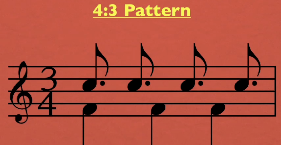
5) Listen to Right Hand on Right Speaker & Left Hand on Left Speaker
Leave a Reply