
- General
- Identify Sharps vs Flats
- Identify Major Sharps vs Flats
- Identify Minor Sharps vs Flats
- Examine the Key of a Track
- Rotating in the Key Circle
- Melodic Energy
- Simple Approach make Melody with Notes just within the Scales (Gm)
- Melodic Balance
- Advanced Approach make Melody with Notes just within the Scales (Bbm)
- Melody Key Recognition Test with "Faithless – Sleep" (Bm)
- Motif and Rhythm
- Practical Motif Melodies and Introduce Dynamic Variations
- Counterpoint
General
– We know that when we build a second Scale of the 5th Note of the current Scale, we have one more Sharp (the same behaves for Flats just Counter Clockwise)
– When Circle crosses Sharps/Flats at 6 o’clock , focus the Subdominant from C = F, then Counter Clockwise every 4th Note of the current Scale will build a Scale with one more Flat, Bb with 2 Flats and logically Eb the 4th Note of Bb Scale has 3 Flats on so on
– a new Flat or Sharp in the Circle is always introduced by the Next Letter (F´s Flat is Bb which is the next Counter Clockwise)
– 2 General Approaches for Melodies, either a Voice or a Instrument
– for a Singer it’s much easier to Sing in Whole-Steps than in Half-StepsBass-lines
– Try Melodic Minor Going Up the Scale (in Gm = G,A,Bb,C,D,E,F#) (= a Augmented 6th and 7th) but a Natural Minor Going Down the Scale (in Gm = G,A,Bb,C,D,Eb,F), because the Melodic Minor backwards just sounds too much Major
– Try Melodic Minor for Lead Melodies (e.g. anything that’s more of a Melodic Line) because of more Drive & Energy (e.g. Garage House has only Melodic Minor Bass-lines)
– Try Melodic Minor for Bass if the Song is just going for the Bass, in other cases not
– Try a Major Melodic Scale with a Flatten 6th and 7th Note (in G = G,A,B,C,D,Eb,F)
Identify Sharps vs Flats
Basic Steps
1) Choose your Key
2) View in Circle if the Key is in the Left Span (Counter Clockwise for Flats) or in the Right Span
(Clockwise for Sharps)
3) Count the Notches from 12 o´Clock (either C or Am) to your Key
4) Yet you know how many Sharps or Flats by counting Notches
5) Now Define what Sharps or Flats by spell the first Letter “Father Christmas Got Dad An Electric Blanket” either Backwards when Flat or Forward when Sharp
Identify Major Sharps vs Flats
– Memory “Clockwise” the Sharps for any Key by counting up from C to any Letter in the Sentence “Father Christmas Got Dad An Electric Blanket” – for Example B (Blanket) is 5 Notches forward from C (Christmas) and has 5 Sharps which are F#,C#,G#,D#,A# cause you count forward the Sentence
– Memory “Counter Clockwise” the Flats for any Key by counting backwards from C to any Letter in the Sentence “Father Christmas Got Dad An Electric Blanket” – for Example Ab (An) is 4 Notches backwards away from C (Christmas) and has 4 Flats which are Bb,Eb,Ab,Db cause you count backward the Sentence
Identify Minor Sharps vs Flats
– works the same way with the same Sentence “Father Christmas Got Dad An Electric Blanket” – just put Am at 12 o´Clock (by default only Natural Minor as the relative Key)
– For Example Bm is “Clockwise” 2 Notches away from Am and therefore has 2 Sharps which are F# (Father) and C# (Christmas)
– Or to the Left Gm is “Counter Clockwise” 2 Notches away from Am and therefore has 2 Flats which are Bb (Blanket) and Eb (Electric)
– Or if you take Cm which is 3 Notches away backwards from Am with 3 Flats which are Bb (Blanket), Eb (Electric), Ab (An) cause you count backwards the Sentence
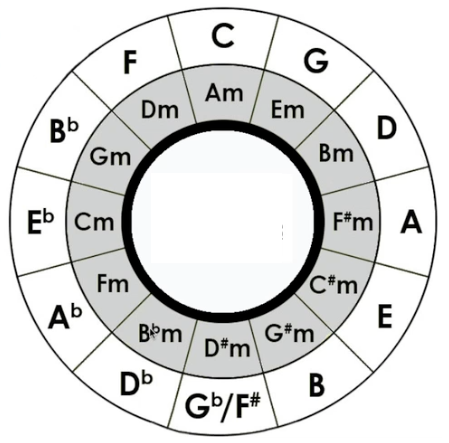
Examine the Key of a Track
– Example for a “Imaginary Song” with 4 Black Notes & First Chord in C#
1) if you know how many Black Notes are used – you can filter the possible Keys from the Scale which have 4 Black Notes (Sharps or Flats)
2) See the Circle – with 4 Black Notes it´s either E or it´s relative Minor C#m in 5th Direction or then Ab or it´s relative Minor Fm in 4th Direction
3) We need more Information – Write down the single Notes of these 4 possible Keys with their Sharps & Flats
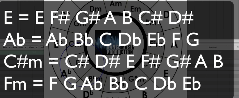
4) Most Songs start in Tonic & have Tonic Dominant Movement (Chord Cadence) – since the First Chord is a C# and has G# as the Dominant, C#m has a good Chance to be the Key (cause no other Key has G# as the Dominant)
5) But the Writer can also use “Accidental Notes” – so let´s indicate the Melody to see what Note is the most “Frequented Note” (played very often) & Compare again to Circle
Rotating in the Key Circle
– the smoothest Change we can make from a Key to another is a difference of only One Note – therefore in the Circle any Key One Step away replaces just One Note
– for Example C to F to the Left (B is replaced by Bb) or C to G to the Right (F is replaced by F#)
– modulate (moving) Awkward (down the Circle ) in small Steps (C-G-D) adds Energy to a Song (Dance Music)
– modulate too far away (C-E-B) is not that effective cause it will Sound like a other Record
– another way to Modulate is between Minor / Major in the Relative Term
– moving Anti Clock Wise produces a typical Natural Chord Progression (E – A – D – G – C)
Melodic Energy
– the Melody should underline the Songs Tonality
– Lead to the Key of the Music
– often you use the Tonic & Dominant Notes of the Scales
– use Melodic Scale upwards & Harmonic Scale downwards for Melodies (in Gm this would be G,A,Bb,C,D,E,F#,G upwards (note that F# is F# because you have raised the 7th for Melodic & G,A,Bb,C,D,Eb,F,G downwards
– start Melody with another Note in the Scale as the Tonic Note – ideal is the 5th (would be D in the Scale of Gm)
Simple Approach make Melody with Notes just within the Scales (Gm)
1) Create a simple 8th Note Pattern as a Melody with the Standard Notes of the Melodic Scale Upwards – starting with the Tonic to the Tonic Octave above (G,A,Bb,C,D,E,F#,G) – Just to Listen how it Sounds
2) Sounds a little boring without real Energy
3) Mute the last 2 Notes E and F# – still predictable but immediately different
4) Un-Mute the last 2 Notes back again – but Change the Notes to G,Bb,D,F#,D,F#,Bb,G
5) Has more Energy – but still just Notes from the Scale which will become boring very soon
6) Build in up & down Steps G,A,Bb,F#,D,F#,D,C,A,G – F# kind a forces Energy and the 2nd Downward Pattern “relaxes” the Energy
7) But still the Leading Tone F# that comes towards Tonic plays to early plus the 5th should sit in the Middle of Melody
8) So change Notes to G,A,Bb,Bb,D,F#,F#,C,G and listen how Melody goes to Dominant & via Leading Tone back to Tonic
Melodic Balance
– simply the Fact that every Action has an Equal Opposite-Action (Newton 3rd Law = 4rthies always occurs in Pairs)
– applies also to Melody as Balance
– if we build to the Dominant we mostly use Skips (skip certain Melody Notes in Scale) & when we return to the Starting Note we mostly use Steps (follow Scale Notes in Sequence)
– 99% in Dance Music have a “Contour” in the Melody – Vocal Lyrics should follow the Contour-Lines to Engage the Melody Foundation
– a Great Melody should stay in 1 Octave Range – if you jump out it sounds more Robotic, Glitchy, Harsh, Jerky
Advanced Approach make Melody with Notes just within the Scales (Bbm)
1) Same 8th Note Pattern (maybe Syncopated)
2) Start Melody on Bb,Bb,C,Db,Eb,C,C,F,F,F#
3) Employ “Counterbalance” to make the Melody Sound a little more “Catchier” to the Listeners Ears – try make a Visual “Contour” in the Melody (like a Hill) that´s Balanced
4) Add a few Notes in the End to get Bb,Bb,C,Db,Eb,C,C,F,F,F#,F,Db,Db,Bb
5) Listen to the already more “Catchy” Melody – this is just a Illustration of a possible Counterbalance
Melody Key Recognition Test with “Faithless – Sleep” (Bm)

1) Listen to the Melody and copy the Syncopated Pattern
2) B follows every Note to underline the above Melody
3) We have only 5 Notes in the Melody B,C#,D,E,F#
4) At least there are no Less than 2 Sharps in the Scale which means certain Keys can be excluded (C,E,F in Major & A,E,D in Minor)
5) We have 3 Naturals in there that can be in any Scale with 5,6 or 7 Sharps or Flats
6) Since Dance Music is mostly in Minor we can further Check if that is true
7) Could be Bm that has 2 Sharps as the Second Notch to the Right of Am in Circle
8) C#m we can Exclude cause D is in the Melody as 2nd Note and therefore can´t be be in the Scale
9) So we are left with Bm or F#m in the Minor Sector
10) Notice that the Melody is also Underlined with a B for every Melody Tone to Double (a further Indicator that Bm could be the Scale)
11) Now look at the Contour of the Melody
– a lot of Great Melodies have that kind a Up & Down in the Melody
12) The first Melody Note in Pattern 1 is a E as the Sub-Dominant of B, followed by D and C#
– this Pattern is repeated 2 Times and shows a typical Down the Scale Movement in Steps
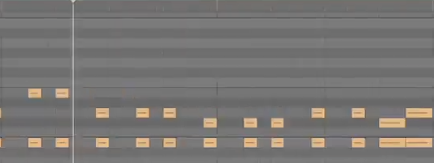
13) The first Melody Note in Pattern 2 is also a E as the Sub-Dominant of B, but then followed by F# as the Dominant of B (& builds the “strongest” Part of the whole Melody) and then again to C#
– this Pattern is also repeated 2 Times and shows a typical “Skip Mode” Movement where Melody Jumps to Dominant
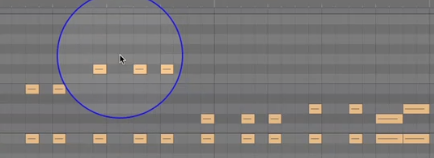
14) The Combination of the Counterbalance, Skip Mode, Step Mode & the Rhythm of the Melody made it so memorable
Motif and Rhythm
– Motif (Motive) = a few Notes that are Rhythmically Charged – they provide the Framework for the Melodies (Keep it Simple)
– Classic Music is close to Dance Music when it comes to the Motif & Rhythm
– think about, Beethoven´s 9th first couple Notes which provide the Motif e.g. Framework for the whole Composition (or again Faithless, or Sasha´s Expander)
– Note that the Motif is not concerned with the Pitch but the Rhythmical Terms (means you may use the same Motif but with Pitch-changes to avoid Repetition)
– also the Voice can hold the Motif (Radiohead´s Tom York where only Chords change E to F# in the first Motif & then to A and finally E in the 2nd Motif while the Motif itself stays on the same in Pitch)
– 2 General Approaches for Melodies – either a Voice or a Instrument
Practical Motif Melodies and Introduce Dynamic Variations
1) keep the Up & Down Contour for better memorable Motifs
2) use slight Note Offsets for more Human Feel
3) Set an Eye to Note Duration
4) Accent certain Notes,
5) Increase Velocity near the End of each Motif for example
6) Change Pitch but leave Rhythmic Pattern
7) Overlap certain Notes together via Pitch Bend or Portamento Style
Counterpoint
– how to set Melody and Bass follow each other without “Copy” the same Pattern (follow the Bass-line with Melody would be the easiest Way but also too “Amateur”)
– the Trick are slight different Notes but not too far away
– we wanna stay in a Approximate Range in the Tonic Key
– some Notes send out more Harmonics than others (means to be careful which Notes you take to Ensure you keep Relation to overall Tonic “Stability”)
– Good Way is to look at the Melody Notes and find the matching Chords for these Notes (means in Fm for Example Ab shares the Notes
– Write down all the Notes from these Chords to Form the Bass
“Similar Motion” = the Bass follows also when the Melody Rises Up or down
“Contrary Motion” = the Bass goes in the Opposite Direction of the Melody Line
“Bleek Motion” = the Bass & Melody stay at the same Pitch while other Instruments follow a Rise or Fall
Practice Example Counterpoint
1) we have a Melody in Fm (Scale Notes are F, G, Ab, Bb, C, Db, Eb, F)
2) the First Melody Note is a Ab and Ab in the Key of Fm can make the Following Chord Triads = F / A / D (& even 7th Chord in B)
3) so we could change the First Bass Note to F instead Ab
4) make Rhythmical Offsets / Changes in the “Form” of the Bass
5) use the 3 Motion Types to construct as the Melody Progresses (Similar, Contrary & Bleek Motion)
Leave a Reply